
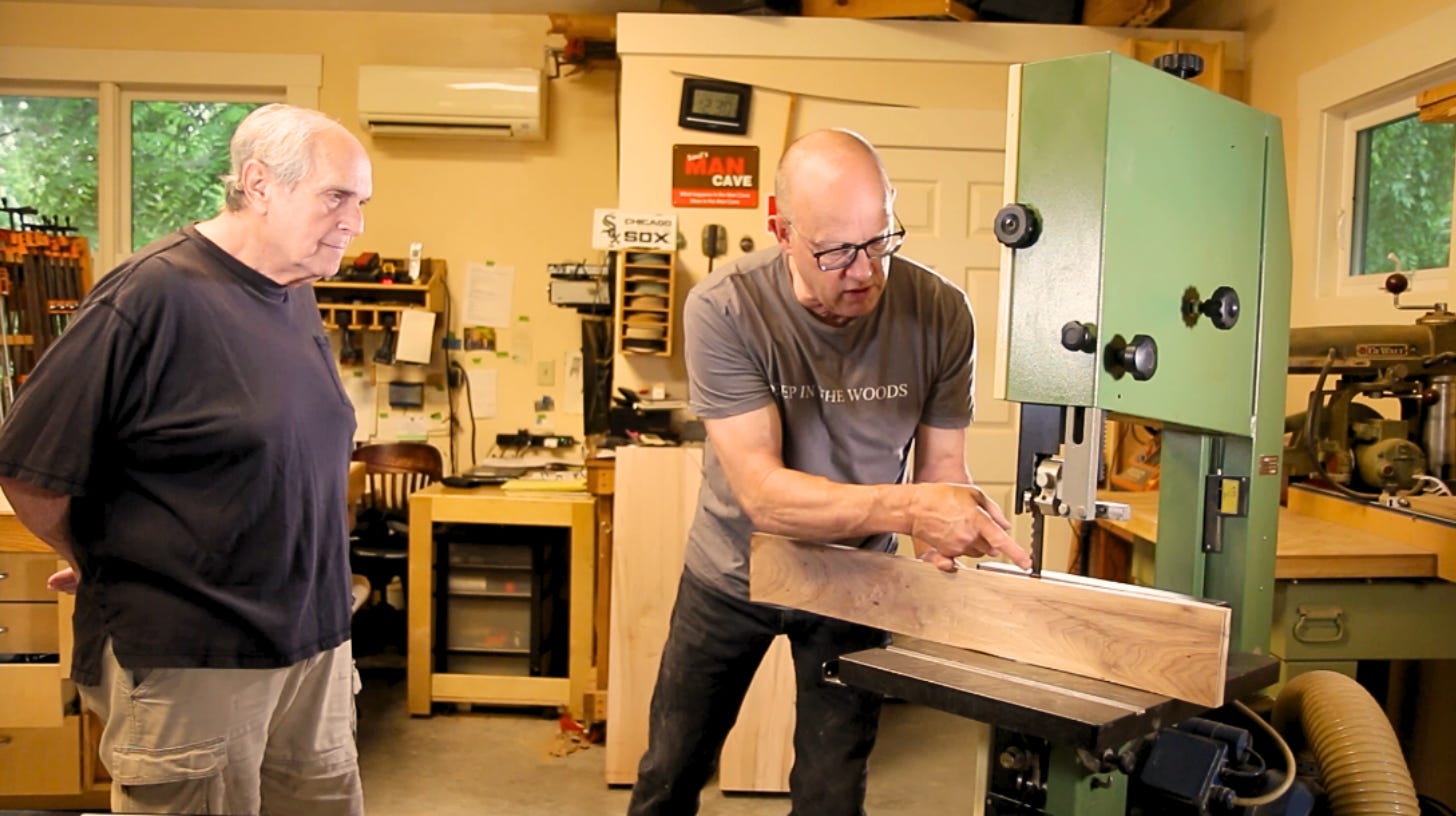
My neighbor Saul wanted to put curves into his work. He just didn’t trust his saw to cut them.
A few weeks ago I wrote about fear in craftsmanship — how it disguises itself as preference, style, or practicality. This is related to that, but it’s really about something else.
It’s about learning the language of a machine.
Saul has a 30-year-old Meber 16-inch bandsaw. A good saw. Solidly built. Well cared for in the general sense that nothing was broken or abused. But when he watched me cutting curves on a timber frame table blank a few days earlier, in my shop, he said, “My saw won’t do that.”
So, we went to look at it.
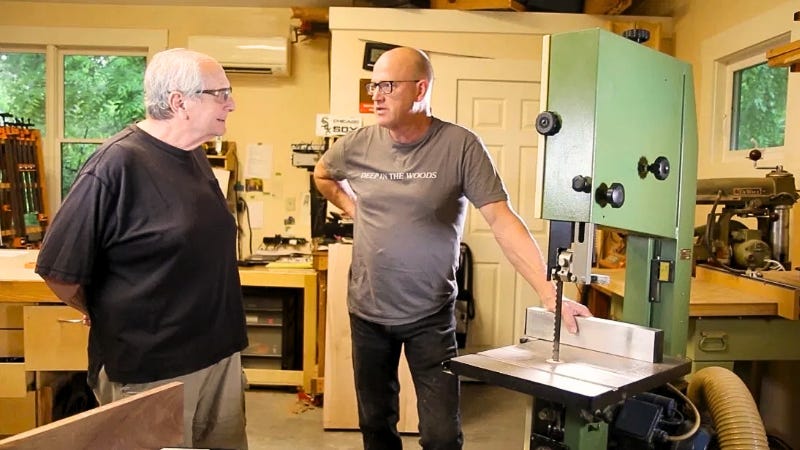
The diagnosis begins. Every bad cut was information. The saw just needed someone who spoke its language.
The first problem we found was the blade.
It had been on the saw for roughly twenty years.
Before anyone laughs, Saul hadn’t been using the saw very much in the last several years because it hadn’t been cutting well. And that’s exactly how these things happen. A blade slowly dulls, performance slowly degrades, and because the decline is gradual you adapt to it without fully realizing it. The machine begins giving poorer and poorer results, and eventually you stop asking it to do certain things.
But the interesting part to me was this:
The saw had actually been asking for help the whole time.
Every washboard surface, every wandering cut, every moment the blade resisted entering the wood cleanly — those were not random failures. They were information. The saw was communicating. Saul simply didn’t yet know how to interpret what it was saying.
A machine talks constantly. Learning how to listen is the key to mastering any machine — and turning a fight into a dance.
A dull blade says something different than improperly adjusted guides. A blade that won’t track properly speaks differently than insufficient tension. Tires with uneven wear produce their own symptoms. Even the feel of an adjustment mechanism tells you something. If tensioning feels sticky or resistant, people often stop fine-tuning because the mechanism itself discourages adjustment.
What appears to be “a saw that won’t cut smooth curves” is often several smaller conditions layered together.
In Saul’s case, while the blade was the core problem, the rest of the saw had slowly drifted out of peak performance as well. The tires needed dressing. The tensioning mechanism needed filing. The Carter guides needed light repair. The blade would not align perfectly parallel to the table, so we temporarily adjusted the fence to the blade instead of tuning the wheels to get the blade parallel to the fence. We’ll look into what made that alignment so tricky another day.
None of these were catastrophic problems. The saw was simply speaking clearly about its condition.
Once the systems began working together again, the entire character of the machine changed.
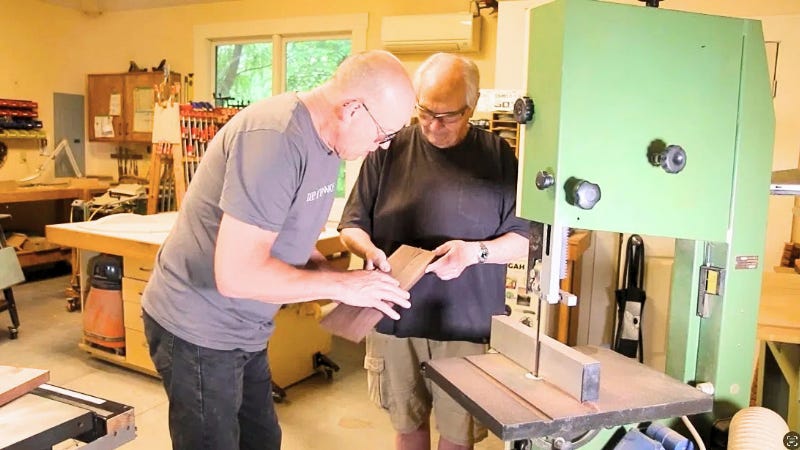
Learning the language together. Once the machine was heard, everything changed.
Then Saul cut a veneer.
The first pass produced a wedge. But again, the saw was talking. The wood carried the message. I watched his hands and could see immediately that his front hand was traveling with the board instead of remaining planted against the table in front of the blade, and the tail end was levering slightly away during the cut. His pressure was also not consistently keeping the wood against the fence top to bottom.
Two old habits. Both visible in the result.
With a few words of coaching, the second cut was straight, clean, and true.
What interests me about all this is how often woodworkers assume the limitation is inherent either in the machine or in themselves, when in reality they simply haven’t yet learned how to read the signals. Machines communicate through sound, resistance, surface quality, tracking behavior, vibration, feed pressure requirements, even smell. A good bandsaw operator is not just pushing wood through a blade. They are constantly interpreting feedback.
That’s one of the reasons I care so much about bandsaw tuning.
Not because tuning is some obsessive ritual, but because a properly tuned saw is constantly calling for help. You can learn to understand what it’s telling you. And once you understand the language, the machine becomes predictable, cooperative, and a trustworthy friend. Good listening makes for a good relationship — and the communication just gets better from there.
You might need to buy a new saw soon. But learn its language first and let that understanding guide your decision.
I hear from woodworkers all the time who think they need a larger saw before they can attempt certain work. But that Meber is only a 16-inch saw. Not some massive industrial machine. Don’t get me wrong, larger saws have huge advantages — more room to work, more horsepower, more rigid frames for stability, and higher blade speeds. All those enhance performance.
And yet, once properly tuned, this little Meber cut a 16-inch radius in thick stock cleanly enough for a timber frame table leg ready to veneer.
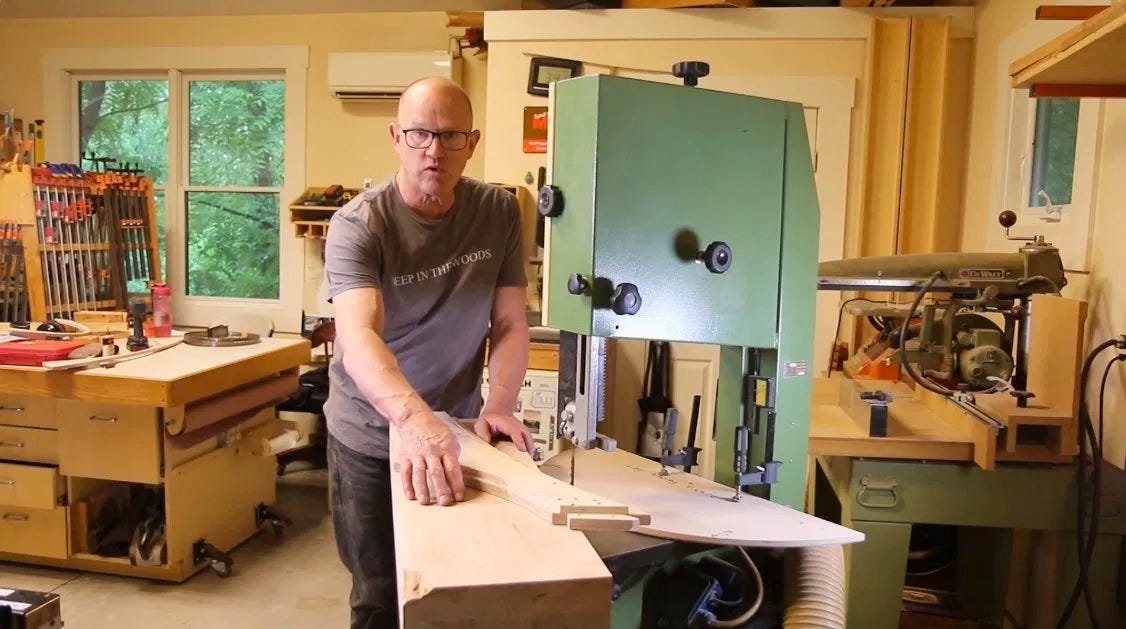
This is the cut we teach in the Boggs Timber Frame Table course. A tuned 16-inch bandsaw will get you there.
Most people do not need a bigger saw.
They need to understand the one they have. Even if a larger model is in order, learning to love the one you’re with will position you to get the best out of whatever upgrade you treat it to. Then call the new saw your graduation gift from bandsaw language school.
Saul’s saw was capable of far more than he believed. The problem was never simply the blade, or the guides, or the tires alone. It was that the communication from the machine had not been understood.
Once that conversation connected, so did the cuts.
Don’t get me wrong, I am almost always advocating an upgrade in bandsaw quality. But they all speak the same language, and until you learn how to listen, a bigger saw just gives more horsepower to the same problems. Once you learn that language, you’ll be positioned to make the right decision about the upgrade when that time comes. You’ll also get a better price for the old one when it’s tuned up.
Saul’s saw wasn’t broken. It just hadn’t had a chance to be heard.
Neither had Saul.
Watch below. Tell us what your saw has been trying to tell you.


