
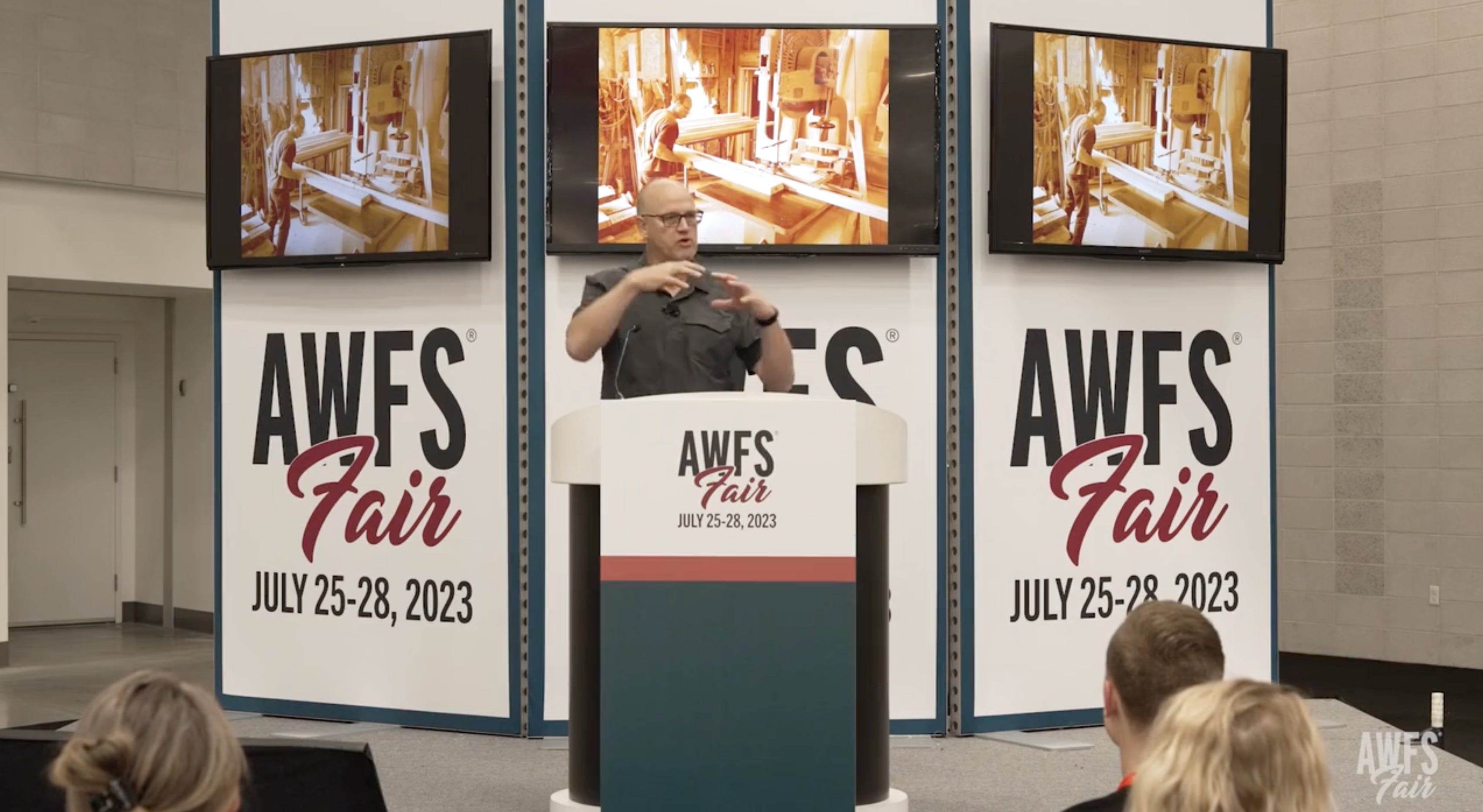
I was standing in front of a room in Las Vegas. July 2023. The trade show floor was full of the most capable machines I’d ever seen in one place: CNC table saws, five-axis mills, AI-assisted design software, equipment that would have looked like science fiction to the version of me who started making chairs with $50 in hand tools in a Kentucky backyard.
I asked the room a question: Does this feel like the golden age of design?
Nobody raised their hand.
I’ve been thinking about that silence ever since.
We have better technology than any generation of furniture makers before us. Better materials, better access to markets, better means of reaching clients on every continent. We know more about ergonomics, wood movement, joinery, and the physics of comfort than has ever been systematically documented. The internet has made nearly every design tradition in human history accessible in an afternoon.
And yet. Nobody raised their hand.
I want to talk about why. I’ve spent forty-plus years inside this exact problem, and I don’t think the answers are what most people expect.
When I started out, I was broke enough that economy forced me into something I wouldn’t trade for anything. I spent the first years of my career making chairs entirely by hand. No machine that plugged into the wall. Just the material, the tools, and whatever I could figure out by paying close attention.
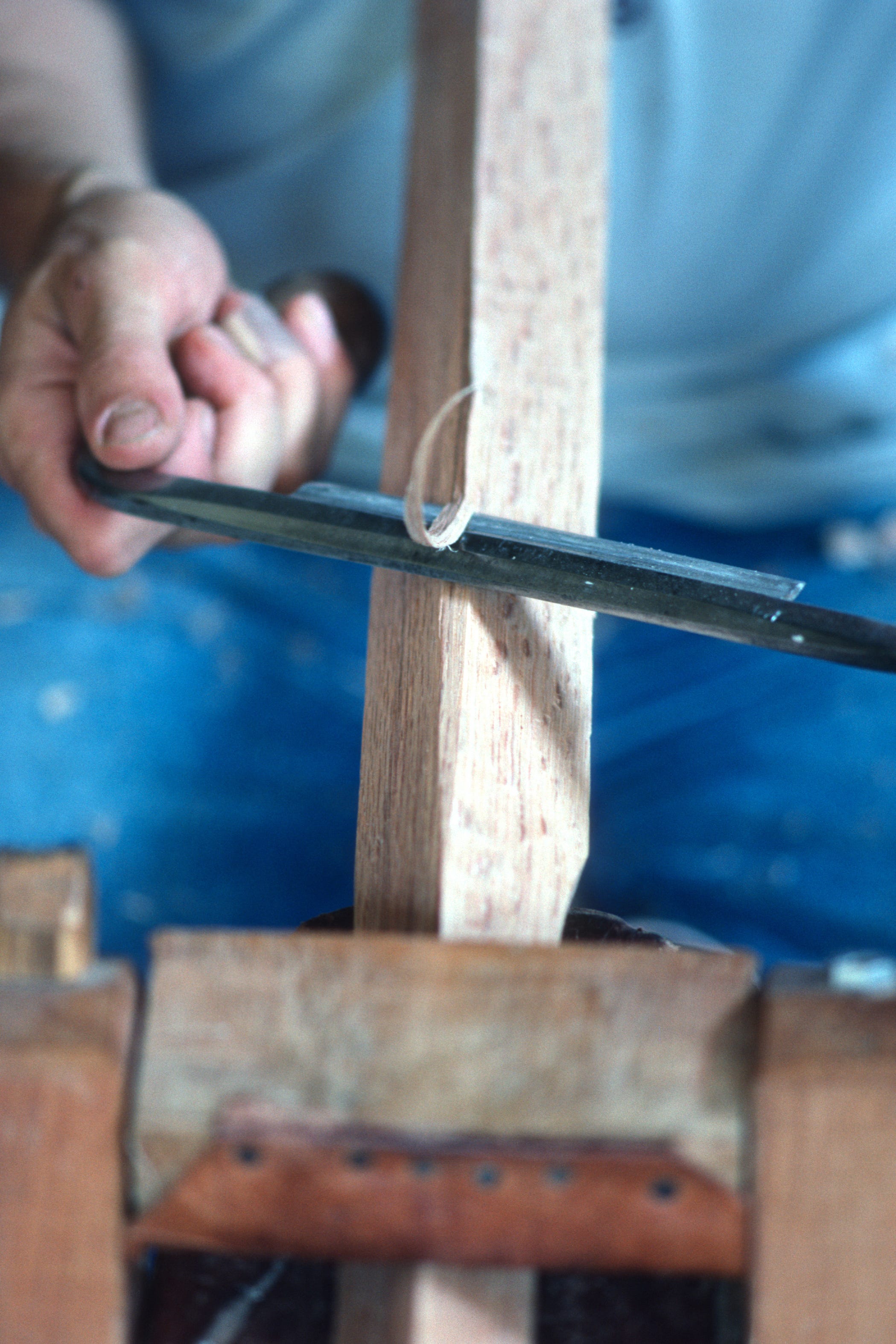
What I learned during that time wasn’t just how to make chairs. I learned how to learn.
Most of us think of learning as something we do: a mental act, thinking our way through a problem. That works, up to a point. But I’ve found a different approach that has made a bigger difference. What if you stopped thinking of it as solving the problem yourself, and started imagining that the material in front of you is there to teach you?
It sounds like a small shift. It isn’t.
When I was frustrated with getting clean surfaces off my hand tools (draw knives, spokeshaves, hand planes), I didn’t know anyone who could help me. So I got the nastiest piece of wood I could find, quilted maple, and spent a week just studying what was happening in front of me. Not thinking my way through it. Watching. Listening. Getting my magnifying glass out and looking as closely as I could.
Einstein said logic will get you from A to B, but imagination will get you everywhere. What I’ve found is that when you shift from generating toward listening, your mind softens. You become more receptive to things that a purely thinking approach would miss. You stop trying to contain the whole experience inside your skull. This is how you allow imagination to do its magic for you.
We call it being self-taught, and I represent that approach. But the myth around that phrase is the assumption that the teaching comes from inside us. It never really does. The learning always comes from something outside: the material, the machine, the problem we’re wrestling with, or a colleague saying the right thing at the right time. Call it child’s mind, if you want the Buddhist framing. Children learn fast because they’re soft and receptive. The power of their imagination is nonstop. We can get back to that.
That same receptivity is what I bring to the question I get asked more than any other: where does an original design actually come from?
The question of original design comes up often in conversations I have with other makers. And the response I hear most often is some version of: it’s all been done before. Four thousand years of furniture history. What’s left?
I understand why people feel that way. I used to cling to that perspective as well. But I think that frame is cutting us off from our best work.
If you look at where most designers go for inspiration, it’s backward. A book of furniture history. Mid-century modern, usually. Something proven, something already in the language. Then they put their spin on it. At best. I’m not saying there’s nothing to learn from history. The opposite is true. My career started by going as deep into traditional hand skills as I could, precisely because I wanted my foundation grounded in that history. But looking backward for design inspiration is different from looking backward to understand material and process. History can give us perspective and offer good ideas to build on, and a foundation for understanding our craft. But to bring new designs to the world, we need to be receptive in addition to being studious.
Here’s what I’ve found works best, and I know this sounds strange: I try to stop thinking altogether.
Elizabeth Gilbert talked about this in a TED talk worth watching: Your Elusive Creative Genius. She describes creative genius not as something that lives inside us, which is actually how the Greeks understood it too, but as something that arrives. You don’t generate it. You receive it.
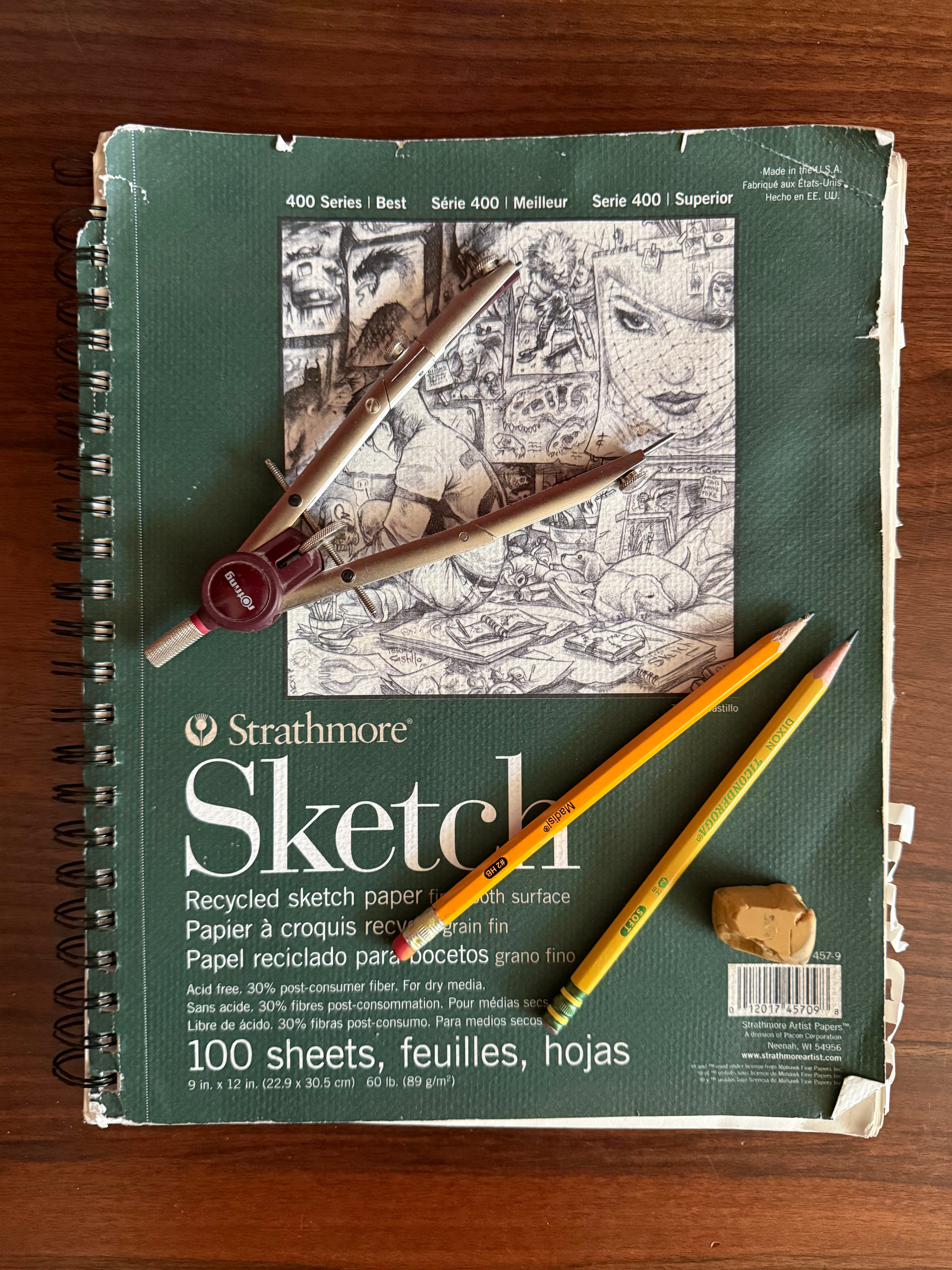
I’ve experienced this enough times that I no longer question whether it’s real. Ideas come in pieces. A line, a form, a gesture. I sketch them not because I’m trying to draw something, but because the sketching keeps the channel open. It calls for more.
The hard part isn’t receiving designs. The hard part is not screwing them up with what I already know. You get a piece of something interesting from your creative genius and immediately your brain wants to put this joint there, use that finish, incorporate an element you’ve been wanting to try. That’s ego coming in. That’s desire getting in the way of a listening process. What I try to hold is that this design is coming to me, not from me. My job is to not damage it in transit.
My sketchbooks are full of things I haven’t built yet: pieces of ideas, gestures toward forms I couldn’t quite hear the rest of. I used to feel anxious about that. Now I just think of it as a library. The ideas that are meant to become something tend to come back around when their time is right.
Ego is one way to damage a design in transit. There’s another way, and it’s a bigger one.
I want to say something directly about AI, because it was already a presence in that room in Las Vegas, and it’s a much larger presence now.
Everyone selling these tools right now says the same reassuring thing: that AI is just a collaborator, that it will only make you more creative, never less. I don’t believe that’s how it plays out, not if we let it lead.
I think AI is going to accelerate a pattern that was already a problem. Every time powerful technology enters our industry, there’s an infatuation. For a while, the technology drives the design. You’re exploring what the machine can do. That’s fine for a season. But if the technology keeps driving, creativity stalls. You end up making what the tool influences instead of what the idea softly calls for. We end up with designs that reflect an infatuation with the machines and processes instead of using the machines to help us deliver the inspirations looking for a birth canal to emerge from.
AI will make this worse. Nothing before it has been this capable of generating content that looks like design. And it’s getting more capable every month. If we rely on AI for our creative thinking, if we outsource the design process to a system trained on what’s already been done, we’re not going to find the golden age. We’re going to make better versions of things that already exist, faster. At best!
The answer isn’t to avoid the tools. I’m not saying that. The answer is to ramp up our own creativity at the same time the tools are ramping up. The two are not necessarily in conflict. But the right one has to lead. And if we can’t say honestly which one is leading, we’ve already lost the thread.
Which brings me to the handmade question. The one that makes me most uncomfortable, because I used to hide behind it too.
If you look at furniture advertising in any trade publication, the word handmade is everywhere, including in companies where CNC machines are doing most of the cutting. I used to chop mortises by hand. Up to ninety a day. I still often finish surfaces with hand planes and spokeshaves. Many of us have real skill there and I’m proud to see so many who have achieved that. But that reality is mostly gone now in modern shops. Most shops are running joinery through machines, and the result is often better, not worse, than what most of us could do by hand.
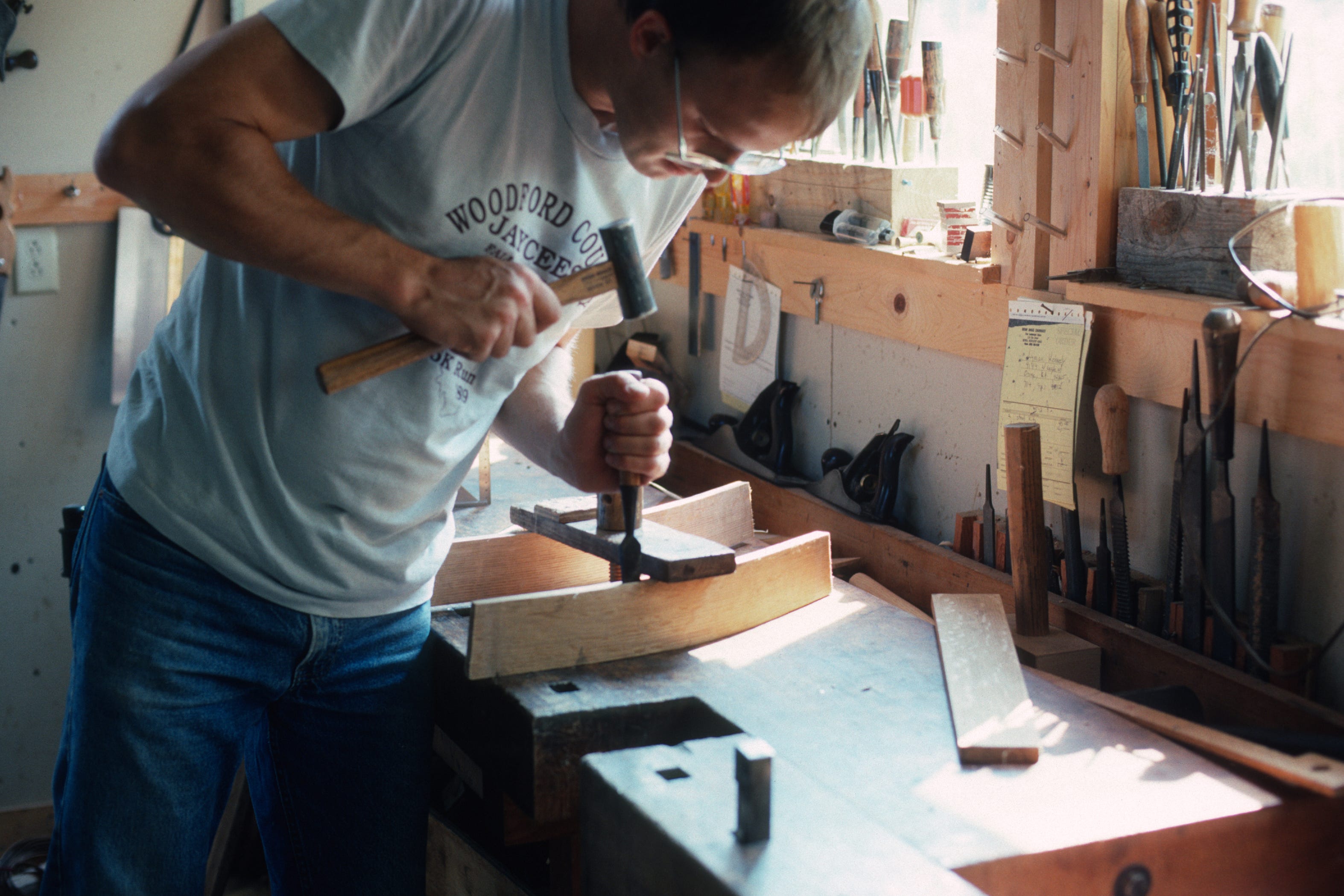
I used to chop up to ninety mortises a day, by hand.
So why are we still saying handmade?
I think it’s because we haven’t fully accepted what we’re doing. We feel, somewhere, that telling people about the machines would lower the value of the work in their eyes. So we borrow integrity from an older era of making. What that does is throw away the sense of integrity of what we can actually be doing now.
If we believe we’re using the best process available to achieve our vision (and we should, otherwise why use it), why wouldn’t our clients love us for that? Why wouldn’t our choice of technology be part of our mission? The “hand” is in the design. The “hand” is in the eye that looks at the grain and decides what to do with it. The “hand” is in what we choose to bring into the world and why. And yes, I am borrowing the pattern so often used to insert the word “hand” where we should use the word “integrity” … to make a point.
That point being that integrity doesn’t require pretending we’re using tools from 1850.
That’s not a small thing. It’s the difference between being honest about what we’re doing and borrowing our ancestors’ integrity to cover it.
I’ve thought a lot about what it would actually take for this to become the golden age of design. Not the golden age of manufacturing, or the golden age of output. We have plenty of both. The golden age of design.
It would take listening more and thinking less. It would take accepting that the ideas are available to whoever shows up with the right kind of attention. It would take putting ego aside long enough to let something come through that none of us could have predicted. And it would take being honest about who we are and what we do.
The technology is there. The markets are there. The materials are there. I believe new ideas are there too, waiting for someone to be quiet enough to let them in.
I asked the room in Las Vegas and nobody raised their hand.
I still think the golden age is walking along this adventure with us, watching and waiting for us to recognize that it’s right here. We just have to decide to have it.
What’s stopping us is us. What will turn this on, will be us too. This “us” I am talking about is global, but it will need to start locally. And maybe in just one shop. Why not yours?
From the Bench, Brian Boggs
This essay was largely excerpted from my talk at AWFS in Las Vegas, 2023. For the full talk go to: WED Talk with Brian Boggs: Challenging the Myth of the Self-Taught Craftsman at AWFS® Fair 2023.


