
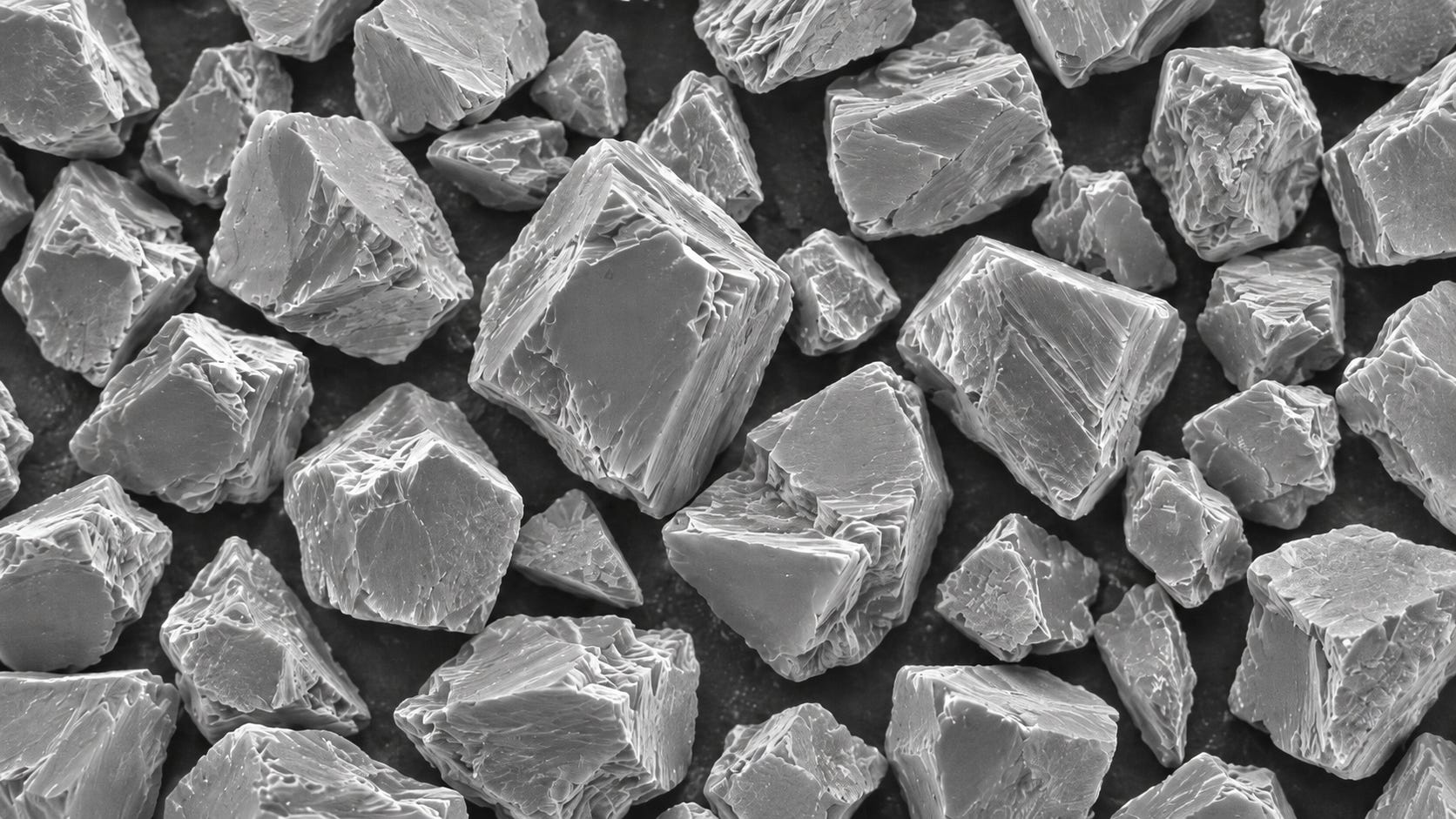
Illustration of CBN abrasive grit at high magnification, showing the angular, fractured geometry of the cutting particles.
When I first started using random orbit sanders, I remember finding something on a package of sanding discs that bothered me.
It was a chart telling you when a sanding disc should be considered worn out and thrown away. The useful life of the disc was calculated partly according to the wage of the person using it. The more you were paying the employee, the sooner it made economic sense to throw the disc away.
The reasoning was perfectly sound. If someone earning a good wage spends five extra minutes trying to squeeze the last bit of cutting life out of a worn abrasive, you may have saved a few cents on sandpaper while spending several dollars in labor.
I understood the math.
I hated the idea.
I was already inclined to think of sandpaper as disposable tools and a necessary evil of woodworking. That chart more or less clinched it for me.
What I didn’t recognize until fairly recently was how much that attitude had gotten in the way of my understanding abrasives.
Sandpaper isn’t going away. At least I haven’t figured out how to run a practical, profitable furniture business without it. Treating it with contempt hadn’t accomplished much except make me less curious about a tool I use all the time.
Over the last several years I’ve occasionally found myself working alongside our finishers just to keep up with production. That put me in a position to learn from people who had spent far more time paying attention to abrasives than I had.
One of them, Rick Fusco, got me thinking differently about the relationship between abrasive grit, pressure and speed.
Until then, I had never really understood why some sanding discs are described with what looks like a range of grit sizes. A disc would read 280-320 grit. I had assumed, in my ignorance, that it meant the particle sizes simply weren’t very consistent.
What I began to understand instead was that the number printed on an abrasive does not, by itself, tell you what kind of scratch you are going to make.
How fast the abrasive is moving matters.
How hard you push matters.
How the abrasive moves across the surface matters.
A nominal grit size doesn’t operate in isolation.
That helped explain something else I had seen for years without really thinking about it. Hand sanding with 220 grit paper can leave remarkably deep scratches compared with what I can produce using 220 grit on a random orbit sander. When sanding by hand, we are taught to work with the grain largely because scratches running across it can announce themselves through the finish.
That should have told me something.
The abrasive hadn’t changed.
The way I was using it had.
And that got me wondering where else my assumptions about abrasives might be getting in the way.
Eventually, that question followed me to the grinder.
For most of my career I ground tools on friable aluminum oxide wheels. I liked them and understood them reasonably well. Then my vintage grinder finally died after nearly forty years in my shop, and by that time my last eight inch wheel had worn down to something closer to four inches.
It seemed like a reasonable moment to update.
About a year ago I bought my first CBN wheels. CBN, cubic boron nitride, is an extremely hard abrasive commonly used for grinding hardened steels. I chose wheels with radiused corners because I wanted some flexibility in the kinds of grinding I could do. And of course, I bought a new Toycen grinder.
Then I had to design a solid way to use them.
While researching another grinding idea, I talked with several CBN wheel manufacturers about having a small custom wheel made. The cost eventually killed the idea, but the conversations were fascinating.
For the small diameter wheel I was considering, the manufacturers wanted considerably more RPM than I expected. What they were really concerned with was surface speed. I knew that a small wheel has to turn much faster than a large one for the abrasive at its circumference to travel at the same speed. But they were recommending 4000 RPM! Grinders in my price range can’t spin that fast.
What I was having more trouble understanding was what all of that meant at the point where one abrasive particle actually meets a piece of steel.
And once again I found myself thinking about sanding.
Speed.
Pressure.
Particle size.
Depth of cut.
Heat.
I don’t mean to suggest that sanding wood and grinding hardened steel are the same process. They obviously aren’t. But what I had learned from sanding made me curious about whether some of the same variables deserved more attention at the grinder.
So instead of asking myself how woodworkers normally grind a plane blade, I started with a different question:
What do I want to be possible?
That is a question I find much more useful and more interesting.
For a plane iron, I want a straight edge. I want the bevel accurately oriented. I want to remove only as much steel as necessary. I want to avoid overheating it. And, if possible, I want the surface coming off the grinder to be good enough that I can eliminate some of the honing that normally follows.
What I really needed was tighter control.
I needed some way to move the blade accurately across the face of the wheel and, more importantly, some way to control how far the blade could move into the abrasive.
That second part became an interesting one.
When we want a grinding wheel to cut faster, the natural impulse is to push harder.
The grinder I just replaced was my only grinder for nearly forty years. It ran at 3450 RPM. I burned an edge perhaps once or twice over those decades. The lesson I took from that experience wasn’t that I needed a slower grinder. For me, it was that I needed a lighter touch.
That is my experience, not a rule about how every grinding operation should work.
But it made me wonder:
What if I could control that light touch mechanically rather than depend entirely on my hands?
And that led me to what may be my favorite stupid question in this whole experiment:
How fine a surface can I produce with an 80 grit CBN wheel?
Not by replacing it with a finer wheel.
By changing how I use the 80 grit wheel.
Imagine one abrasive particle sticking out of the wheel like an iceberg.
Now imagine an 80 grit particle beside a much smaller, finer particle.
Obviously the 80 grit particle has the potential to make a much deeper cut. If I push the steel hard enough into it, that’s exactly what it will do.
But what happens at the very tip of each of those particles?
I know an 80 grit particle doesn’t somehow become a 600 grit particle just because I touch it lightly. Particle size, shape, spacing and all the other things abrasive engineers worry about haven’t disappeared.
But that wasn’t really my question.
My question was this:
If I can stop the blade from entering the wheel beyond a very small and repeatable depth, how smooth a surface can that 80 grit wheel leave?
I don’t yet have a scientific answer.
But I can test the practical one.
And that meant I needed better control of the blade.
I won’t turn this into instructions for the fixture because the fixture isn’t really the point. I wanted the blade held more rigidly than I could hold it with my fingers. I wanted its movement constrained to a predictable path. And I wanted a positive stop controlling how deeply it could engage the wheel.
I also began questioning where the blade belonged in relation to the grinder.
Most woodworking grinding arrangements put the tool above the wheel. I tried to come up with a compelling reason why.
I couldn’t.
I kept thinking about precision grinding operations I had seen in machine shops, where the work was held securely and everything was referenced as closely as practical to something rigid. And the grinder was above the part being ground
So I turned my usual method upside down.
And, quite literally, some of the grinding arrangements with them.
Then I started experimenting.
The results so far have surprised me.
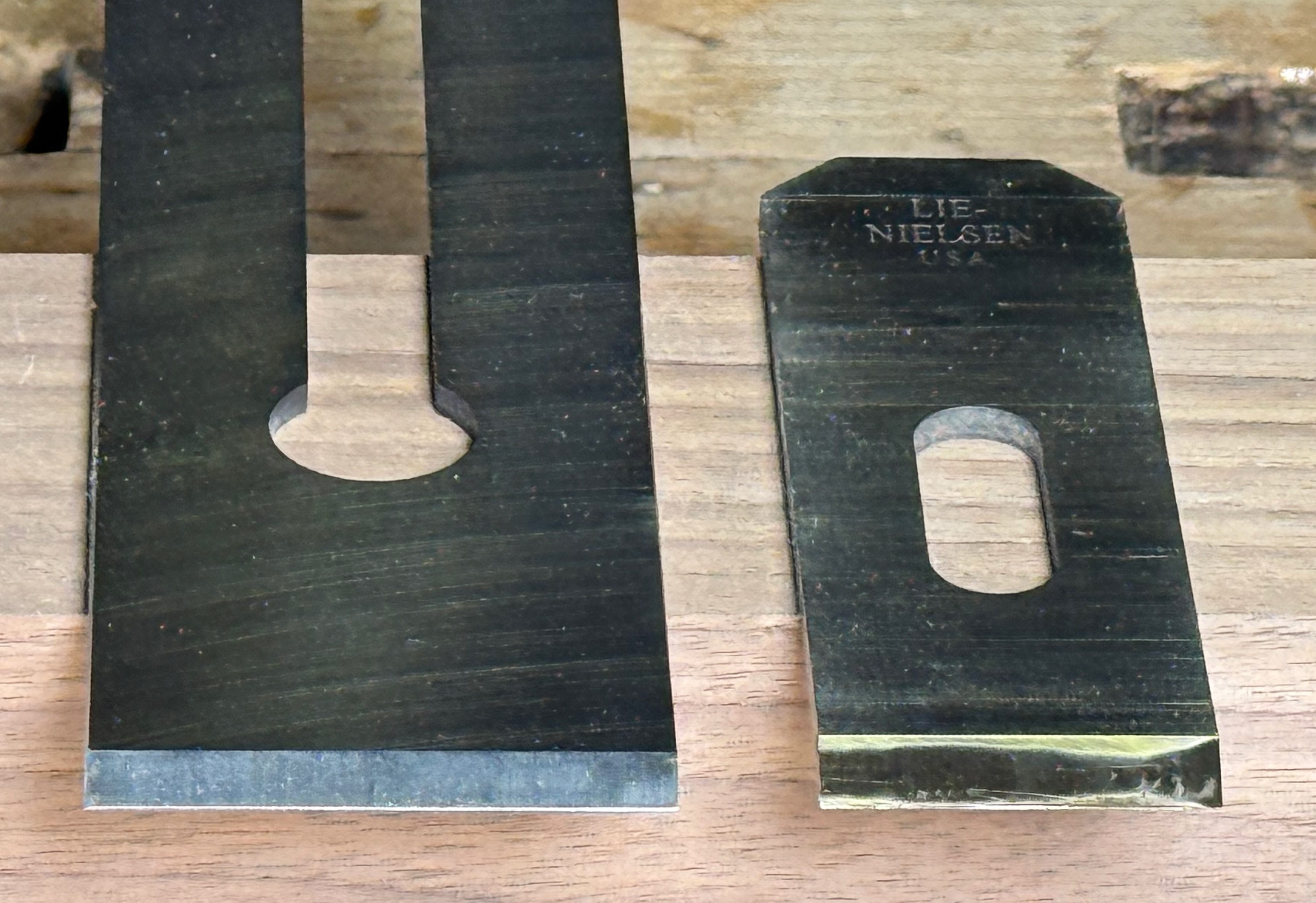
The blade on the left was sharpened upside down; the blade on the right in the conventional orientation. Both have been honed to clean up the grinding.
Using an 80 grit CBN wheel with very carefully controlled engagement, I can produce a cutting edge straight and clean enough that I have been able to go directly from the grinder to a half micron diamond abrasive and clean up the edge in ten strokes.
I want to be clear about what I mean by that.
I am not polishing the entire 80 grit bevel to half micron in ten strokes.
I am talking about the very small area at the cutting edge. That is all that engages the wood anyway.
With roughly ten honing strokes at half micron, I can remove the grinding scratches at that edge and produce a clean, straight hone.
No progression through several intermediate stones.
That is not what I expected from an 80 grit wheel.
If you’re relatively new to grinding and have been burning the edges of your plane irons, I’m not suggesting that you reproduce the setup I’m experimenting with.
The more useful experiment may be much simpler.
Pay attention to what happens when you stop asking the wheel to cut faster by pushing harder.
See what changes when you lighten the contact.
Watch the scratch pattern. Watch the heat. Pay attention to what the wheel is actually doing rather than simply getting the grinding over with. Watch what you hands are actually doing and how straigh you are holding the blade. What’s keeping this from being smoother and easier?
That is essentially where this experiment started for me.
There is also a problem still waiting for a better solution..
The burr.
Controlling the grind has not made it disappear, and burr management may turn out to be one of the limiting factors in how far I can take this approach. I’m experimenting with that now.
Which is one reason I want to be careful about what I’m claiming here.
This isn’t a finished sharpening system.
I don’t know yet where the limits are.
There are questions about speed, wheel diameter, steel, abrasive geometry, burr formation and surface quality that I don’t have answers to.
I’m writing about it now because the results are promising enough to make the questions worth sharing.
The most valuable part in all this, at least to me, isn’t the fixture.
It’s realizing how many assumptions I had carried into the experiment without ever examining them. Ideas such as;
An 80 grit wheel leaves an 80 grit surface.
The faster I want to grind, the harder I should push.
A burr is simply part of getting to the edge.
The blade belongs where we’ve always put the blade.
Maybe some of those assumptions will turn out to be perfectly sound.
But I find it interesting to ask why.
I spent a surprisingly large part of my woodworking life treating abrasives as something I simply had to put up with.
I wish I had become curious about them sooner.
So I’m not suggesting that you build what I’ve built.
I’m suggesting that you look more closely at something you may already use every day.
The next time you go to the grinder, don’t just look at the tool.
Look at the abrasive.
Think about what is happening where the two meet.
Think about speed. Think about pressure. Think about how deeply you’re allowing the abrasive to engage the steel. Think about the scratch it leaves and the heat you generate.
Then ask what you actually want that abrasive to do.
And see how close you can get it to doing that.
I have a feeling I’m going to be asking stupid questions about this for quite a while. I like writing the questions in ink; the answers in pencil. Good questions (especially what we call stupid questions) are usually better guides than answers. They keep us open to what’s happening now and exploring better ways to adapt to the moment. Good answers help us today, but tomorrow’s world may need a different one. That’s why I keep the answers in pencil and the questions in ink.
From the Bench, Brian Boggs
Brian has spent more than four decades learning from wood, tools, mistakes, teaching, and making. He is still at the bench, working, questioning, experimenting, and finding new things to understand and share.
These essays are our way of capturing that ongoing work and putting it into the world.
If you believe this kind of knowledge is worth documenting and sharing, becoming a paid subscriber helps support the work of capturing it while Brian is still at the bench.
Frequently Asked Questions
Does the grit number on an abrasive tell me what kind of scratch it will leave?
Not by itself. Brian says the printed number doesn’t tell you the scratch you’ll make, because abrasive speed, how hard you push, and how the abrasive moves across the surface also matter. His example is that 220 grit paper used by hand can leave much deeper scratches than 220 grit on a random orbit sander.
Can an 80 grit CBN wheel leave an edge fine enough to skip the intermediate stones?
Brian reports that with very carefully controlled engagement he can go straight from the 80 grit wheel to a half micron diamond abrasive. It takes about ten strokes to clean up the edge, and he is only refining the small area at the cutting edge, not the whole bevel. He stresses this isn’t a finished sharpening system and that he doesn’t yet know its limits.
How can I avoid burning the edge of a plane iron at the grinder?
Brian’s experience is that a lighter touch matters more than a slower grinder. His old grinder ran at 3450 RPM, and he burned an edge perhaps once or twice in about forty years. He calls this his experience, not a rule. He suggests noticing what changes in the scratch pattern and heat when you stop pushing harder to cut faster.
What do you do with the blade after grinding? Do you still flatten the bevel?
Brian has stopped flattening it. He takes the hollow-ground blade to a round honing mandrel with a 1.25 inch radius and finishes with .5 micron diamond paste. His 8 inch wheel gives a 4 inch grinding radius. The two arcs are tangent at the cutting edge, so he can hone a tiny band at the edge without changing its angle. He says he is still experimenting and hasn’t found a final answer.
Source: Flat Thinking (https://boggsbench.com/flat-thinking/)
How do I deal with the burr (wire edge) when sharpening?
Abrasive Behavior says controlled grinding hasn’t eliminated the burr and that it may limit how far the approach can go. Brian’s “Battling the Burr” video covers this. It says even a microscopic burr can spoil a blade’s performance, and the video introduces techniques for a burr-free edge.
Source: Battling The Burr (https://boggsbench.com/battling-the-burr/)


