
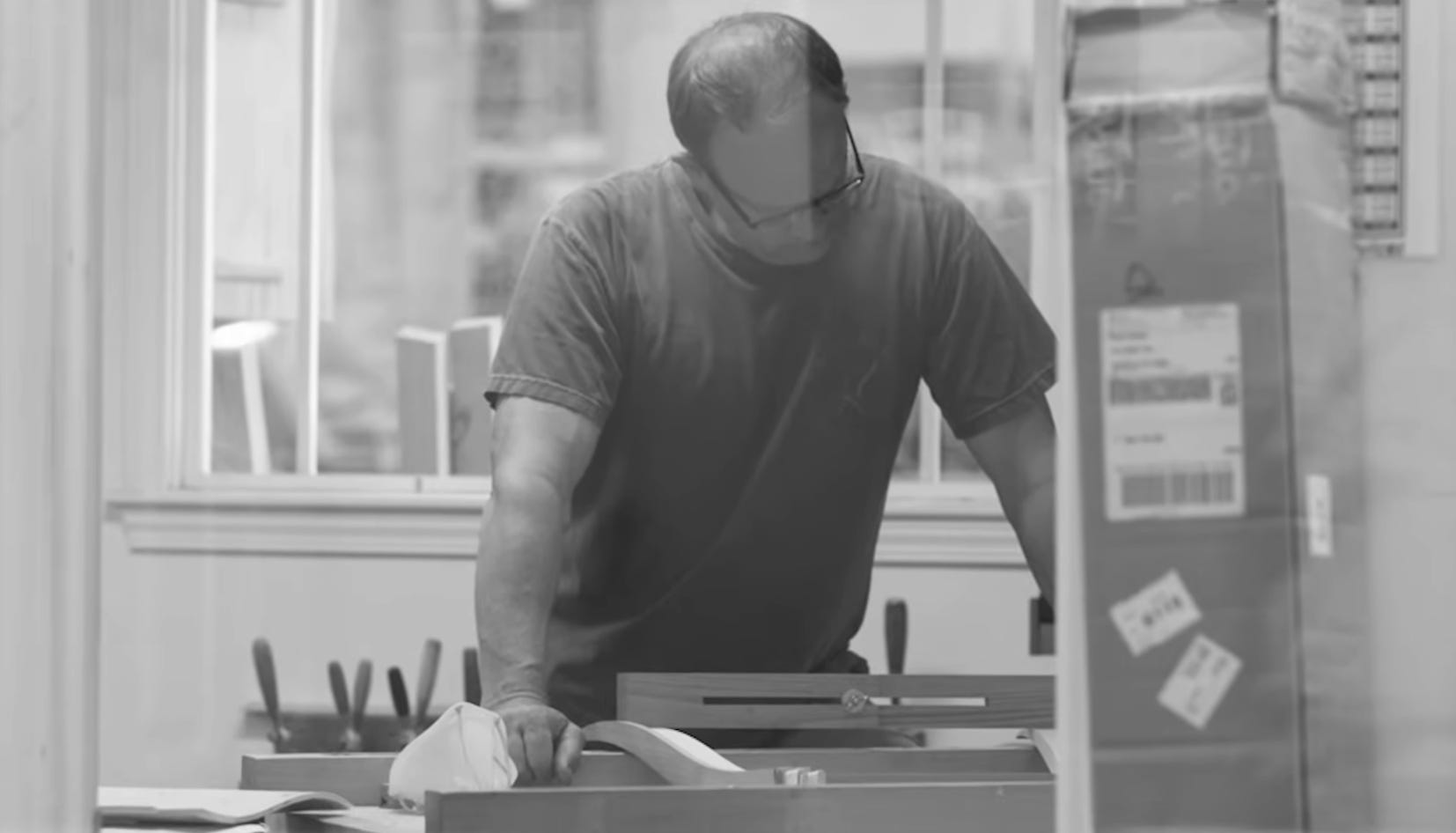
Thinking through the Cio chair.
For those of you who have read many of these essays, you know that I love questions. And my fascination with them seems to be increasing almost daily.
One of the things I’ve enjoyed about writing here is that I get more questions from people than I ever have before. What has become especially interesting to me is not just the questions themselves, but how they are asked—and why they are being asked.
For me, a question is not necessarily a search for an answer.
More and more, I think of a question as a tool for directing my attention.
In a way, this is another version of something I keep coming back to in my work: the **why behind the how**.
The how matters, of course. I spend a great deal of time thinking about technique, tools, geometry, fixtures, and process. But if I only ask how to do something, I can become very efficient at solving the wrong problem.
The more useful question is often why.
Why am I making this choice?
Why does this shape need to be this way?
Why is the tool behaving the way it is?
Why am I reaching for this solution in the first place?
That distinction has become increasingly important in both designing and making. The more I learn, the less interested I am in arriving at a final answer and the more interested I am in recognizing which question I should be holding at a particular moment.
I use the phrase *holding a question* deliberately.
There are certainly questions that need answers. If I need to know the diameter of a drill bit or the moisture content of a board, I want the answer.
But the questions that have stayed with me through most of my working life are different. They tend to become less useful when I try to dispose of them by answering them too quickly.
Instead, I let them evolve.
Holding a question seems to put me in a kind of open space. I’m not trying to force an answer or prove something I already believe. I’m simply directing my attention toward something I don’t yet understand well enough.
There may be some relationship between this and meditation, although I don’t really think of it that way. What I notice is that when I can remain open to a question, ideas begin to show up.
But so do other questions.
Often the next question is more valuable than the answer I thought I was looking for.
Chair design has been a good example of this throughout my career.
One of the central questions I have held for decades is:
**What is the best shape for a seat and a back?**
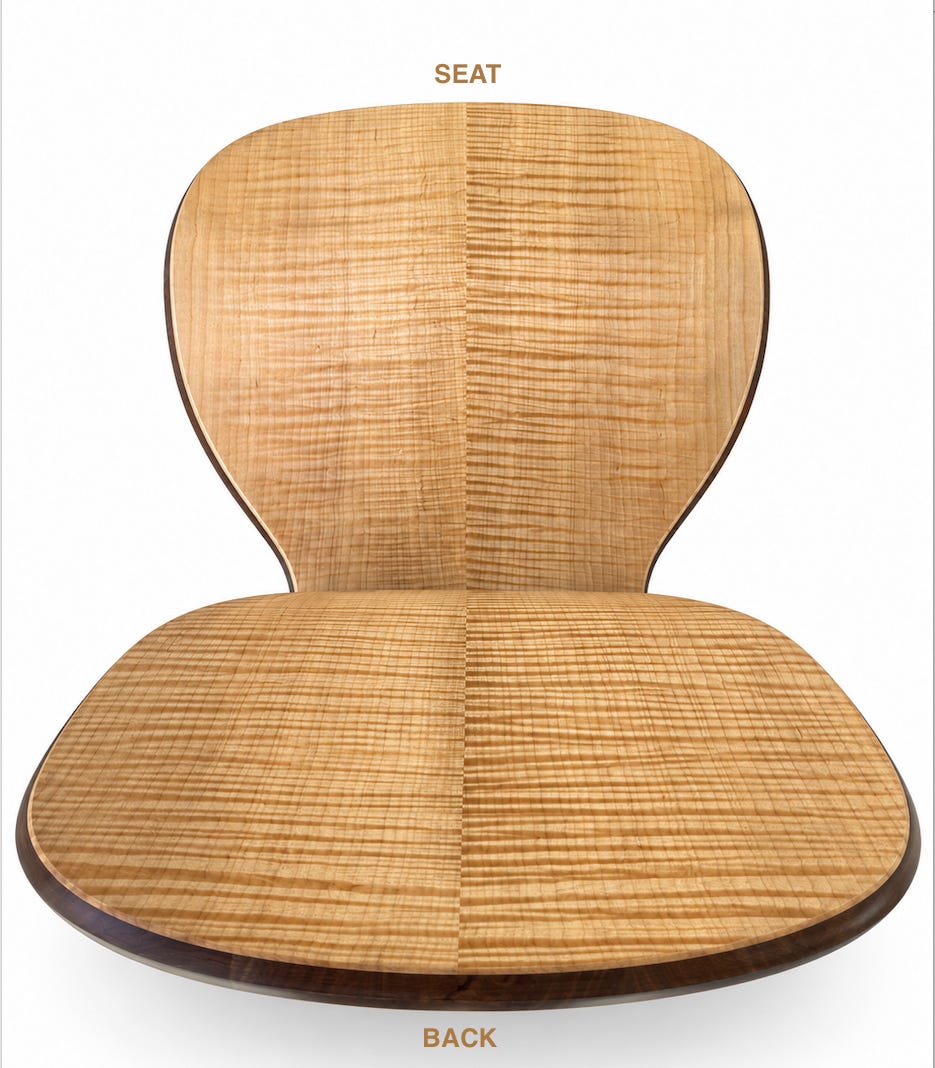
Viewed from behind and above, the relationship between the seat and back becomes visible. I’m still asking how these two shapes should relate to one another.
But that question immediately generates others.
How do I define those shapes?
What is their relationship to one another, and how do I record that relationship so I can repeat it?
How should that relationship change depending on what I am asking the chair to do?
I have come up with a lot of answers over the years. I’ve designed different curves, built different forms, developed methods for defining them, and learned a great deal from the feedback I get once people actually sit in the chairs.
But I have never really let go of the question.
And I’m glad I haven’t.
Just this morning I woke up with another idea about how I might more precisely define the relationship between the curves I use in a chair back and those I use in a seat.
What interests me is finding a way to shift those relationships intentionally and predictably so that, as I develop the structure of a new chair, I have a clearer understanding of what those shapes are going to do for the person sitting in it.
I’ve been designing chairs for more than forty years, and the question is still producing new ideas.
The same thing is happening for me with the bandsaw.
After forty-four years of using one, I am learning things about bandsaw technique right now that are as exciting to me as anything I’ve learned before.
Some of those discoveries have come from questions I’ve carried for years:
How does the blade actually behave during a cut?
How should the work be guided toward it?
What changes when I guide the work by hand rather than with a fixture?
How can I cut organic shapes with greater precision and repeatability without fighting what the blade naturally wants to do?
I could have settled on answers to those questions a long time ago.
Instead, what comes to me as I hold these questions evolves as my perspective does.
What I understood ten years ago allowed me to ask something I couldn’t have asked twenty years ago. What I understand today allows me to look at the same machine—and in some cases the same problems—differently again.
Ideally, that is one of the things experience gives us.
Not simply more answers.
Better questions.
Someone wrote to me this past week asking where he could get a travisher I designed for Lie-Nielsen Tools about twenty-five years ago. That tool never went into production, so I pointed him toward the best travisher I know of, the one Peter Galbert is making.
He also asked about a shaving horse for holding the work and sent me a photograph of the stool he was making to illustrate the problem.
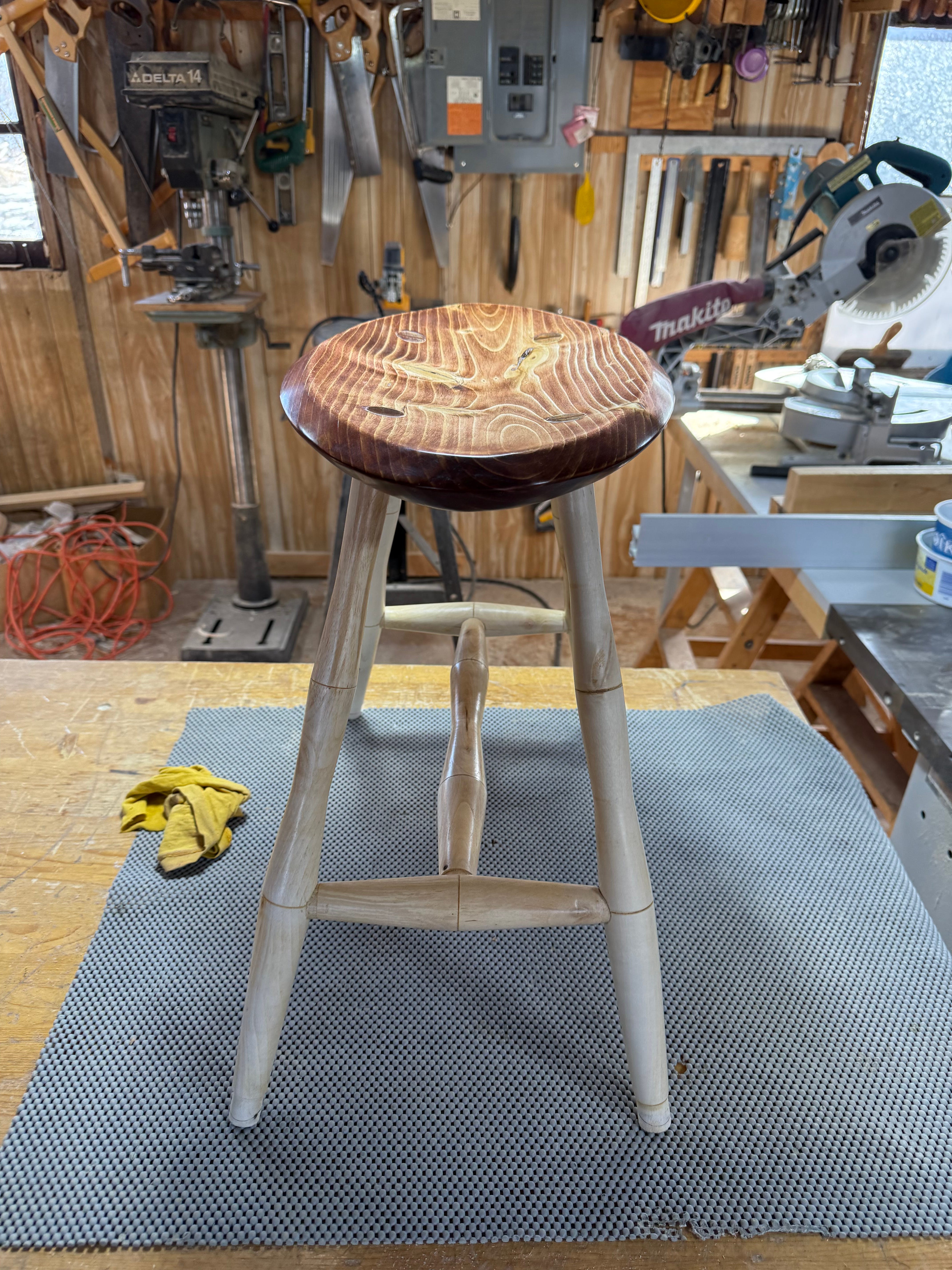
A photograph sent by a caller asking about tools for carving a stool seat. What began as a question about how to make it led Brian to a much larger set of questions about why, what, and whether.
That photograph stirred up a storm of questions for me. Imagining me in this guy’s situation I asked…………
What is the best seat shape for this stool?
Is there a better shape than this round bowl that I can make more easily without investing in more tools?
What tools do I already have that could create a comfortable seat more easily if I weren’t committed to making a round bowl?
Why am I making stools?
Is this the kind of stool my shop is best suited to make?
How many stools am I actually going to make?
That last question alone changes the way I think about investing in a specialized tool.
Where to get a travisher or which shaving horse to use were not yet on my list. I needed the questions above to lead me toward my next move.
And that next move might not require spending any money at all.
That is the why behind the how.
The original question was about a tool. But before deciding *how* to shape the seat, I want to understand *why* this is the shape being pursued in the first place.
That same process keeps showing up in my own work.
As I work on the outline and plan for a series of bandsaw videos Melanie and I want to make, I keep thinking about fundamentals.
When I look back at what I learned from books, some of the fundamentals I now think are most important simply weren’t there. It took decades of doing cartwheels at the bandsaw for me to realize there were holes in the foundation most of us start with.
Those holes hampered my development significantly.
But the more I learned, the more clearly I could see what I was missing.
I discovered some of those holes by holding questions like:
What are my hands actually doing while I push the wood through the blade?
What path do they need to take when cutting a syma curve?
What path does the wood itself need to take?
How could I guide that curve mechanically?
I was more than thirty years into my bandsaw practice when I began holding some of those questions deliberately.
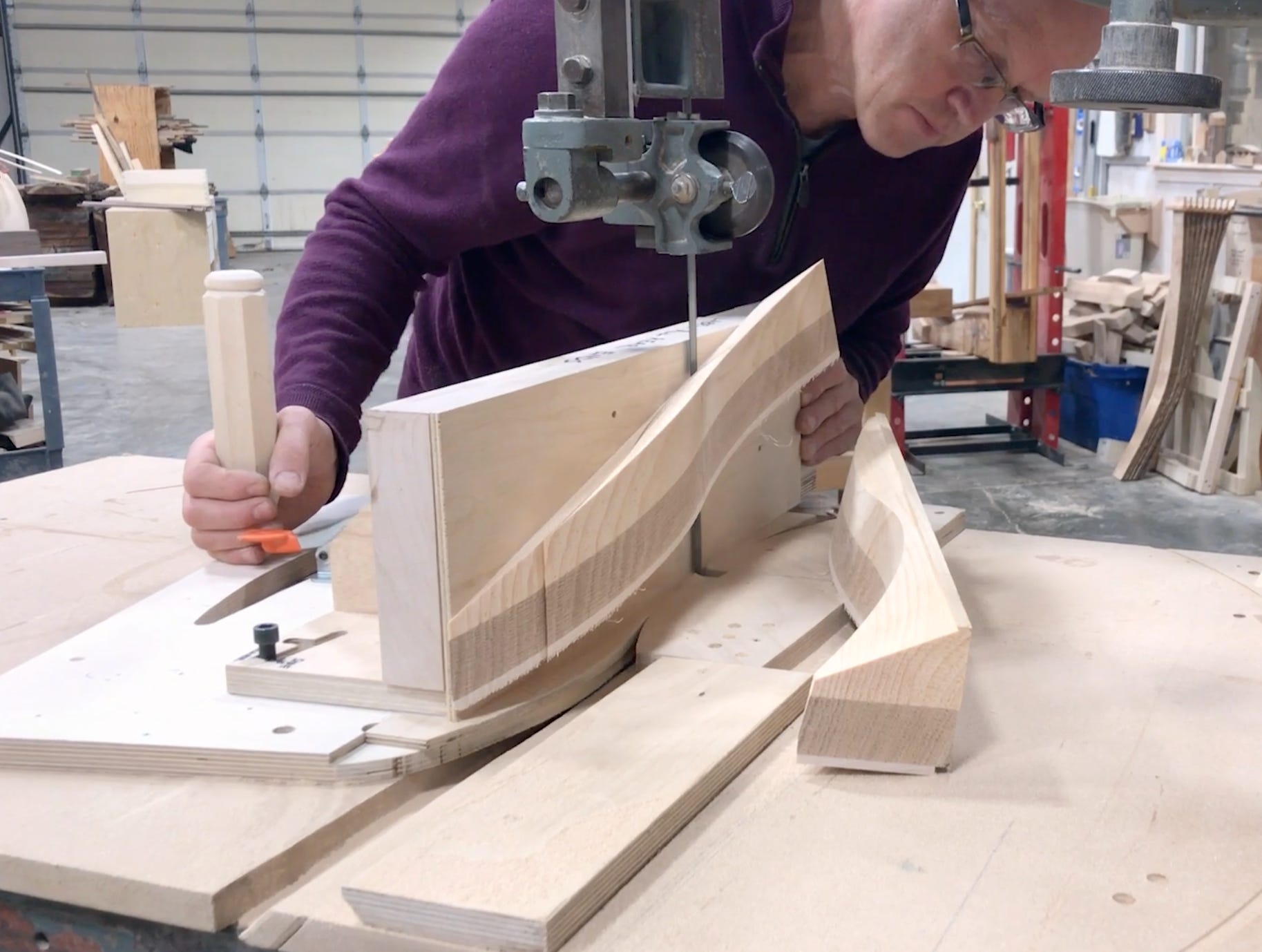
A fixture can answer part of the question—but only after I understand the path I’m asking the wood to take.
I still hold them.
And they still bear fruit.
I continue to find holes in my bandsawing foundation that I simply didn’t know enough to recognize before.
I would not have discovered those things if I had answered the questions years ago and moved on. And I would not be able to do what I do today on the bandsaw if I had simply written down the answers and dropped the questions.
Because I have not fixated on the answers, my learning has accelerated, and working at the bandsaw has become a much richer experience.
I think that is the real value of holding a question.
We don’t always need an answer as quickly as we think we do.
Sometimes what we need is the space to let a good question do its work—the space to pay closer attention, to notice what we have been overlooking, and to let our understanding catch up with our experience.
The answer may change tomorrow.
A good question can keep working for decades.
From the Bench, Brian Boggs
Brian has spent more than four decades learning from wood, tools, mistakes, teaching, and making. He is still at the bench, working, questioning, experimenting, and finding new things to understand and share.
These essays are our way of capturing that ongoing work and putting it into the world.
If you believe this kind of knowledge is worth documenting and sharing, becoming a paid subscriber helps support the work of capturing it while Brian is still at the bench.

