
There is a particular kind of stubbornness that mastery produces. Not the stubborn ignorance of someone who doesn’t know better — something more interesting than that. It’s the stubbornness of someone who has solved the problem. Who built the machine, proved it worked, and watched it produce results nobody else was getting. That kind of stubbornness is earned. It’s also, eventually, the thing you have to be willing to set down.
I came in Monday morning to find water seeping through the back wall. Not a flood, just enough to force me to move things, clear things out. And somewhere in the middle of dragging equipment across wet concrete, I found myself standing in front of a machine I’ve moved more times than I can count.
This time I decided I wasn’t going to move it again.
I started taking it apart instead.
The machine was my tenon-cutting system, the third version of something I’d been developing since around 2000. The original starting point came from Rusty Nixon, a woodworker who designed some clever fixtures. I took his approach and kept going, building the whole contraption from the ground up, until I had something that could hold tenon dimensions to within a thousandth of an inch.
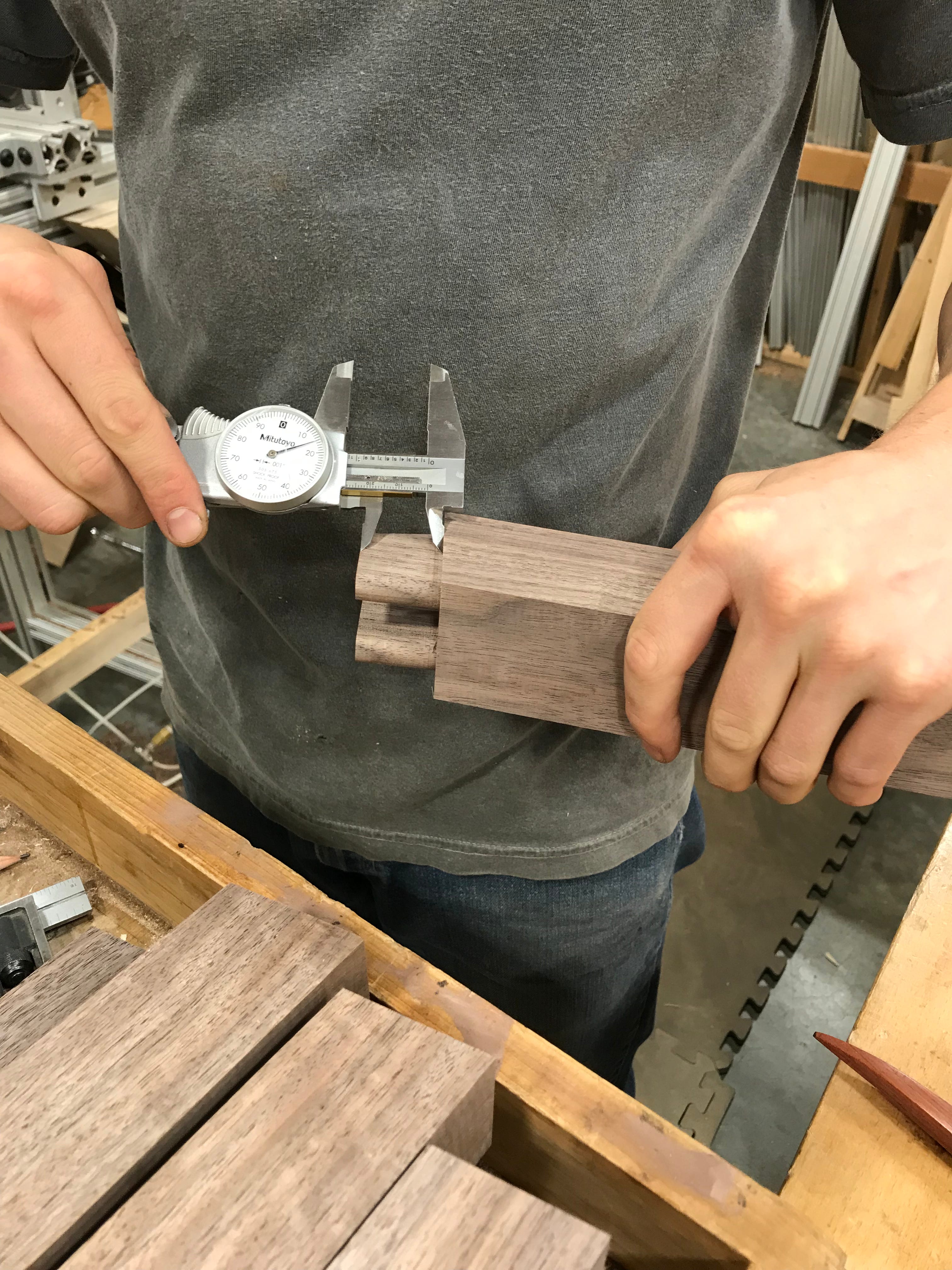
That number matters. Everything else on the market at the time varied too much. The adjustments weren’t fine enough. In a shop with multiple craftsmen, that variation adds up, joint to joint, chair to chair, year to year. Consistency isn’t just an aesthetic preference. It’s structural. It’s the difference between a piece that holds and one that doesn’t.
So I built what I needed.
The machine used a pneumatic plunging mechanism to push the router into the wood, guided by tapered bushings controlled through an oval plate I could adjust with extraordinary precision. It worked. It did exactly what I designed it to do.
And somewhere in the back of my mind, I thought it might be more than a shop fixture. I thought it might be something other shops would want. I don’t think I fully admitted that to myself until Monday, standing there with a wrench in my hand, deciding whether to move it again or finally take it apart.
Before I built my system, I had looked seriously at the Pantorouter, a design originated by Matthias Wandel that uses a pantograph mechanism to cut mortises, tenons, dovetails, and other joinery with consistent, repeatable results. The plans were impressive. But to make it robust enough for a production shop with five or ten people, the complexity felt beyond what I wanted to manage at the time. I needed something simpler and more direct. So I started almost from scratch. There were some things I liked about Rusty Nixon’s approach so I designed and built a more industrial version incorporating aspects of that concept. It was a big deal and expensive to build, but it worked as intended and we cut a lot of precise tenons with it over the years.
Then I met Mac Sheldon.
As it turns out, while I was building my tenoning machine, Mac was taking Wandel’s original design, with full permission, and re-engineering it into something commercially manufacturable. More refined. More robust. When I saw what he had done, something in me recognized it immediately: the problem I had spent years engineering around had been solved better by someone who devoted himself entirely to that single problem. If you want to explore it yourself, Mac’s Pantorouter is available through boggsbench.com, and we’ve arranged a $200 discount for our readers.
That’s a specific feeling. I want to describe it accurately, because I think it gets misread.
It is not defeat. It doesn’t feel like having your work invalidated. What it actually feels like is clarity. The years I spent building my system weren’t wasted. There’s a specific kind of recognition that only comes from having wrestled with the same problem. I knew immediately what Mac had achieved, and I knew it because I’d spent years chasing the same thing.
But clarity does demand a response.
This is the part that’s harder to talk about. Because it isn’t just a machine.
At our largest, we had thirteen craftsmen on the floor. Now it’s just the two of us, and that’s by design. Teaching has always been an important part of my work. Whether through Fine Woodworking, Popular Woodworking, in-person classes, or with very employee who came through this shop over forty years. But it’s the center of things now in a way it never quite was before. Not just how-to instruction. The Why behind the How. That takes a different kind of shop than the one that needed a precision tenon machine running every day.
I’ve been thinking a lot lately about what to carry forward and what to let go of. The honest answer is that the most important things to carry forward are almost never the objects. They’re the understanding those objects represent. The tenoning machine taught me what consistency actually demands at the joint level. I have that now. The machine can become something else.
That’s one of the things I’ve always appreciated about building from extruded aluminum. Nothing is wasted. It just changes form. The pneumatic components, the fixtures, the adjustable plate, all of it will find its way into something new.
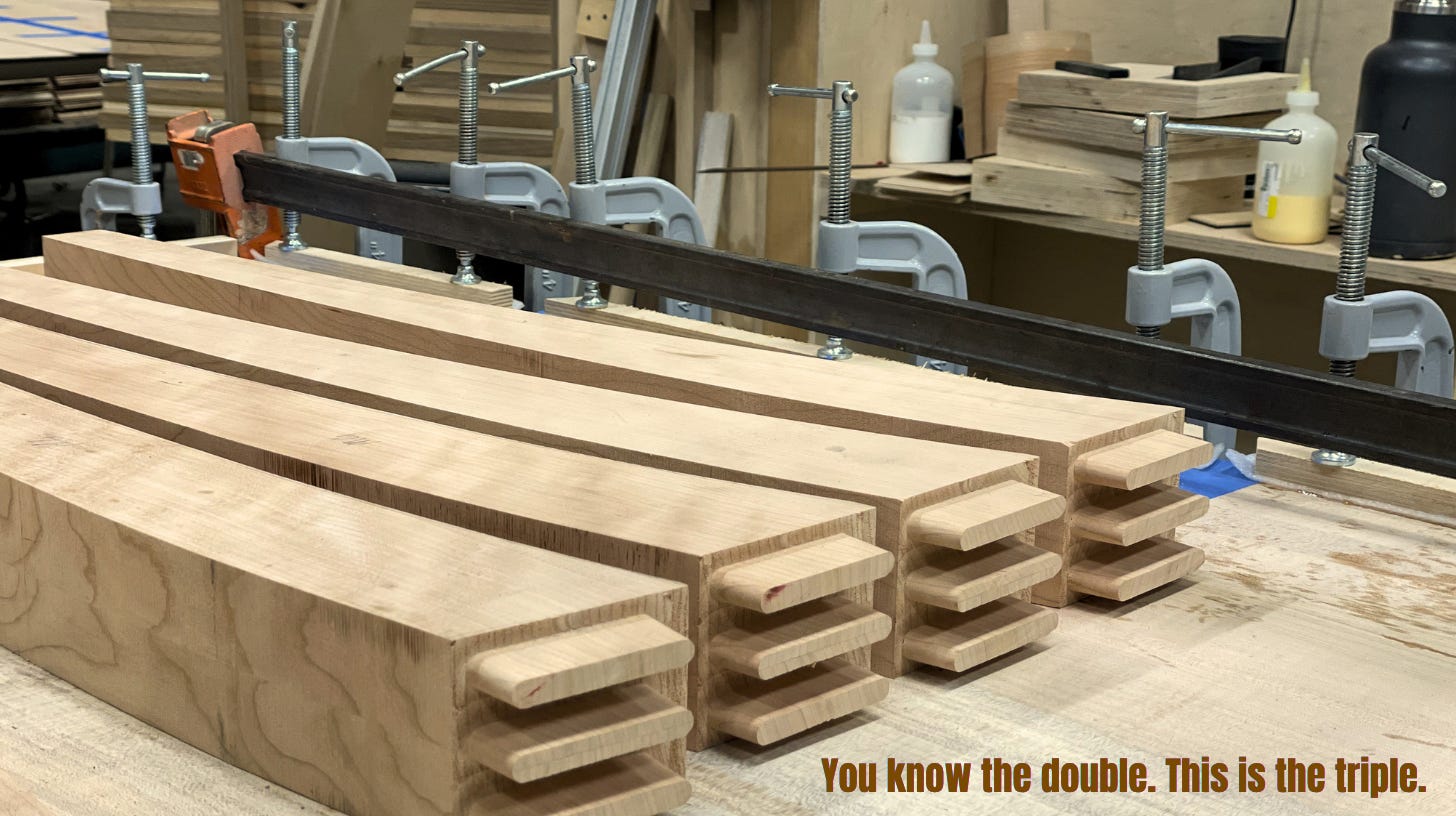
We’re already using the Pantorouter to cut double tenons with our taper-locking joinery system. Mac has been a genuine collaborator in getting that right. This isn’t me stepping back from precision. It’s me trusting the best tool for the job with the right person behind it.
Forty-some years in, I’m still working out which problems are mine to solve.
Some of them are. When I designed the Boggs spokeshave, there wasn’t a tool on the market that did what I needed, so I made one, and Lie-Nielsen has been manufacturing a version of that tool it for decades now. That problem was mine to solve. The bark-processing machine. The seat carving machine. The steam-bending system. The shave horse with the ratchet mechanism. Those were my problems to solve too. I could not buy those tools and machines when I needed them.
But not every problem I can solve is one I should solve. Especially when someone else has already solved it better.
The craftsman’s stubbornness, the kind that drives you to build your own tools, design your own machines, stay up late thinking about a joinery problem until it resolves, that quality is genuinely valuable. But it has a shadow side. It can keep you moving the same machine across the same floor for years because you built it and it works and letting go of it feels like losing something.
What I found, taking it apart that Monday morning, is that it doesn’t need to feel like losing anything.
It feels like I finally know what the machine was for. And it has served that purpose fully now.
The aluminum didn’t wait long to tell me what to do with it next. I’d been putting off building a proper grinding station, something to get my grinder away from the Nano Hones and lapping plates it had been contaminating for years. My old grinder finally died earlier this year, so I bought a Toycen with CBN wheels. A fabulous grinder. I’m also developing some sharpening systems I’m genuinely excited about, and the extrusions are already speeding up that prototyping. The pile of heavy rails that would have gone into overhead storage is becoming something I actually needed and they are speeding up the prototype work.
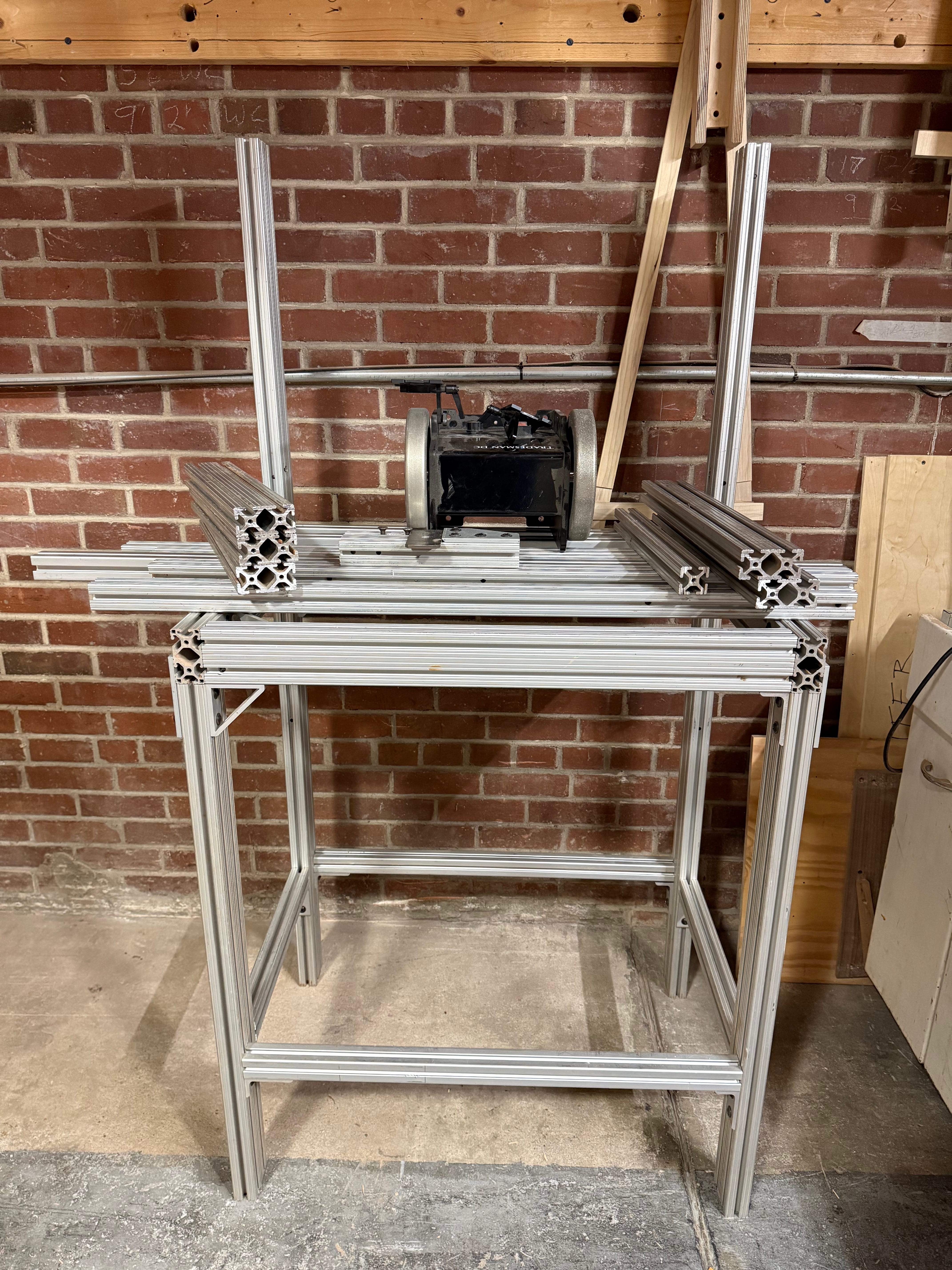
It wouldn’t have made sense to buy all this material for a grinding station. But it makes complete sense to build one from material that was already here, already understood, already calling me to repurpose it. The knowledge transfers. The form changes.
Good design often comes from a moment of letting go. Recognizing that moment is as important as any other aspect of being a designer. It need not be painful. When you recognize that what creatives do is totally in line with all natural systems, it’s easy to watch letting go give way to birth.
From the Bench — Brian Boggs


