

Melanie says that if I were a trout, I’d have been dead a long time ago.
She’s probably right.
During a talk last week, I was trying to explain something about the economics of design, and a trout came to mind.
A trout in a stream has to make a decision every time a mayfly goes by. Is the food value of the mayfly worth the energy it will take to catch it?
If the trout consistently spends more energy chasing food than the food provides, eventually it starves.
That is a pretty good rule for a woodworking shop.
It is also a rule I have spent much of my career violating.

Brian fishing in the Edisto River, South Carolina. He hadn’t come prepared to fish, but the pull of the water was too strong to resist, so in he went, jeans and all.
I love designing. Probably too much.
A problem gets hold of me and I disappear into it. I can spend hours changing a curve, working out a joint, building a fixture, trying a different material, or solving something that no one but me may ever notice.
Time goes away.
So does space.
Eventually I will come to Melanie and ask some version of, “How much longer can I keep working on this?”
Which is a funny question, because by then I usually already know the answer.
There is an economy to everything we make.
I don’t mean that everything has to make money.
Years ago, I was talking with a student about the time he was putting into a project. He told me it didn’t matter because he was a hobbyist.
I remember biting my tongue.
Of course it matters.
That doesn’t mean his time needed to produce a financial return. Maybe what he wanted back was three quiet Saturdays in the shop. Maybe he wanted to learn a new joint. Maybe he wanted to make something for his daughter that would still be around after he wasn’t.
Those are perfectly good returns.
The question isn’t whether the project made money.
The question is whether what you are putting into it makes sense for what you hope to get back.
If you’re entertaining the idea of making your craft your profession, however, the equation gets more literal.
Over the years, we’ve heard makers say they want to make $50 or $75 an hour. That’s a useful place to start. Pick a number. Track your time. See what actually happens.
Years ago, we used a very simple exercise with our employees to show how quickly the selling price of a piece could get divided up. We used ballpark numbers like these:
$5,000: selling and marketing
$1,000: materials
$2,000: overhead
$2,000: labor
That 50 percent for selling and marketing may sound high. But 50 percent is a common gallery commission for putting your work on the floor, representing it, and selling it. If you sell directly, that cost doesn’t simply disappear. You have taken on the work of finding the customer and making the sale yourself. Our number was usually well under 50%, but we wanted to reserve the option of sales through a gallery without losing money.
That’s a $10,000 piece.
If your goal is to make $75 an hour, that $2,000 labor allowance gives you about 26 hours and 40 minutes total.
That includes developing the design, finding and procuring the right material, making any fixtures you need, taking the piece from rough lumber to final finish, and absorbing the part you get wrong and have to make again.
And we’ve already spent the entire $10,000.
There is no profit in that equation.
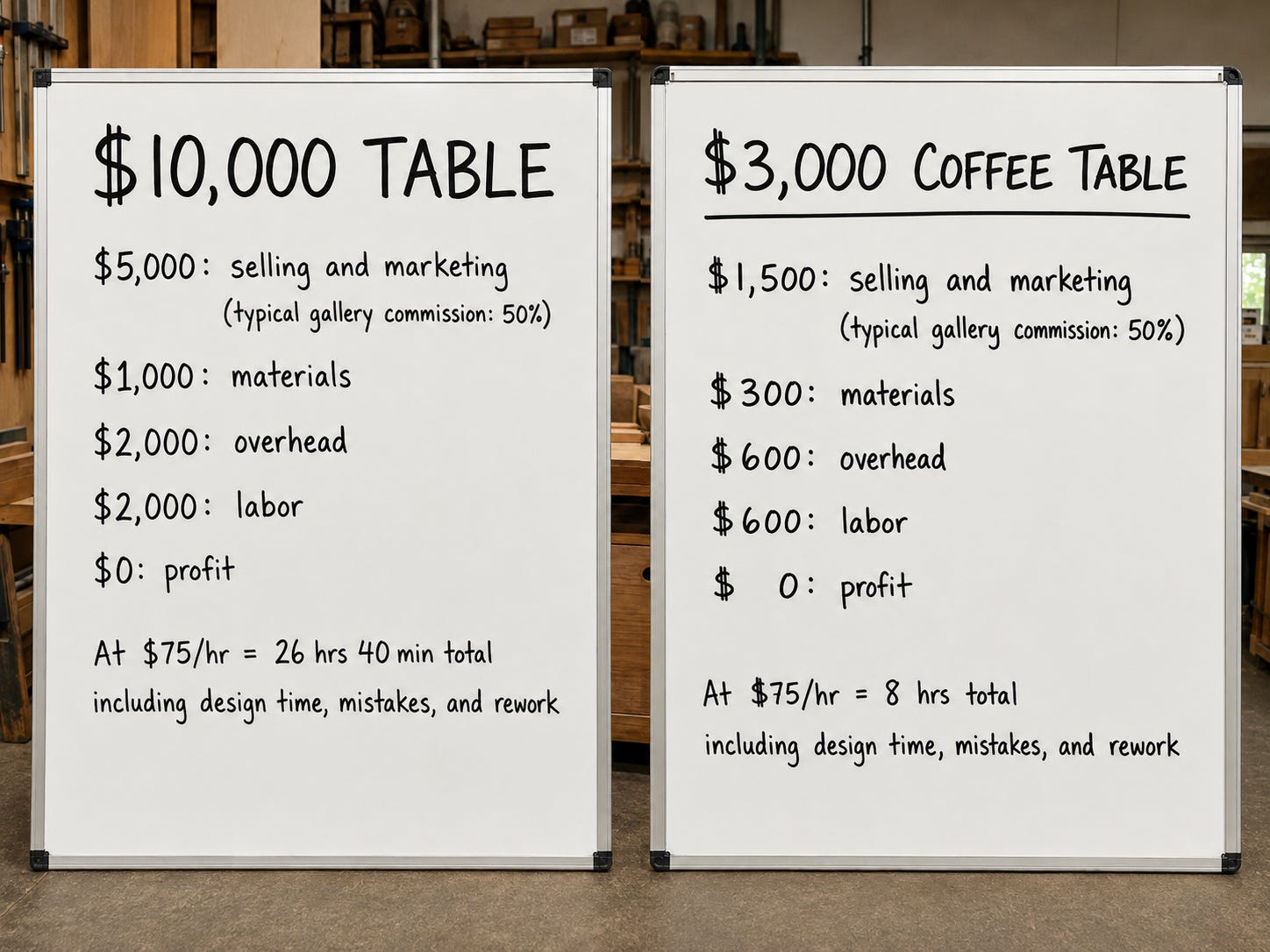
A simplified, high-level look at how the selling price of a piece can get divided up. These are ballpark numbers we used to help employees understand the economics, not a pricing formula.
Material costs alone can vary enormously. For most of my career, I bought logs, had them sawn, and dried the wood myself. That grew naturally out of the way I started working with riven green wood, and it kept our material costs relatively low. Depending on the species and thickness, some of that lumber might sit stickered and drying for months, sometimes years, before we could use it.
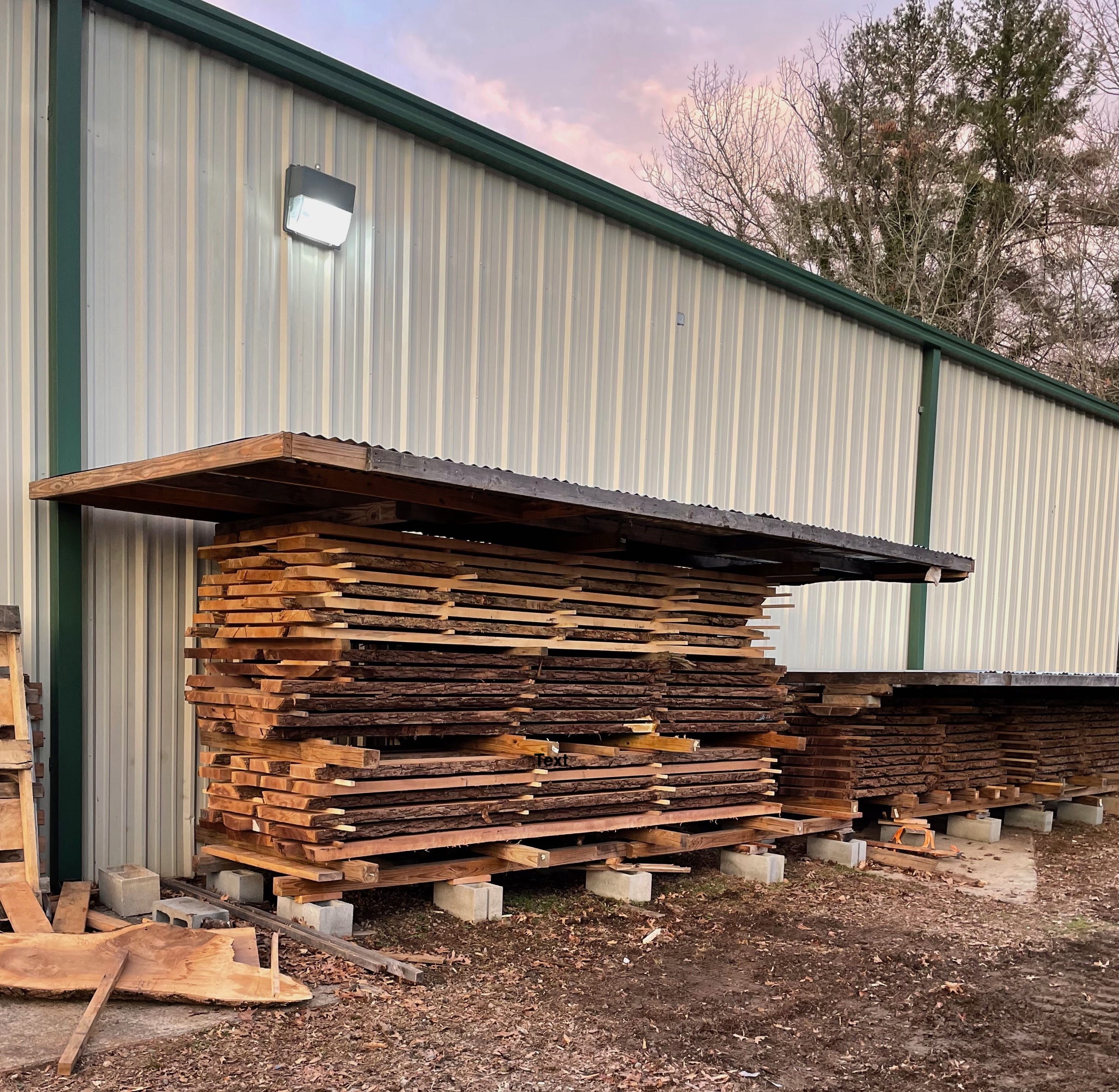
For most of Brian’s career, lumber was bought as logs, sawn, stickered, and dried slowly on the south side of the shop. Only in the past couple of years have we shifted toward buying our lumber already dried from outside sources.
One thing we’ve learned over the years is that making furniture and building a business that can support making it are two different jobs.
Someone has to design and make the piece. Someone also has to find the customer, sell the work, maintain the shop, keep the books, handle the marketing, manage the client relationships, and do all the other work that happens away from the bench. One person may do all of that.
In our business, Melanie and I have always divided the responsibilities according to what each of us does best, with employees and other staff supporting both the making and the business side over the years. For the past two years, it has been just the two of us.
However you divide the responsibilities, the furniture still has to pay for all of it.
And the business needs something left over at the end.
Profit is not what you get because you charged too much. It is what allows a business to replace a machine, survive a slow month, absorb a mistake, develop the next piece, and keep going.
I don’t say any of this to discourage someone who dreams of making a living at their craft. Quite the opposite.
But loving being at the bench and running a business that allows you time at the bench are not the same thing. The more clearly you understand what the business will ask of you, the better chance you have of building one that actually supports the work you love.
Over the years, I’ve stopped from time to time and looked at how much of my working time I was actually spending at the bench. It has rarely been more than about 50 percent.
I have had to look at tools and machines with that trout analogy too.
For roughly 35 years as a professional furniture maker, I didn’t own a table saw.
That surprises people.
It wasn’t because I had anything against table saws. Every year or so I would reconsider buying one.
But I kept asking what it would actually do for me.
How much time would it save?
How often would I be doing the kind of work it could speed up?
How much floor space would it take?
Would it improve the flow of the shop, or interrupt it?
For years, the numbers never supported that purchase.
At one point an employee bought a beautiful old Oliver table saw and asked if he could put it in the shop. He said I could use it as much as I wanted.
Great.
I didn’t even have to buy the thing.
We put it in.
I used it.
It was a very good saw.
After about a month, I asked him to take it back out.
It wasn’t worth the floor space. I also didn’t like the idea of changing the way I worked simply because there was now a nice saw sitting on the floor. None of the changes I would have needed to make to ensure the saw paid for itself would have made the shop more efficient overall.
Years later, the equation changed. We had more employees, and some of them already knew how to work safely and efficiently on a table saw. Training them to do the same operations on a bandsaw would have taken more time.
Suddenly the table saw earned its place.
The saw hadn’t changed.
The shop and the people in it had. So had the portfolio: more tables and cabinets.
That is the problem with simple rules about efficiency. The answer depends on what you are trying to do.
Design makes the calculation even messier.
I am redesigning the Sonus and Lily chairs right now, and one part in particular has reminded me of this.
For fifteen years, we made the back-leg assembly from three pieces joined in a pinwheel arrangement. Structurally it worked very well, but it created problems when we tried to move production to other makers.
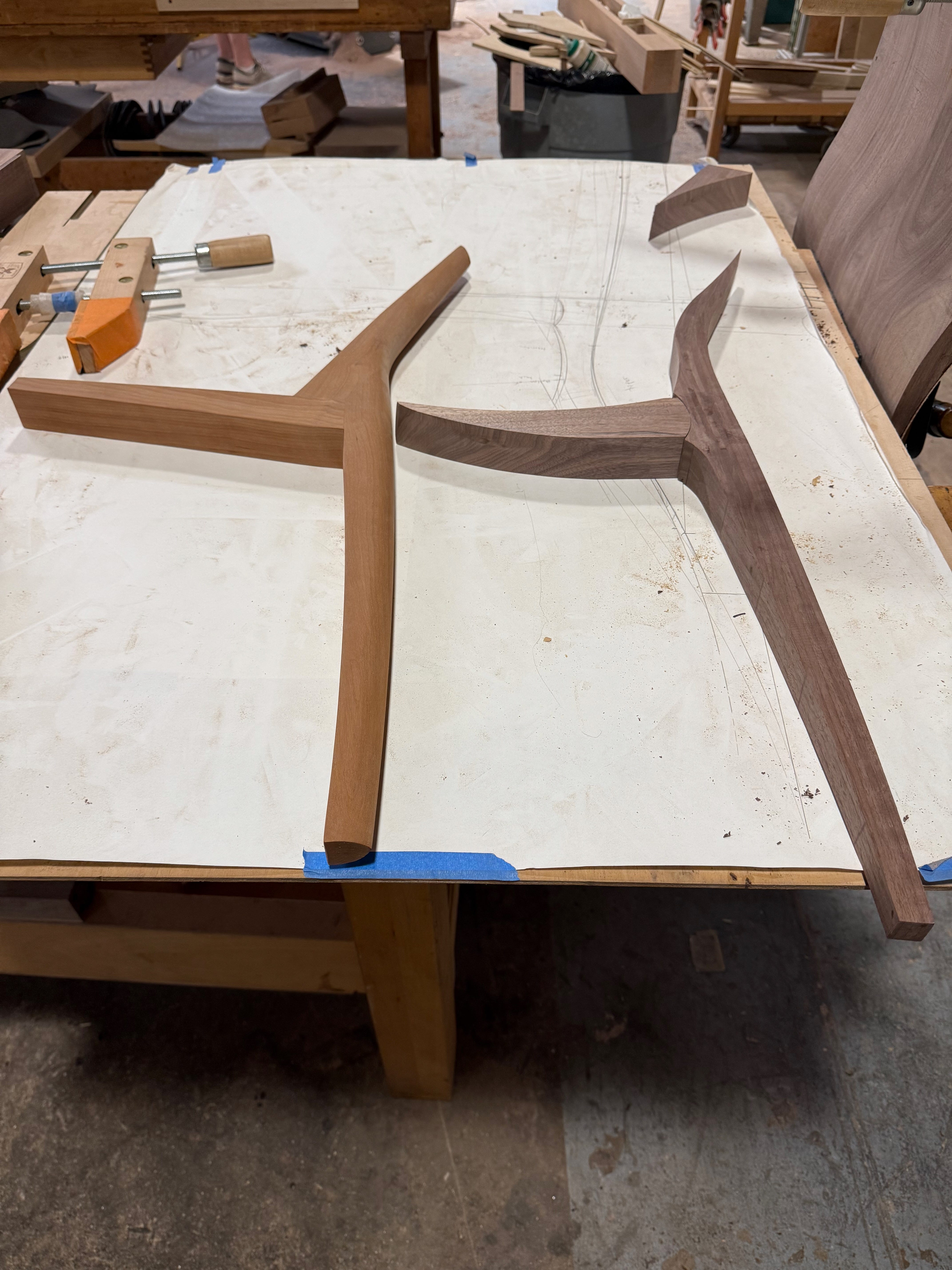
The original three-piece pinwheel assembly beside the new Sonus/Lily leg. Both are unfinished. The redesign is not just about appearance; it is also about finding a form that can move more cleanly through production while improving the look and comfort of the chair.
So I started looking for another solution.
I developed a new version using a soft maple core with walnut veneered over it. It gave me more freedom in shaping the relationship between the leg, seat, and back than the prior assembly. It also allowed me to use the walnut sparingly.
I loved it.
I kept telling Melanie, “This is going to work.”
That should probably have been a warning.
After a couple of weeks I realized I had designed a little monster.
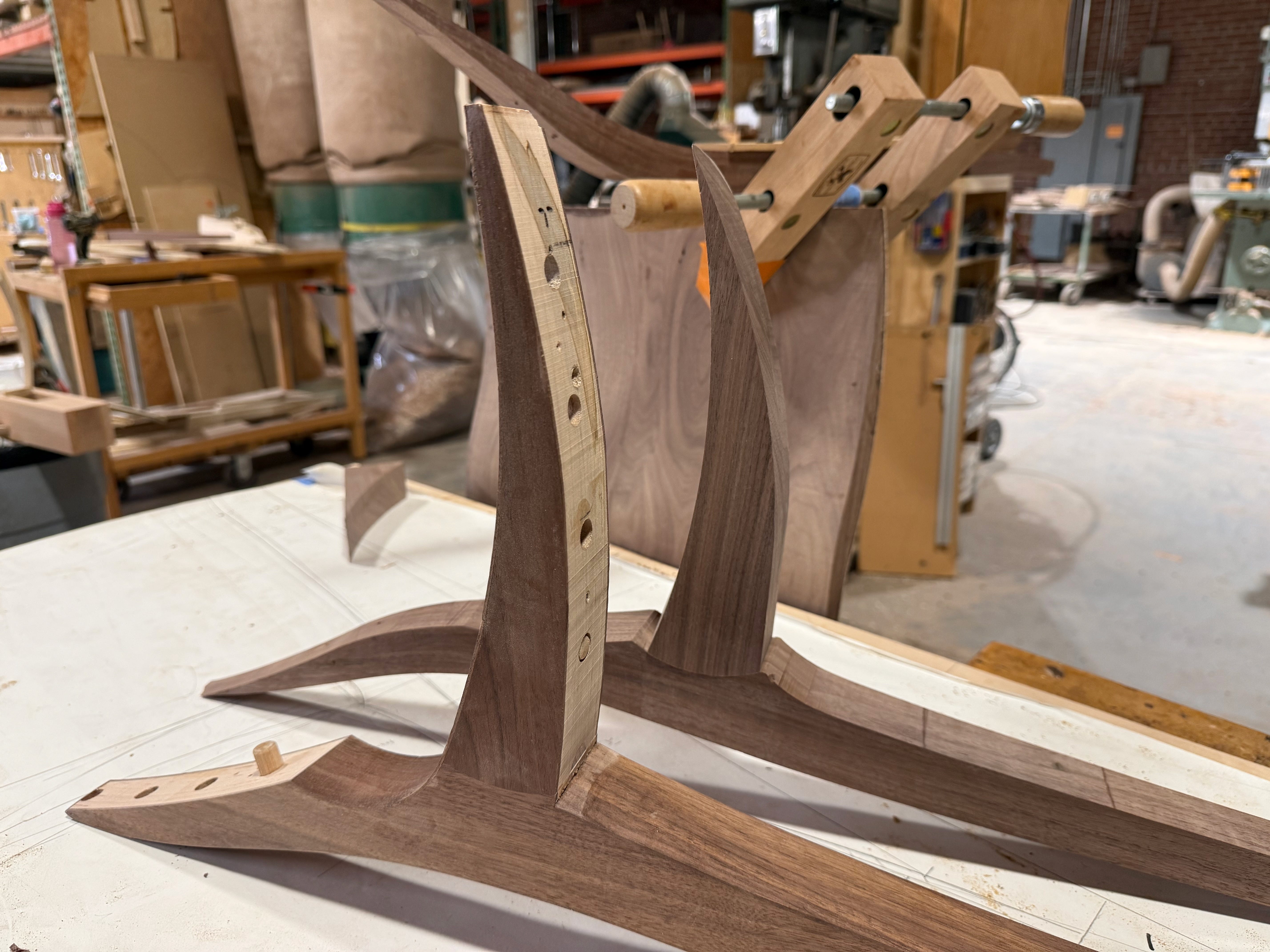
The “little monster” beside the cleaner new Sonus/Lily leg. Both are unfinished, but the difference in production complexity is already clear.
It worked, but the steps and complications involved in making it were out of proportion to what that one “improvement” contributed to the chair. The process just didn’t flow after all.
So I let it go.
We are now making a bent lamination that is much cleaner to produce. Eventually, if we make enough of these chairs, steam bending may make even more sense.
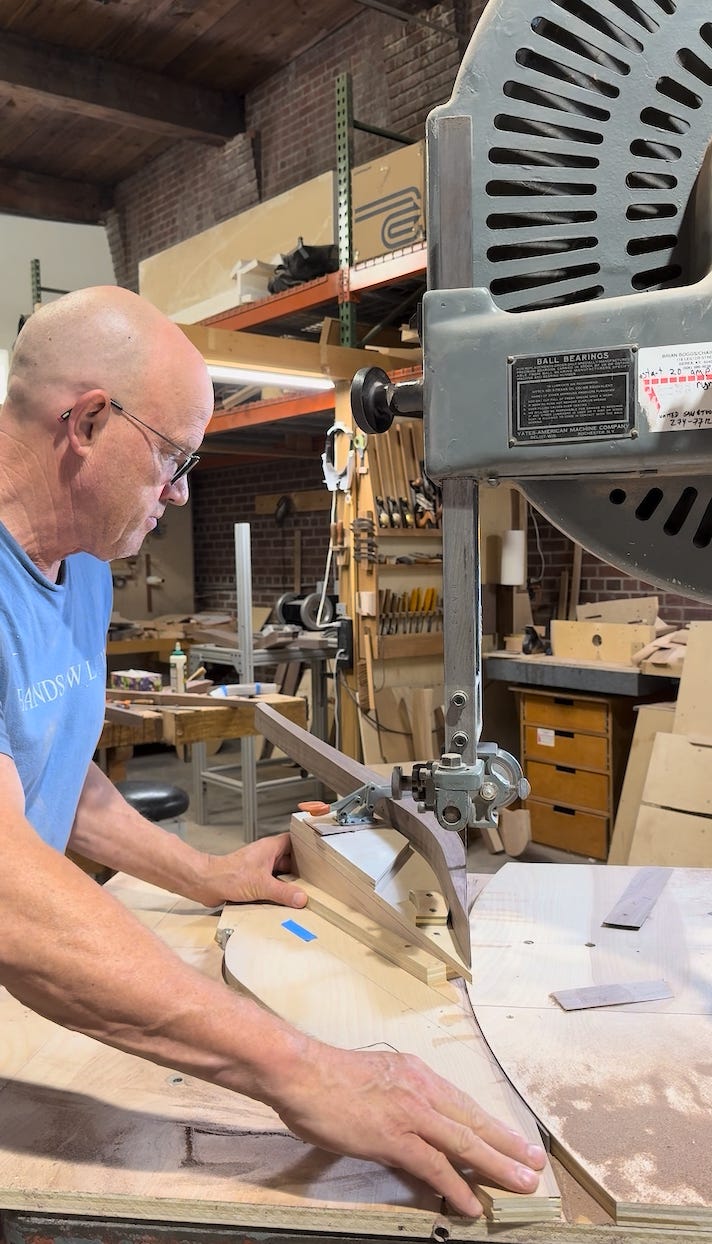
Brian cutting one of the new Sonus/Lily legs at the bandsaw. The redesign has been as much about process as form, developing a sequence that another maker can repeat reliably.
The answer keeps changing because the conditions keep changing.
And because I keep learning.
There is another wrinkle when you are designing something that will be made many times, and by other hands.
If I spend an extra day working out a detail on a one-of-a-kind table, that entire day has to be paid for by one table.
If I spend that day improving a chair we may make hundreds of times, that investment gets spread over all of them. And the efficiencies gained are multiplied too.
Production can actually give me permission to design more and better, not less.
But even then, there is a limit.
I’m just not always very good at recognizing it soon enough.
There is a point where another hour makes something better.
And there is a point where another hour is simply another hour.
I wish I could tell you exactly where that line is.
I can sometimes, but it is always a gamble.
Sometimes the thing you learn in those extra hours becomes the most valuable part of the project. Sometimes a detail no customer will ever consciously recognize is the thing that makes the whole piece feel right.
I’ve watched people respond to furniture before they can explain why they like it. Something pulls them toward the piece. Sometimes it is exactly the detail I spent that extra day sorting out.
Which is why the calculation is so difficult.
An hour that looks wasted while you are spending it may turn out not to have been wasted at all.
And sometimes you have just followed a mayfly halfway up the stream.
That distinction matters whether you make furniture for a living or build one piece a year in your garage.
Maybe the return you want is money.
Maybe it is mastery.
Maybe it is the pleasure of figuring something out.
Maybe it is an afternoon when nobody needs anything from you and you can lose yourself in making something with your hands.
I don’t think there is a wrong answer.
But I do think it is worth knowing what your answer is.
I’m still trying to figure out when one more hour is worth it.
What’s your mayfly: the tool, detail, process, or problem you know you can spend far too much time chasing?
Fortunately, I am not a trout.
From the Bench – Brian Boggs
If something I have shared here has taught you something, changed the way you think about your work, or simply made you curious to try something new, an $8 paid subscription is one way you can help me keep sharing lessons from the bench. We’re not putting up a paywall. We’re asking for your support. There won’t be a separate stream of writing reserved for paid subscribers. We’d rather everyone get to read it.


