
A few weeks ago I wrote about what keeps a maker’s vocabulary narrow, how the boundary of what we feel confident executing becomes the boundary of what we’re willing to design. Tables came up in that essay, and I want to return to them from a different angle. Not design thinking. Geometry.
Every few months, someone asks me to make the chairs smaller.
They have a dining room they love, a table that’s already in it, and a guest list that doesn’t quite fit. So the logic goes: if the chairs were a little slimmer, maybe we could squeeze in one more seat.
It seems reasonable. It isn’t.
The chairs aren’t the problem. The adults are, or more precisely, the geometry of them. No amount of clever chair design changes the fact that a person needs about 24 inches of table width to eat comfortably without bumping elbows with the person next to them. That’s not a design preference. That’s a body.
I’ve had this conversation with clients and interior designers for decades. I understand why it comes up. A 72″ × 36″ table looks like it should seat eight. And if you crowd it — if everyone turns sideways and nobody orders a second glass — maybe it can. But that’s not dining. That’s tolerating proximity while trying to eat.
We’ve all done it. Holidays have a way of turning a six-person table into eight by sheer will. Nobody complains out loud, and everyone survives. But there’s a difference between what a family endures on Thanksgiving and what you build for a client. One is making do. The other is intentional.
The standard in dining table design is 24 inches of table space per person. That allowance accounts not only for shoulder width and arm movement, but also for the space occupied by knees, feet, and the subtle shifts of posture that happen during a meal.
What that means in practice is simple: a 72” × 36” table comfortably seats six. Seat eight, and everyone is working with about 18 inches. Nobody complains. But the meal feels different. People move less, conversations become more constrained, and guests are ready to leave sooner than they otherwise might.
This is what the request looks like from above. Three chairs on each side, one host squeezed into each end. The place mats don’t lie.
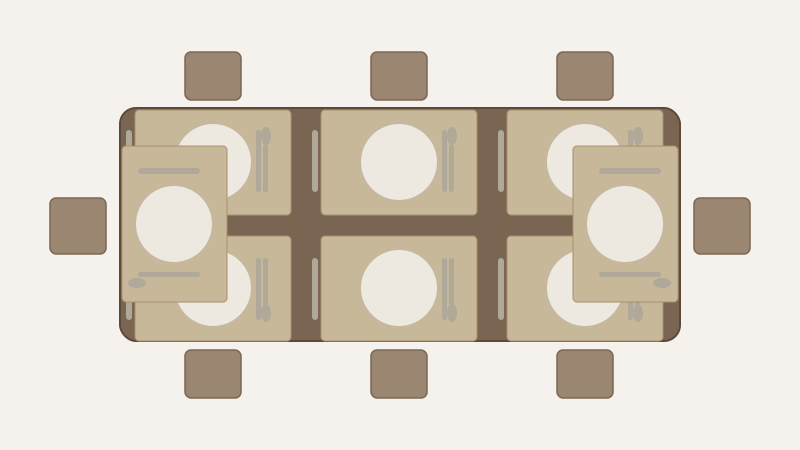
The hosts chairs don’t just crowd its immediate neighbors. There’s just no room for them, period. That’s the part people don’t see until they set the table.
The mistake is assuming that because a chair can be made narrower, the person sitting in it somehow becomes narrower too.
I’ve had designers ask me to reduce seat width so a client’s table could accommodate more guests. What they’re really asking is for the chair to compensate for a table that was undersized from the beginning.
It goes the other direction too. There’s no shortage of oversized dining chairs on the market, and plenty of clients who want armchairs all the way around the table. That’s a legitimate preference. But it’s worth understanding why armchairs are traditionally placed only at the ends: that’s the one seat with enough lateral clearance to accommodate them. The end guests aren’t getting a special chair as a courtesy. They’re getting the only seat at the table where an armchair actually fits.
The more useful conversation isn’t about how many people a client hopes to seat. It’s about how many people they actually need to seat most of the time, and what the room can realistically accommodate. Those two numbers determine the table size, and often its shape. A square room and a round table are a natural fit. In today’s homes the dining room is often open on at least one side giving table dimension and shape more options. In these spaces, it’s important to identify the traffic lanes that define no-go zones defining the limits of dinner parties. whether you are getting up to go to the bathroom or the fridge, you don’t want someone to have a to move their chair so you can get by.
This is where table design becomes more interesting.
It doesn’t matter whether the table uses a trestle, a pedestal, or four legs. The geometry remains the same. The structure must land where stability requires it, and everything above it should get out of the way of the people using it.
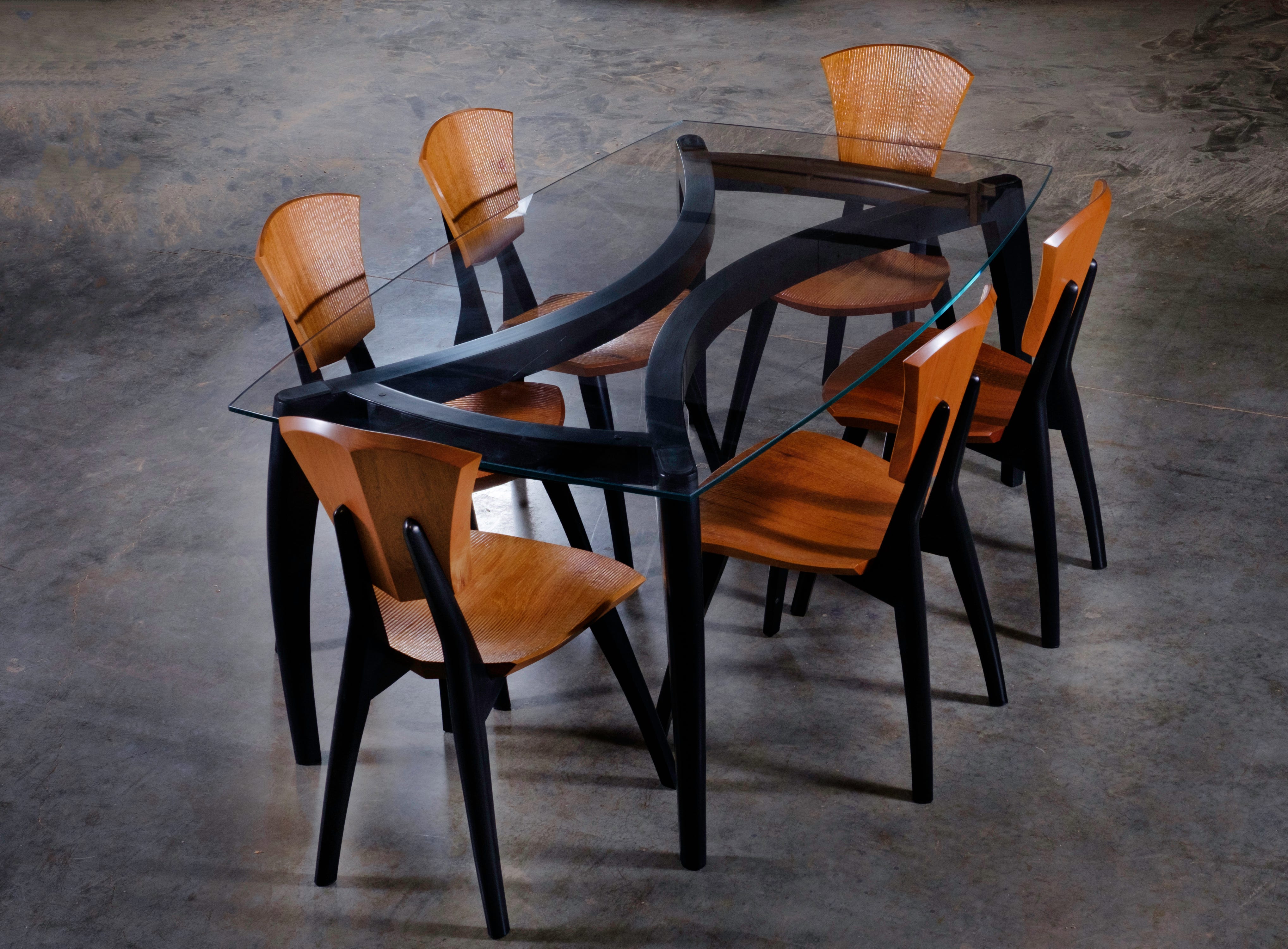
Through the glass top you can see exactly where the legs start and where they land, splaying outward from the frame all the way to the floor, staying clear of the guests at every point. The frame curves for the same reason: so you can cross your legs without hitting a table skirt.
A table base isn’t just structural. It’s ergonomic.
A poorly placed leg forces someone to straddle it or push their chair away from the table. A pedestal that’s too wide intrudes on knee space. A base that’s too close to the ends interferes with the host’s seat. Different symptoms, same problem: the structure wasn’t designed around the people who would use it.
This is one reason I’ve never understood the popularity of trapezoidal metal bases in the live-edge world. Whether the legs flare inward or outward, they’re often positioned exactly where knees and shins need to be.
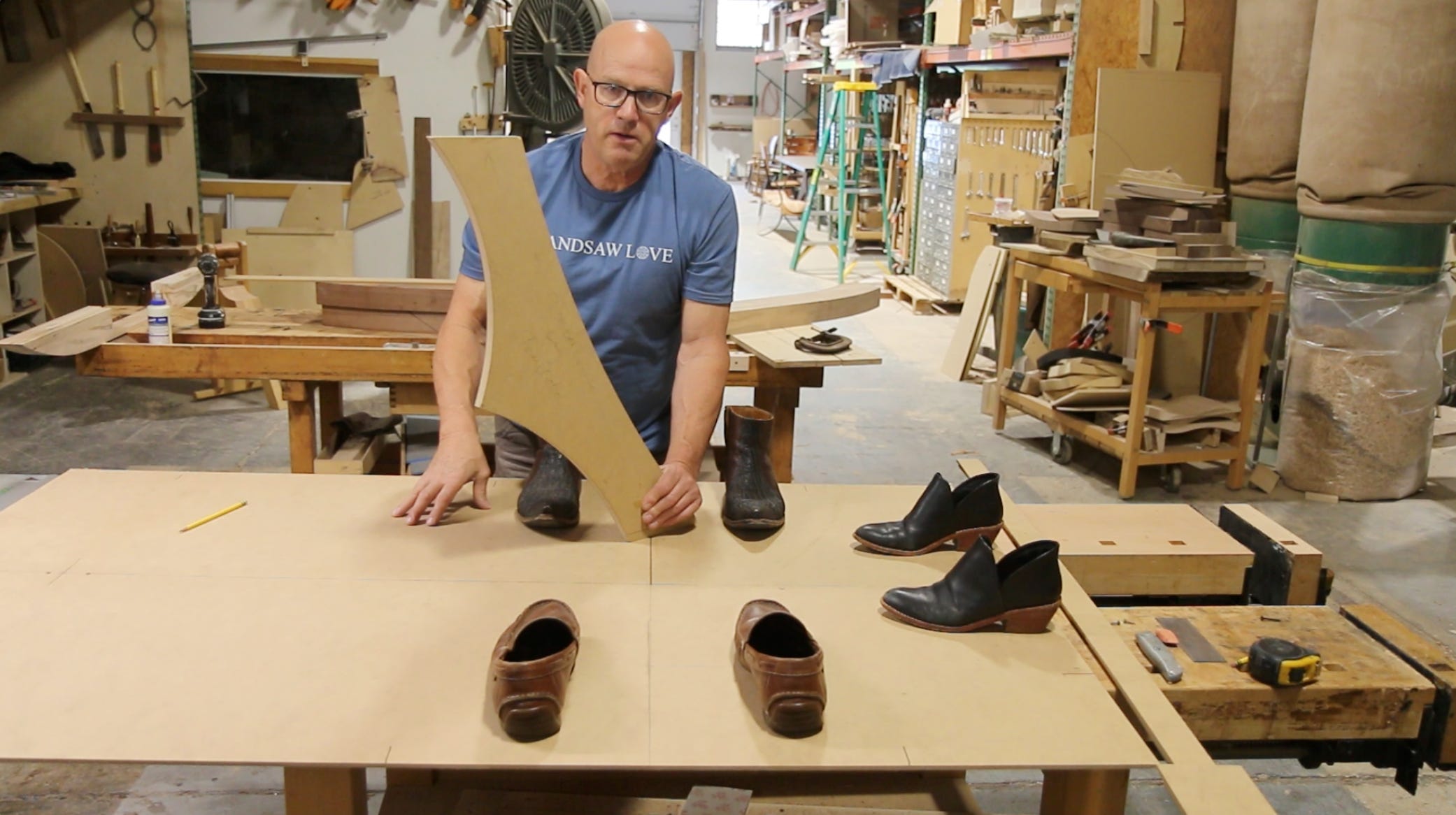
The sweet spot to land a pedestal foot.
My approach on the Timber Frame Table is simple. The foot of the base goes as far outward as stability requires, and everything above it moves inward and out of the way. The angled legs aren’t merely aesthetic. They’re solving a clearance problem.
Regardless of table size, I typically place the base feet about 24 inches from each end, centered between the feet of the outer side-seated guests. That position keeps it clear of both the host and the adjacent diners while maintaining excellent stability.
Can a dining table base be both beautiful and ergonomically correct? Of course.
Given the design tools available today, there is no reason for a table base to compete with the people sitting around it. The structure should serve the guests, not the other way around.
None of that is an afterthought. The number of people who need to sit there on an ordinary Tuesday — not Thanksgiving — the room’s actual dimensions, the base position that keeps structure out of the way of the people around it. Those are the first questions, not the finishing touches. Every dimension of the table follows from them.
When the geometry is right, nobody notices it. Guests sit down, settle in, and stay longer than they intended.
From the Bench – Brian Boggs
For anyone who wants to work through the full geometry, the base positioning, the structural logic, and the sequencing of a table this size from rough stock to finished piece, that’s exactly what the Timber Frame Table course covers.
It’s the most complete teaching I’ve put into a single course.
The table is the vehicle. Understanding how to design around the people who will use it is the point.
That’s what we’re after.


