
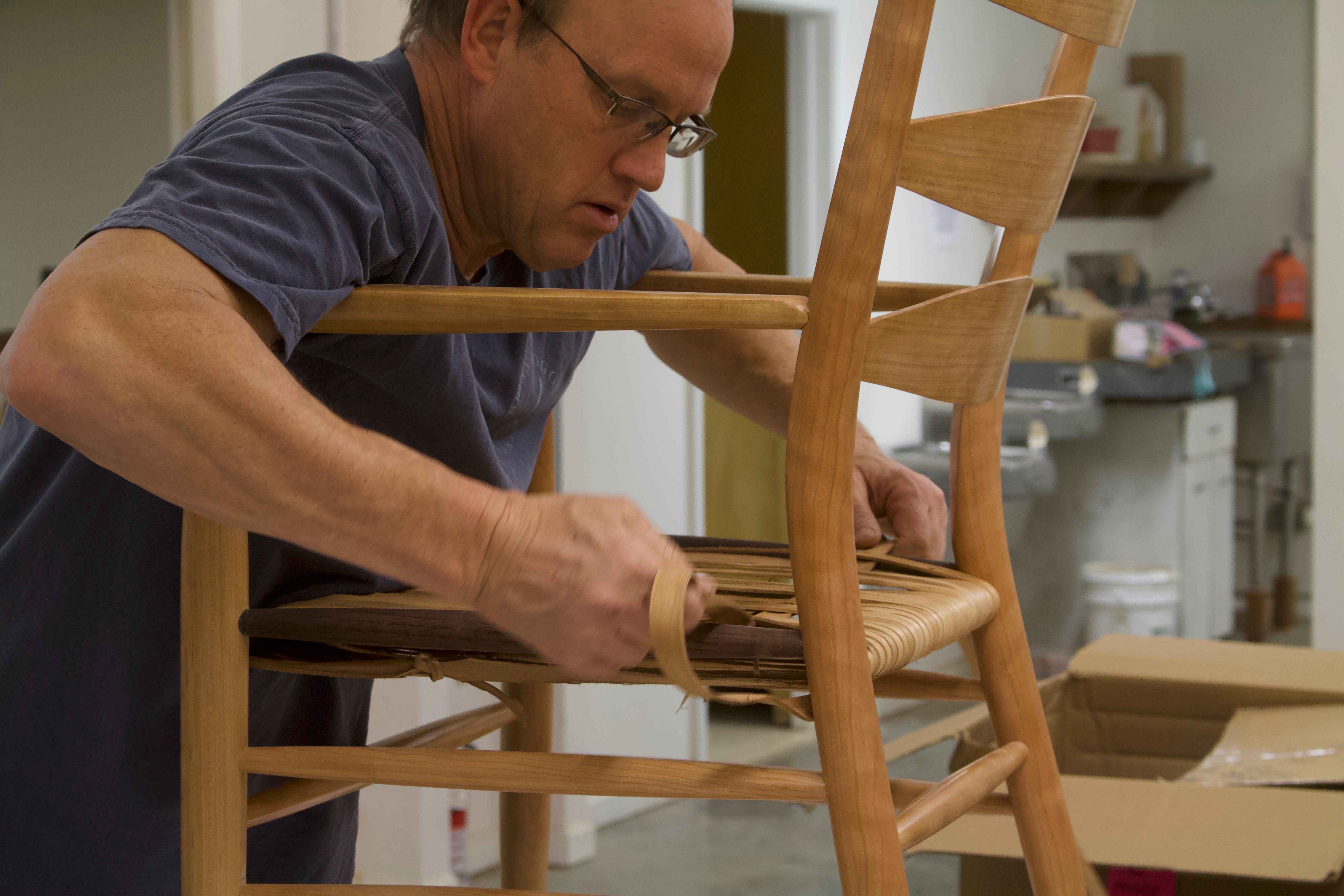
I’ve been thinking lately about how my path into woodworking became the best school I could have attended.
When I was around twenty years old, I was discouraged about painting and drawing as a profession, even though I had thought of myself as an artist since childhood. Around that time, I discovered James Krenov’s book The Fine Art of Cabinetmaking in the public library. What fascinated me was the way he spoke about wood, not simply as a material for construction, but as an artistic medium. He talked about using grain the way a painter uses a brush, composing with figure and texture instead of pigment.
I was deeply inspired by that vision.
But I was also intimidated by it.
As I tried to understand what it would take to begin woodworking seriously, I made my best estimate of what a shop like Krenov’s might cost to set up. Even in the early 1980s, I figured it would take around ten thousand dollars to get started properly. At that point in my life, that number might as well have been a million.
Then I came across another book entirely by accident.
I found John Alexander’s Make a Chair from a Tree sitting on my father’s coffee table. I borrowed it and never returned it. What struck me immediately was how different the approach was. John wasn’t talking about fine machinery or precision cabinetmaking. He was talking about fibers, moisture, structure, and the relationship between wood and the human body.
Most importantly, he was talking about accessibility.
Instead of needing ten thousand dollars to begin, I realized I could start with about fifty.
That changed my life.
I was attracted to John Alexander’s chairmaking from a lot of standpoints. I thought the chairs themselves had a beautiful sculptural energy to them, something that seemed connected not only to the forms, but to John’s personality and way of thinking. But just as important was the directness and simplicity of the process. Compared to the shop filled with machines I imagined would be required to follow Krenov’s path, this felt much closer to my own reality.
What appealed to me most was the physical nature of it. The sparse tool kit placed the craftsman in direct contact with the material in a way that appealed to me on a cellular level. And it turned out to be exactly that. I wasn’t thinking strategically about becoming a chairmaker or imagining where it might eventually lead. I simply sensed that this tradition, this approach to working with wood, offered a perfectly approachable opportunity to explore woodworking, design, and making.
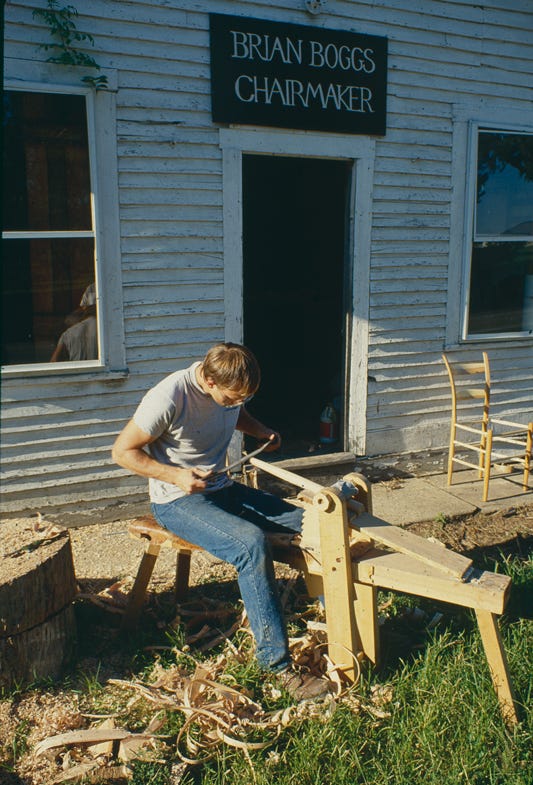
Working on my shaving horse outside my first chairmaking shop, powered by a single 15 amp fuse.
I built a terrible shaving horse out of old fence planks from my father’s farm. I found a short sassafras log and started splitting it apart and shaping those pieces with a drawknife. The chair I eventually made was rough by any reasonable standard, but something much more important was happening in the process.
I wasn’t just building a chair.
I was building a foundation.
Splitting wood taught me things no machine could have taught me at that stage of my life. You could feel the fibers separating. You could understand strength physically rather than abstractly. Working green wood through its drying process taught me how dramatically moisture changes the behavior of a material. Every joint, every failure, every success carried information.
Even the limitations mattered.
I didn’t own many tools in the beginning. I cut mortises with a sharpened screwdriver because I couldn’t afford chisels yet. A broad axe and a drawknife were my shaping tools. But those limitations forced me to pay close attention to the material itself rather than relying on machinery to solve problems for me.
Over time the chairs became more refined, but the underlying lessons remained the same. Those early experiences splitting wood and working with green material taught me to pay attention to grain orientation, moisture content, joinery, and the relationship between structure and the human body. Looking back now, I can see how much of my later work was already embedded in those early experiences with a drawknife and a green log.
Over time, I made thousands of ladderback chairs using those early greenwood techniques. Gradually, the designs evolved. I began experimenting with posture, angles, steam bending, and comfort. After studying Windsor chairmaking with Dave Sawyer for two and a half weeks in the mid-1980s, I started incorporating some of the stance and geometry I admired in Windsor forms into my ladderback experiments.
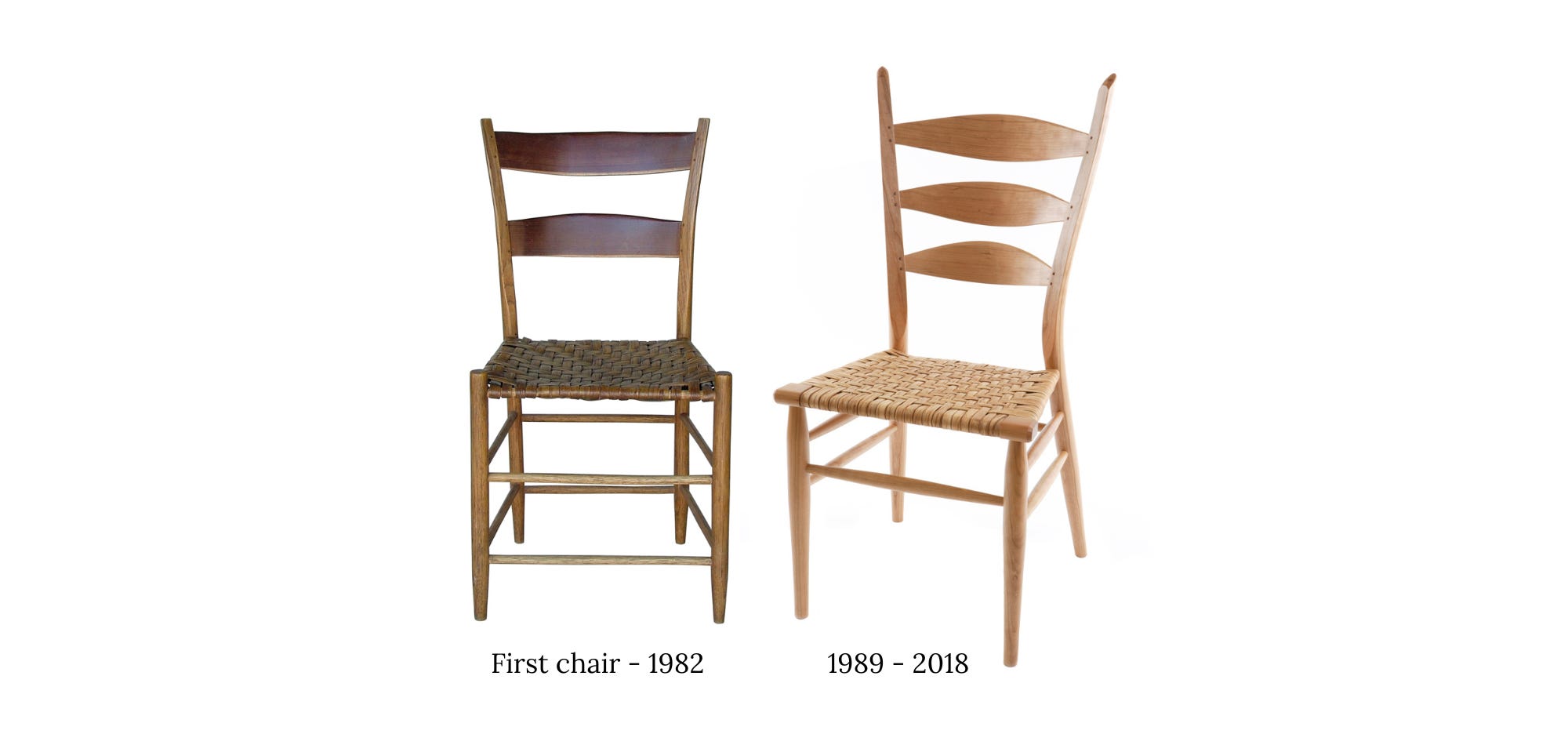
The forms evolved over time, but the underlying lessons remained the same.
I never thought of those early ladderbacks as “my” chairs in the sense of inventing something from nothing. They emerged from years spent studying vernacular post-and-rung forms, working within greenwood traditions, and trying to solve practical and aesthetic problems through making. Over time, certain details, structures, proportions, and ways of thinking became recognizable enough that others began referring to them as “Boggs chairs.” Personally, it felt like I was becoming part of a tradition, not inventing or designing new concepts.
When I eventually redesigned the ladderback form into what became the Cio chair (pronounced chee-oh, and derived from the Latin idea of revival or renewal), many people saw it as a dramatic departure from tradition. In some ways it was. The engineering became far more sophisticated. The joinery evolved. The ergonomics became more precise. I began incorporating veneered structural components and eventually developed lightweight composite-reinforced seats using linen fiber and bio-based resins.
But in another sense, the thinking never changed at all.
The work still begins with fibers.
It still begins with understanding how materials behave structurally. It still depends on learning how strength moves through a form and how a chair relates to the body sitting in it.
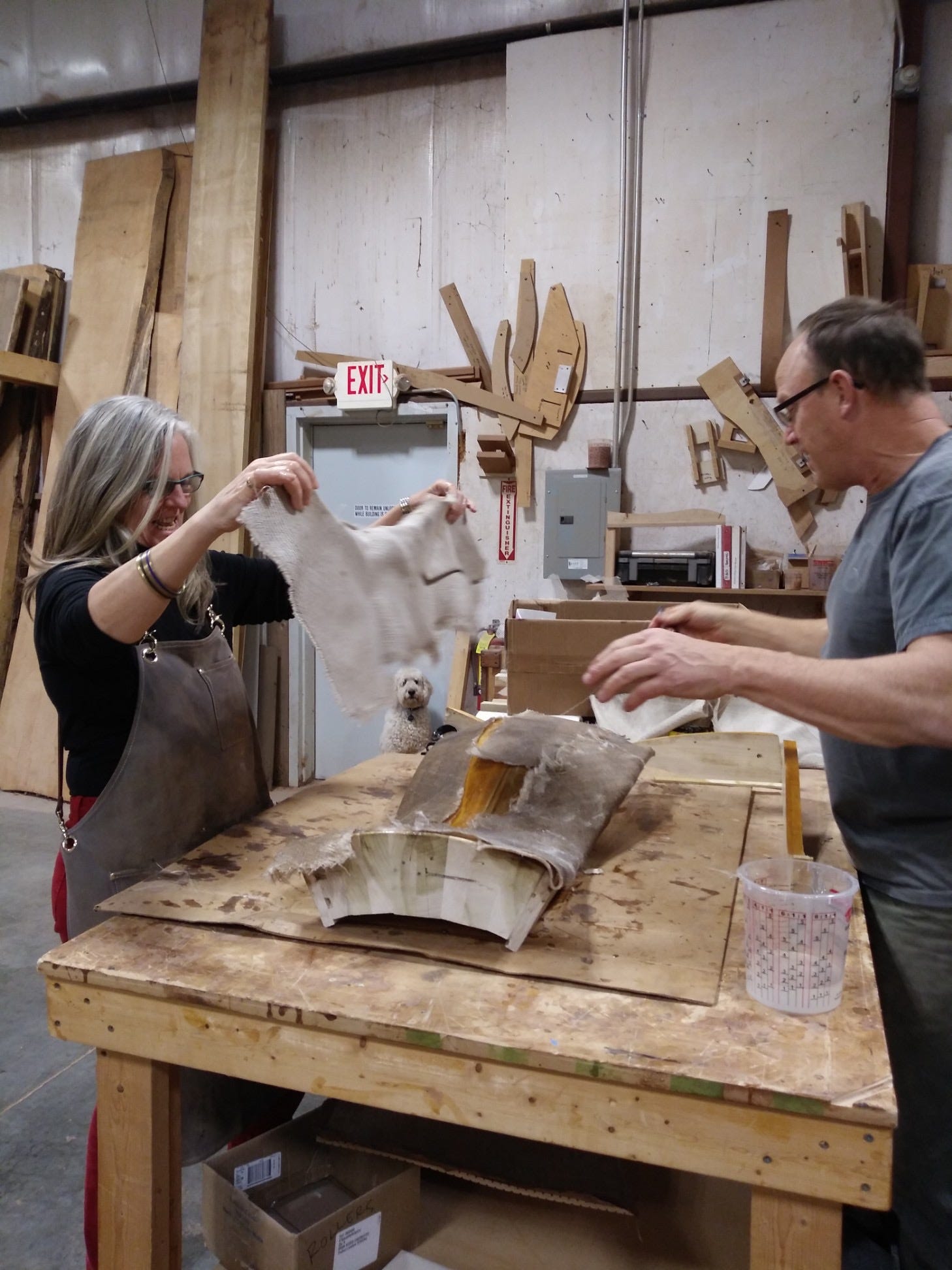
My wife, Melanie and I, experimenting with linen fiber and bio-based resins after hours while working through a new chair design.
Ironically, after all these years, some of my newest work has brought me full circle. The linen composite we use in our seats is fundamentally fiber-based construction. In a strange way, after decades of refinement and experimentation, I’ve found myself returning to something not so far removed from the bark seats I spent decades weaving. The linen is actually made from the bark of the flax stalk, a technology that allowed Alexander the Great to protect his soldiers with lightweight armor some 3000 years ago. I have not left traditional chairmaking. I am carrying my understanding of it into broader explorations. I am using old ideas in new ways.
That continuity means something to me.
People sometimes assume that craftsmanship advances by leaving older ideas behind. My experience has been almost the opposite. The deeper I go into design and engineering, the more I find myself returning to the foundational lessons that came from splitting wood by hand and paying attention to what the material was trying to teach me.
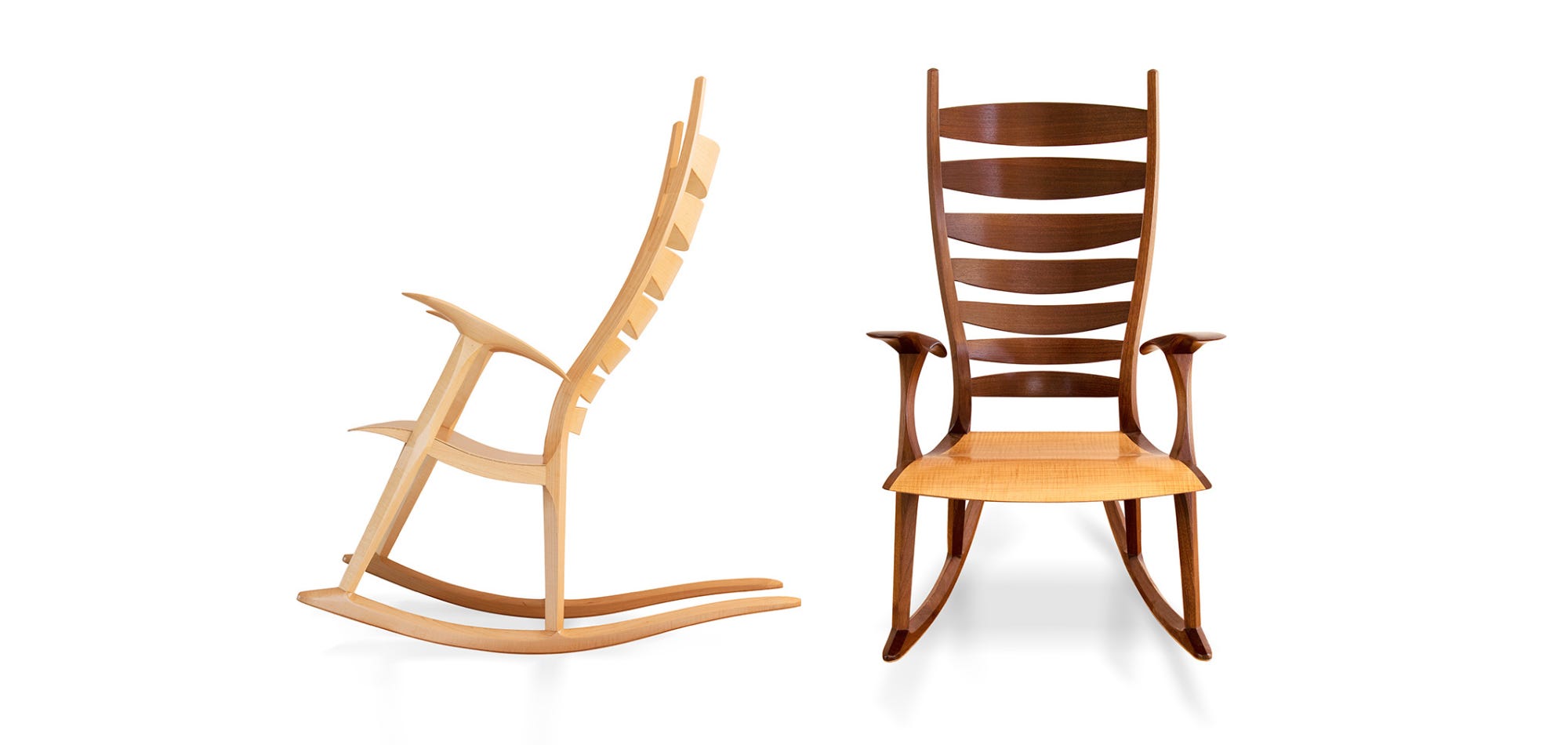
Two views of the Cio rocker in different wood species.
Those early chairs were imperfect, and so are the ones I make now. The exploration has broadened, but the early traditional grounding still guides my creativity and shapes my perspective. And I am still stumbling upon new ideas for how to make a chair.
From the Bench — Brian Boggs
For those interested in the broader Appalachian chairmaking tradition that shaped much of my early work, here is a Kentucky Educational Television interview filmed with Loyal Jones in the mid-1990s. Watching it again, I was struck by how many of the same ideas I’m still wrestling with today were already present then. (aprox 6 minutes long)


