
Editor’s Note
This essay first appeared in Popular Woodworking Magazine in 2009.
At the time, I had already been teaching chairmaking and furniture design for nearly twenty years. Since then, I’ve spent another seventeen years designing furniture, teaching students and employees, and trying to understand where ideas actually come from.
My answer today is much the same as it was then. If anything, experience has only reinforced it.
Many makers spend so much energy trying to be original that they never become receptive. Originality isn’t something we manufacture through effort. It arrives when we develop the skills, attention, and humility to attract it. When the love of what we do drives how we develop, we can become an idea magnet and a partner for ideas that are looking for physical manifestation.
For newer subscribers, this is where a lot of what I teach begins.
I have been teaching classes on designing chairs since 1989, and it’s always interesting to watch students’ creative process. I like to keep my classes as fresh as I can for my own benefit, if not for the students’ so I plan each class a bit differently. Still, every design class seems to run into the same wall. This wall appears in the form of the question “How do we come up with good design ideas?”
While there are guidelines for evaluating a design, the process of generating a new design idea seems more elusive. What is a new idea anyway? How do you make it appear?
As I watch students struggle to give birth to original forms for beautiful and comfortable chairs, I often see the struggle to create something original getting in the way of great ideas. While I don’t design chairs without a lot of effort, there is a conflict between thinking hard to solve a problem and being genuinely creative. It is this creativity element that seems difficult to “put to work” when faced with a challenge of designing something new or “original”.
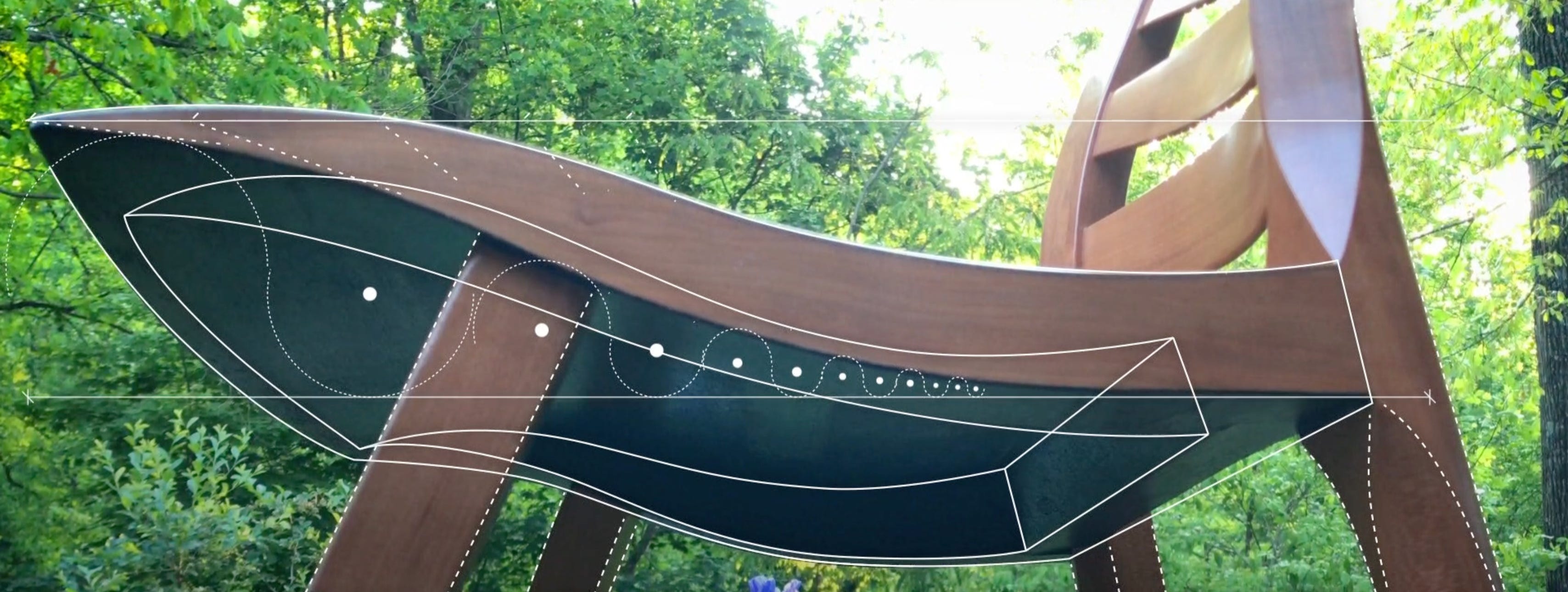
Designing something light strong and still comfortable will challenge even fairly advanced furniture makers. For me, answers to these challenges seem to emerge in the process of sketching, not so much as a result of the lines I lay down on paper. Ideas seem to take form best when my thoughts allow them to, not because I “think of them”. I initially get a little activity or tingle that takes shape after thinking about what need I am wanting to meet with a new piece. As my vocabulary of joinery advances my range of creativity expands as well since any incoming design has more forms it can take. Increasingly I am getting ideas for designs constructed unlike any traditional furniture. The Sonus guitar and Lily chairs are examples as are the Lily table and our new outdoor chair.
While these designs did take their form on my bench, I see my role more as a midwife assisting a birth than as an architect “designing” a structure. The creative process flows best when my thoughts retreat to give it space and allow me to facilitate its arrival without deforming it with ego. Like in the birthing process, the baby is not the achievement of the midwife, it’s just a baby arriving. The more I learn about how to shape, join, and finish wood, the greater my ability to facilitate these design arrivals without having to deform them to fit my limited repertoire of options. Good design development is an amazing process to experience when it is genuine and the results are enjoyed by everyone who encounters them. My signature on the bottom, just means I facilitated its arrival.
The term original does have a place. For me original design refers to a craftsman tapping into the original source of creativity, not taking credit for being the source of the creativity. What is important in this distinction is the recognition that good ideas and creativity come through us, not from us. We are not going to “think up” something brilliant. At best we let it happen by being present and available to it. It’s a much lighter experience and a whole lot of fun.
Periodically, I think back on this idea as a devil’s advocate and wonder, is any of this really true? And how can I effectively share this so that other folks can find it useful? For me it doesn’t really matter if this is “true” in the sense that it can be proven. It is true for me in the sense that holding this as how life works has taken me from feeling lost when I need a new idea to working with this source, whatever you want to call it, like an old friend. When I show up, it’s there waiting.
From the Bench –
Brian Boggs


