
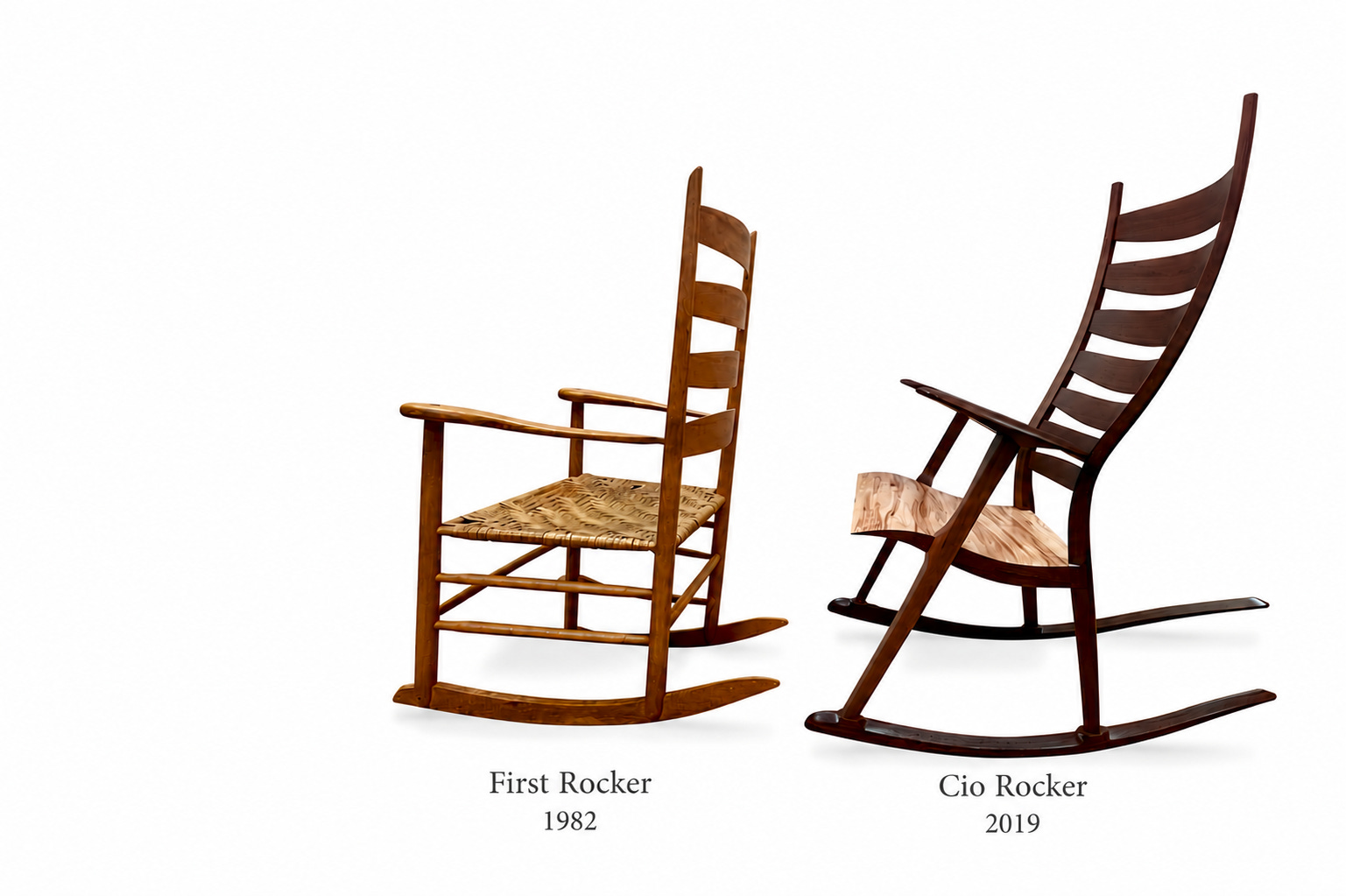
For four decades I’ve believed a joint should tell the truth. If a mortise and tenon holds a chair together, you should be able to see it do that work: the shoulder line, the pin, the grain running through the connection like a sentence that resolves. That belief shaped nearly everything I designed. It solved a structural problem and gave me the look I wanted, in the same cut, at the same moment. I never had to choose between the two.
I’m revisiting that assumption right now, in a redesign that has consumed me for weeks.
Then I realized we’d been doing something very similar for years.
Every time we build a tabletop. Veneer wraps a substrate nobody will ever see: a torsion box doing plain, unglamorous work underneath a face of curly maple or bookmatched walnut. We don’t call that dishonest. The surface carries the figure, the color, the light. The structure underneath carries the load. They’re not the same job, and we made peace with separating these roles a long time ago without thinking twice about it.
I’ve just never consciously applied that thinking to a joint.
I want to be careful here, because the easy version of this idea is wrong. I’m not talking about letting a hidden structure get sloppy because no one will see it. A hidden joint still has to be beautifully executed: every shoulder square, every tenon cut to the exact thickness the mortise wants, every glue line as tight as if a client were going to run a thumbnail across it. The standard doesn’t drop. What changes is what the standard is for.
A visible joint has always had to satisfy two demands at once: hold on tight, and look just right. A hidden joint only has to hold. That sounds like it should be easier. In practice it’s a narrower, harder discipline: precision with no audience, and no pleasing line left to hide a compromise behind.
What it opens up is a category of decisions I’ve never had access to before. The surface can say one thing. The frame inside can do something else entirely, unconcerned with whether it reads as beautiful, only with whether it’s right. Separating what you see from what holds it together isn’t a shortcut. It’s a different design problem, and I’m only starting to understand its potential.
I actually have used this separation of roles in a chair before. The Cio chair sports a strange combination of hemp composite, veneers, and solid sawn curves to separately accomplish several critical tasks: sawn curves for comfort, hemp and core veneers for structural integrity, and surface veneer for beauty while supporting structure.
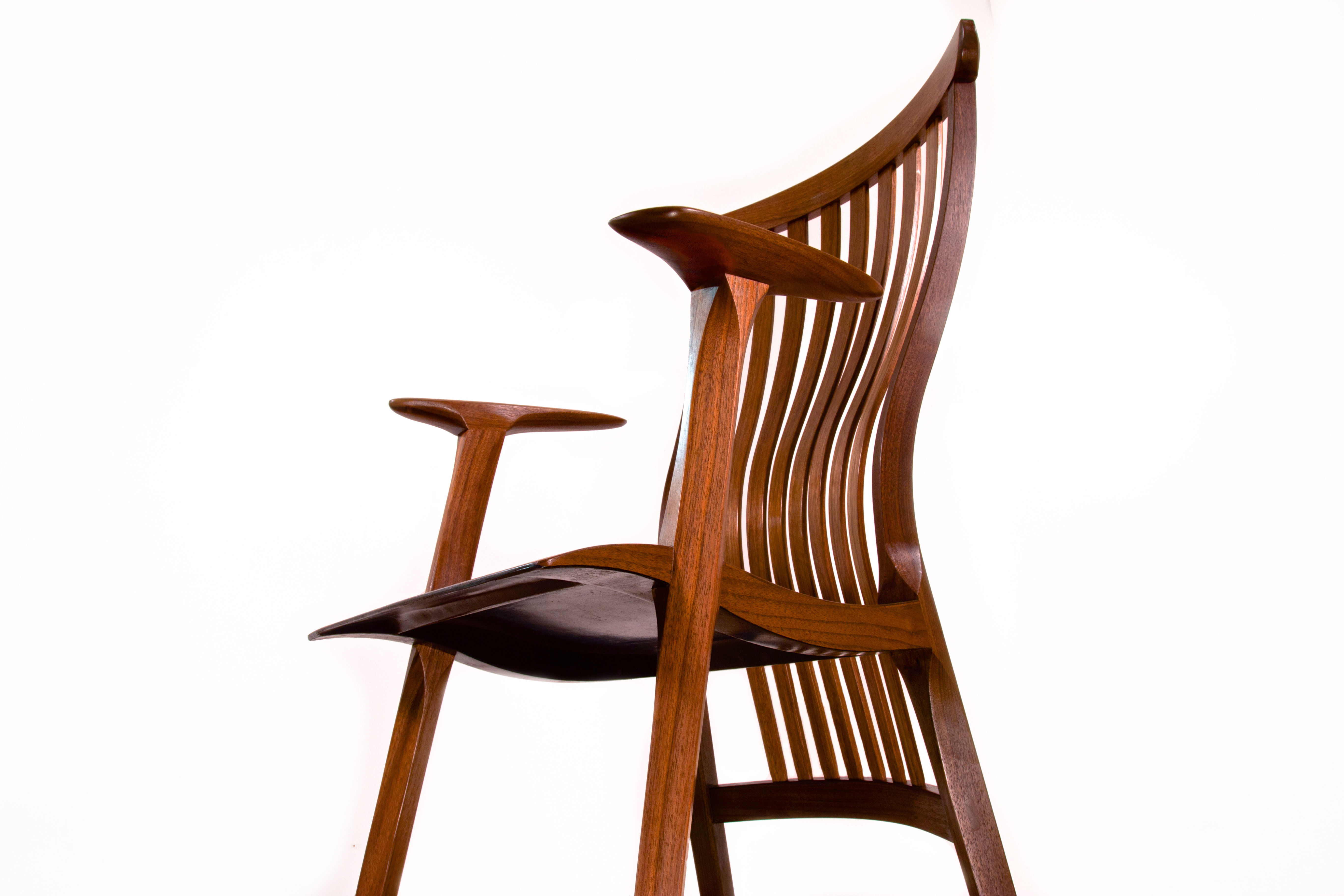
The Cio Sculpted Fanback uses solid wood, hemp composite, and veneer, each doing the work it’s best suited to do.
Long before humans made furniture, the natural world was busy developing designs with all kinds of composites. Bird and insect wings, turtles with shells protecting their vulnerables and providing a hiding place, and porcupines with weapons as fur. Examples are everywhere, including our own bodies. That it felt like a question at all to think this way about furniture design demonstrates the power of traditional thinking and dogma and how right and wrong (honest and dishonest) get to be defined by historic patterns of work rather than from considering the whole of life on earth.

Nature separates structure and function without apology.
That word—honesty—didn’t arrive on its own.
I’ve been calling this a question of honesty. I’m not sure that word earned its way into the conversation on its own. The term “honest craftsmanship” landed in my psyche in the 90’s thanks to Thomas Moser furniture’s branding machine. I’ve noticed that language ever since, in manufacturers’ branding and in other studios’ own words about their work. The term found a place to rest in my awareness like a parasite, feeding a back-seat question about how honest a certain design element or wholesale approach might be. This parasite gets fed by would-be clients (and other makers) who question my move toward more technically sophisticated furniture, as though the post-and-rung vernacular had somehow become the default image of “honest furniture.”
I’ve watched people who knew my early work take a new look at what I make now. Mostly, that response has been generous. But I get enough pushback from stalwart traditionalists to prove there’s real tension between exploratory design and good old honest handmade furniture. Some appreciate the trail I took. Others look at me like I’ve left the tribe. Like I betrayed the traditional clan I came into this craft through. Of course I should expect this. I even appreciate what feeds it. I benefit from asking the same questions as I rethink designs. Not questions about “honest” furniture. The real questions for me are: Am I working with the wisdom my traditional background gave me? Or am I letting an egoic attraction to something cool crowd out the judgment that knows what actually comes next?
Terms like “honest craftsmanship,” “handmade,” and even the modernist mantra “form follows function” may all be true. The problem isn’t their truthfulness. It’s their familiarity. Repeated often enough, they stop inviting curiosity and instead become labels that reassure us we already understand what we’re looking at. Rather than opening a thought, they close it.
That’s why this language works so well for branding conventional work. It reassures rather than challenges. But truly original design asks us to suspend our conclusions, and these familiar labels encourage precisely the opposite. Over time, that same numbing familiarity lets our interest in new design go blasé.
We’ve always looked for meaning in what we do, in the things we attach ourselves to, in how we experience a moment. The language we use can open that up. It can also close it down. If honesty is what we want our work to reflect, it will help to get clear about what that honesty is about.
Maybe we need a new word, one that stimulates new thought and reflection.
From the Bench – Brian Boggs


