
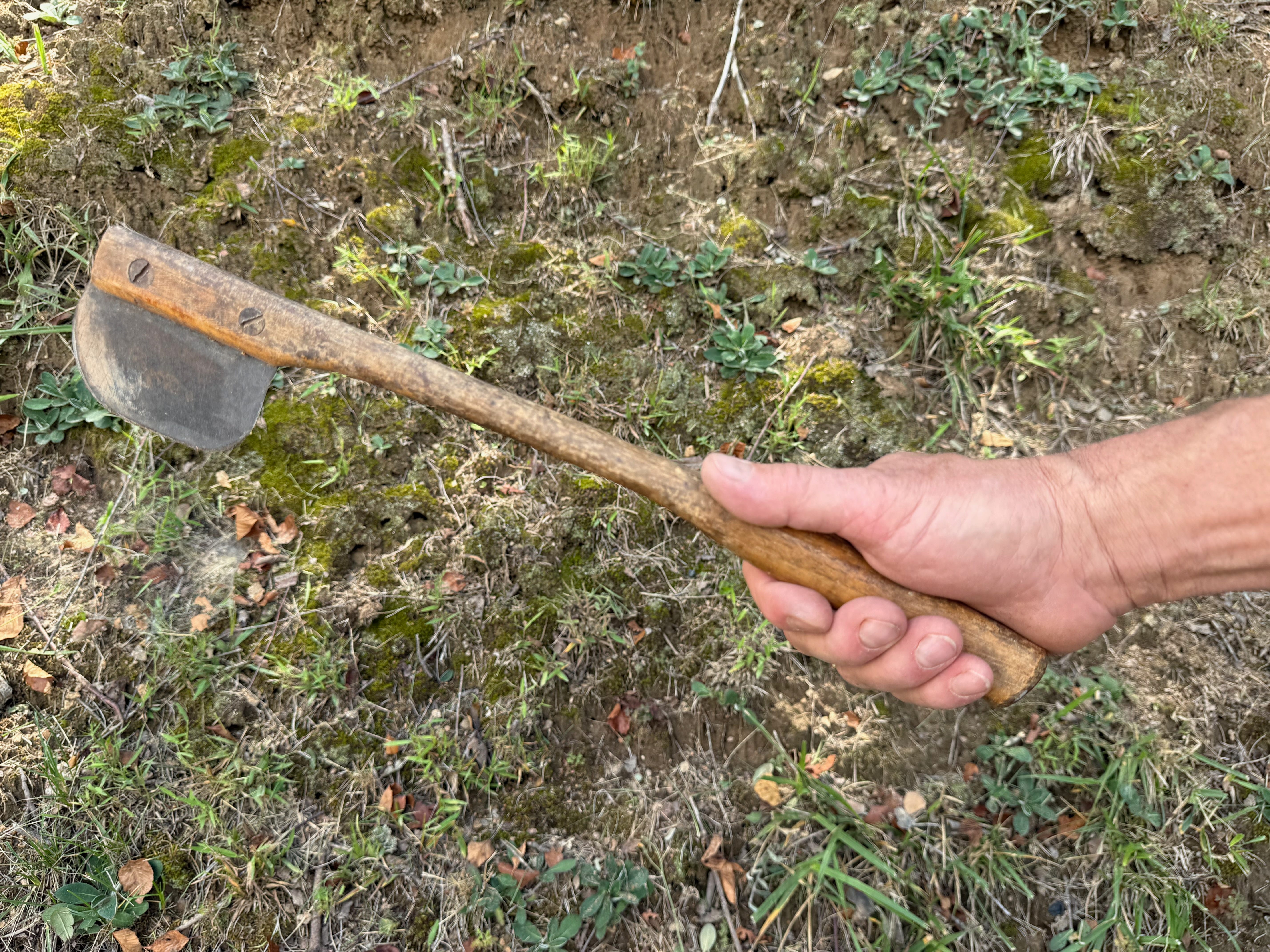
When I was thirteen, I took my first job off the farm where we lived, tobacco cutting. The work was brutally physical. Armed with a crude tobacco knife and a spear, we cut six-foot tall plants weighing ten to fifteen pounds each, speared six of them onto a stick, and repeated the process hundreds of times a day. We were paid just five to eight cents a stick, so every wasted motion hurt.
Years later, after I had begun making chairs, I was still cutting tobacco every season. In those first two years of chairmaking, tobacco cutting provided an important cash infusion. By then I had enough woodworking skills to make something better than the miserable knife I had been using.
So I did.
I carved a hickory handle that was thinner through the shaft, allowing it to flex slightly and absorb some of the shock from every cut. It fit my hand instead of fighting it. The blade was oval instead of square and sharp around the full circumference to avoid incomplete cuts. At the end of the day my wrist hurt less, I worked a little faster, and I realized something that has stayed with me ever since.
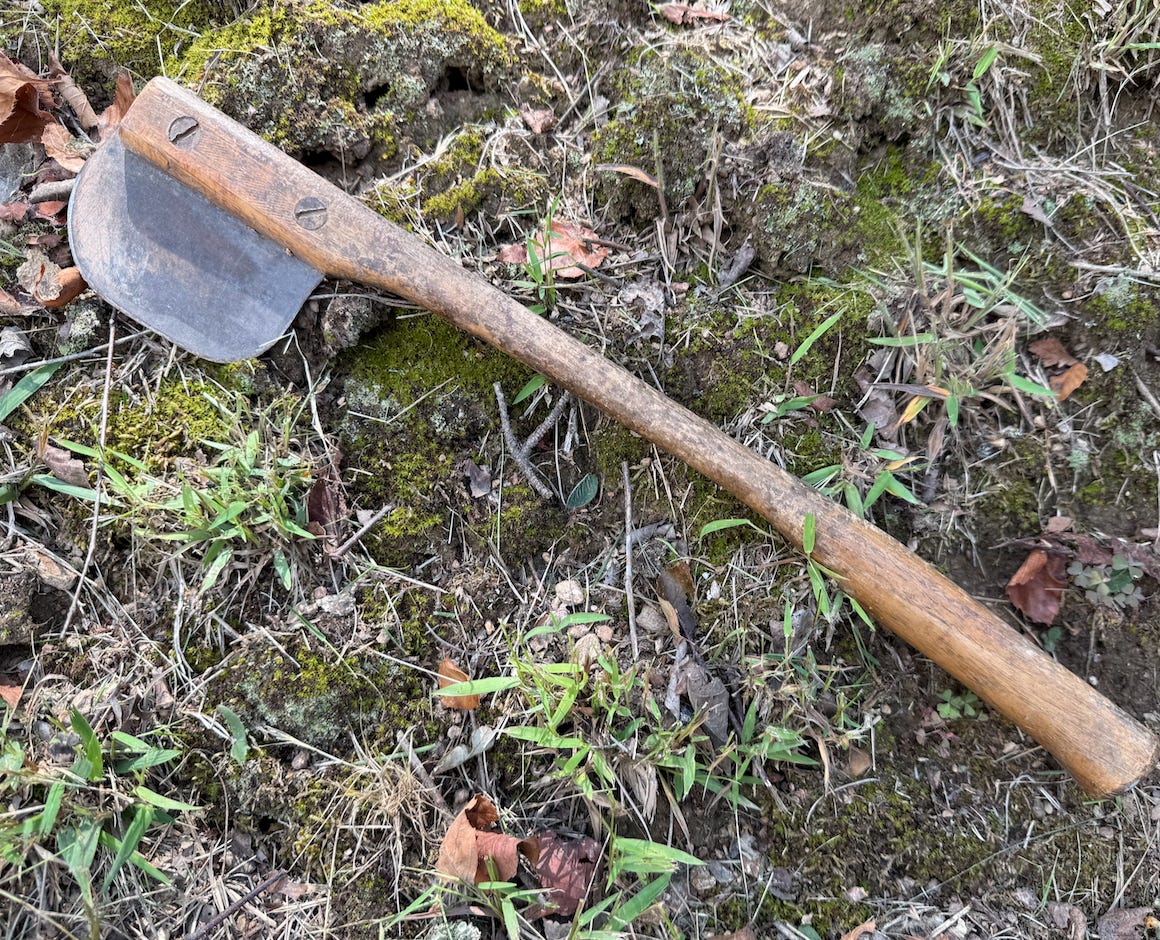
Understanding toolmaking started here for me: my trusted tobacco knife
Around that same time I stumbled across James Krenov’s The Fine Art of Cabinetmaking. I loved the way he talked about wood — about letting the grain lead his eye to harmony in surface patterns. But what really stopped me was discovering that a woodworker could make his own hand planes.
Until then I had assumed tools came from factories.
Krenov suggested something entirely different.
You could build the tool you wished existed.
That idea lodged itself somewhere deep.
Looking back, I think that little tobacco knife did far more than make my work easier. It introduced me to an obsession that has shaped the rest of my life.
A good hand tool can be a game changer. Designed to integrate how our bodies work while delivering our muscle power precisely into the wood, woodworking tools open up a vast world of possibilities. For some of us, the attraction to designing and making tools that do this better holds a power that goes far beyond what is practical.
Seeing what makers are coming out with today gives me goosebumps. I can’t wait to get to Handworks 2026 and start drooling over this year’s showcase of these toolmaker’s art.
My own toolmaking experience has produced a pile of hideous junk with the occasional tool that actually worked. I use the good ones every day. The failures still lurk in drawers, waiting to embarrass me whenever I go looking for something else. Their job now is to remind me what tool development is really like: time-consuming, frustrating, creative…and addictive.
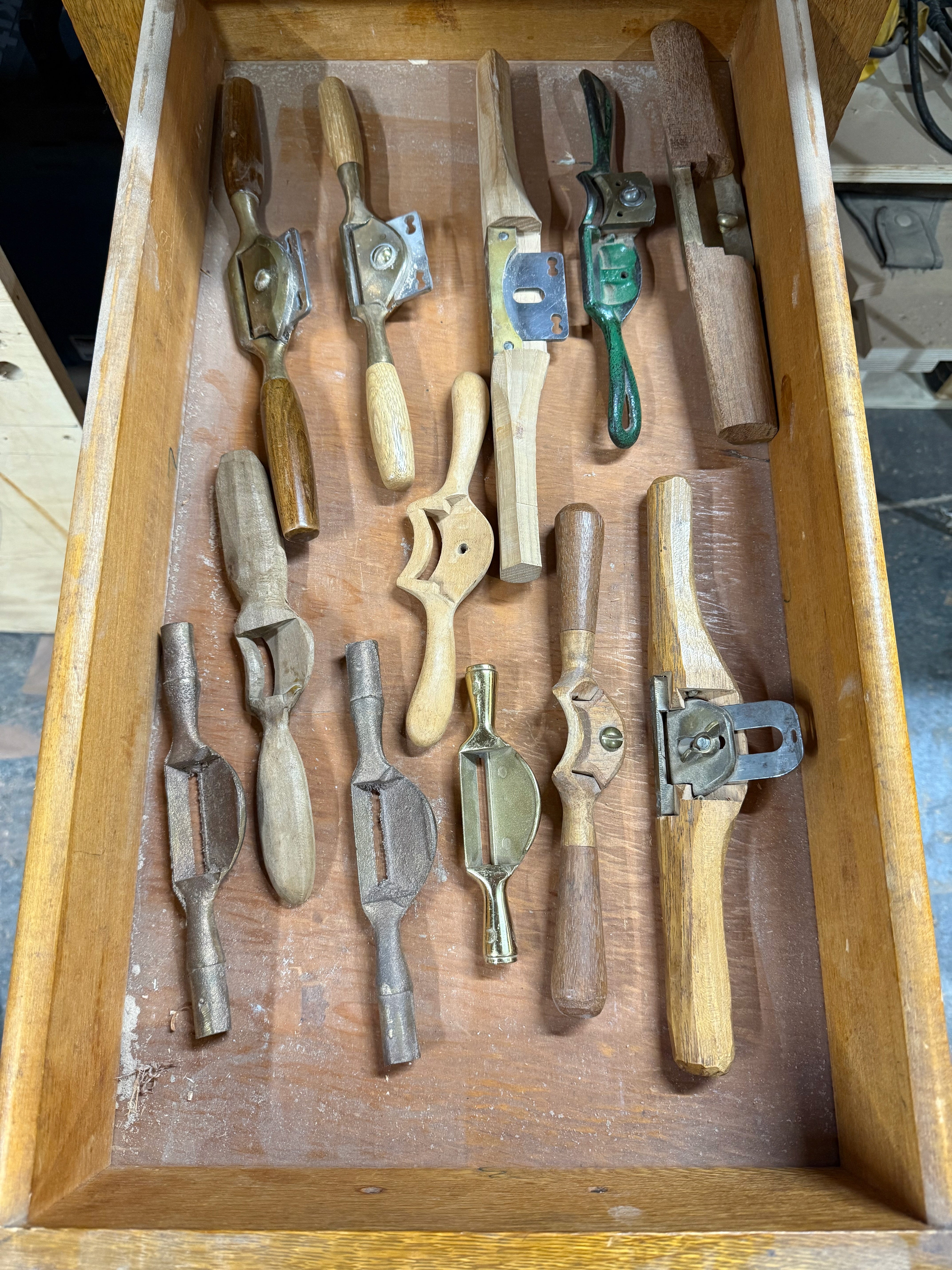
Old reminders of struggle and failure, a toolmaker’s education
The addiction is fed by the tools on my rack that finally became what I had hoped for. Every time I pick one up, the Sirens call me back to the sketch pad in my brain where the next idea is already taking shape. It’s been a while since I brought a new tool to market, so the sketch pad is filling up. The Sirens, meanwhile, seem to be reproducing. I’m doomed.
Not long afterward my grandfather offered to buy me a spokeshave of my choice. I chose a Kunz combination shave because I thought I was getting two tools for the gift of one.
Oops.
That shave chattered so badly that whichever blade I wasn’t using would slowly work its way downward and cut a finger, no matter how hard I tightened the screws. I eventually threw away the straight blade and used only the curved one.
To this day, it’s still the worst woodworking tool I’ve ever bought.
Krenov’s voice in the back of my mind was getting louder. Instead of giving up on the shave, I started trying to understand why it failed.
Over the next couple of years I modified nearly every part of it. I eventually coaxed it into producing whisper-thin shavings and tear-free surfaces regardless of grain direction. But by then I was holding what could only be described as Frankentool: a wooden frog grafted onto the casting, a scrap of brass serving as a cap iron, and enough modifications to make the original manufacturer wonder what crime their tool had committed.
It was also the best spokeshave I owned (the only one).
That realization sent me searching antique tool shops and catalogs, convinced that somewhere someone must have built a truly great spokeshave.
Instead I found decades of evidence that spokeshaves had always been the poor cousins of hand planes — not quite important enough to deserve a toolmaker’s best thinking.
I bought a Record shave hoping for better.
It wasn’t.
So I started making my own.
Wood.
Brass.
Wood and brass together.
Prototype after prototype.
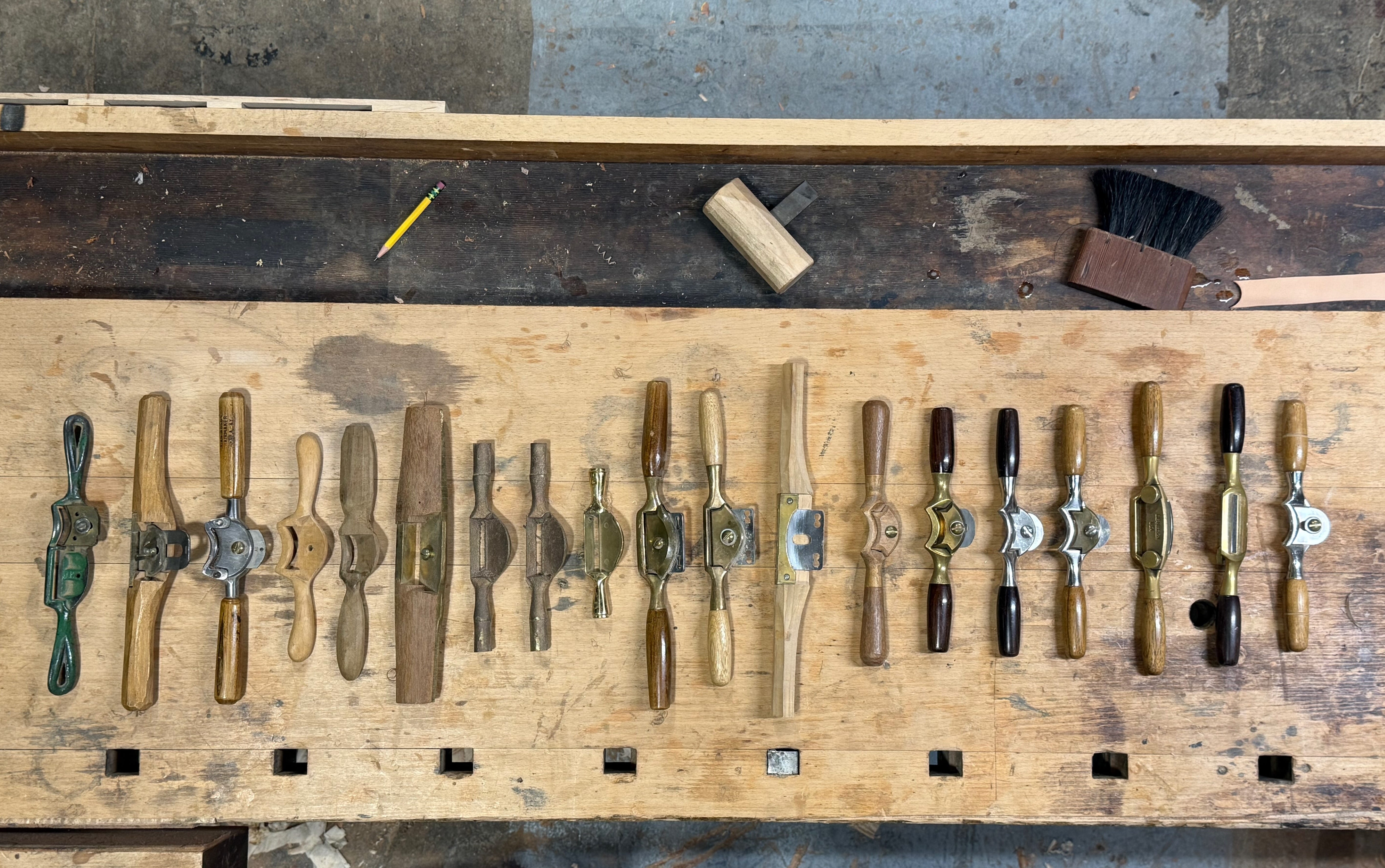
At some point, the lights came on. It’s kinda obvious where
Eventually I took a toolmaking class with Darry Wood at Drew Langsner’s Country Workshops. We built hand planes from scratch, and I learned something every aspiring toolmaker eventually discovers.
Working metal is slow.
Painfully slow.
Making a fine tool requires an amount of patience that borders on obsession.
Apparently, I had already crossed that border.
What I had not done yet was make a great spokeshave.
Just junk.
But now my obsession had been armed with a new understanding. I needed more patience. I needed to let the clock spin longer while I shaped new ideas out of metal by hand.
And by “hand,” I mean a hacksaw, a few files, and a hand-cranked grinder. Okay, I had a drill press too as well as a collection of bits and a few taps. That was my complete toolmaking arsenal.
Even with this new level of patience, I still felt the need to be practical. On my first all-metal shave, I compromised for efficiency’s sake and forced the handles to sit slightly off their ideal location.
It still worked.
In fact, it worked well enough that I have worn all the way through two blades in that shave and am still using the third. But I knew it was not right yet. And with only failures behind me to that point, the Sirens owned me.
The next one will be the one.
Familiar words?
I bought some brass, drew the handle locations where I had learned they needed to be, and took a deep breath. I knew this one was going to take a while. I also knew I could not bear another failure.
So I made it in bite-sized sessions, stopping every time I felt myself beginning to compromise (maker’s fatigue). I made a point to forget how long it took, so don’t ask.
I got the body together, had a blade made for it, and shaped the handle stubs only roughly at first so I could use the tool before committing to the final form. Then I took my time finessing the shape on my hand-cranked grinder.
Cranking with my left hand and holding the tool against the wheel with my right, I became mesmerized by the texture the 80-grit wheel left behind. I decided to let that texture decorate the surface, which meant I had to get the shape exactly right at the grinder.
Then came the cap.
Then the wooden handles.
Then the slow fitting of everything that had to come together before the tool could become what I had imagined.
In my essay on original design, I wrote about keeping an idea intact — about building something true to the form that first showed up in your imagination. When that happens, there is a point where the piece seems to come alive. It begins to breathe.
Some of you know that feeling.
The first time it happened to me was with this tool. I had made hundreds of chairs by now and never experienced it there (yet).
I had never spent nearly as much time making anything as I spent making that shave. Nor had I ever ignored the clock so completely, or held myself so tightly to an imagined form. Something inside me compelled me to make this tool the way some people feel compelled to swim across the English Channel — not because it is practical, but because some barrier has been casting a shadow over their awareness and they had to break through it.
Making that tool was seriously difficult.
But the accomplishment was not just the tool.
It was what happened to me while making it.
Today that shave is still my favorite, even though I have since made, designed, and sold hundreds of spokeshaves that work every bit as well. That one took me through the barrier.
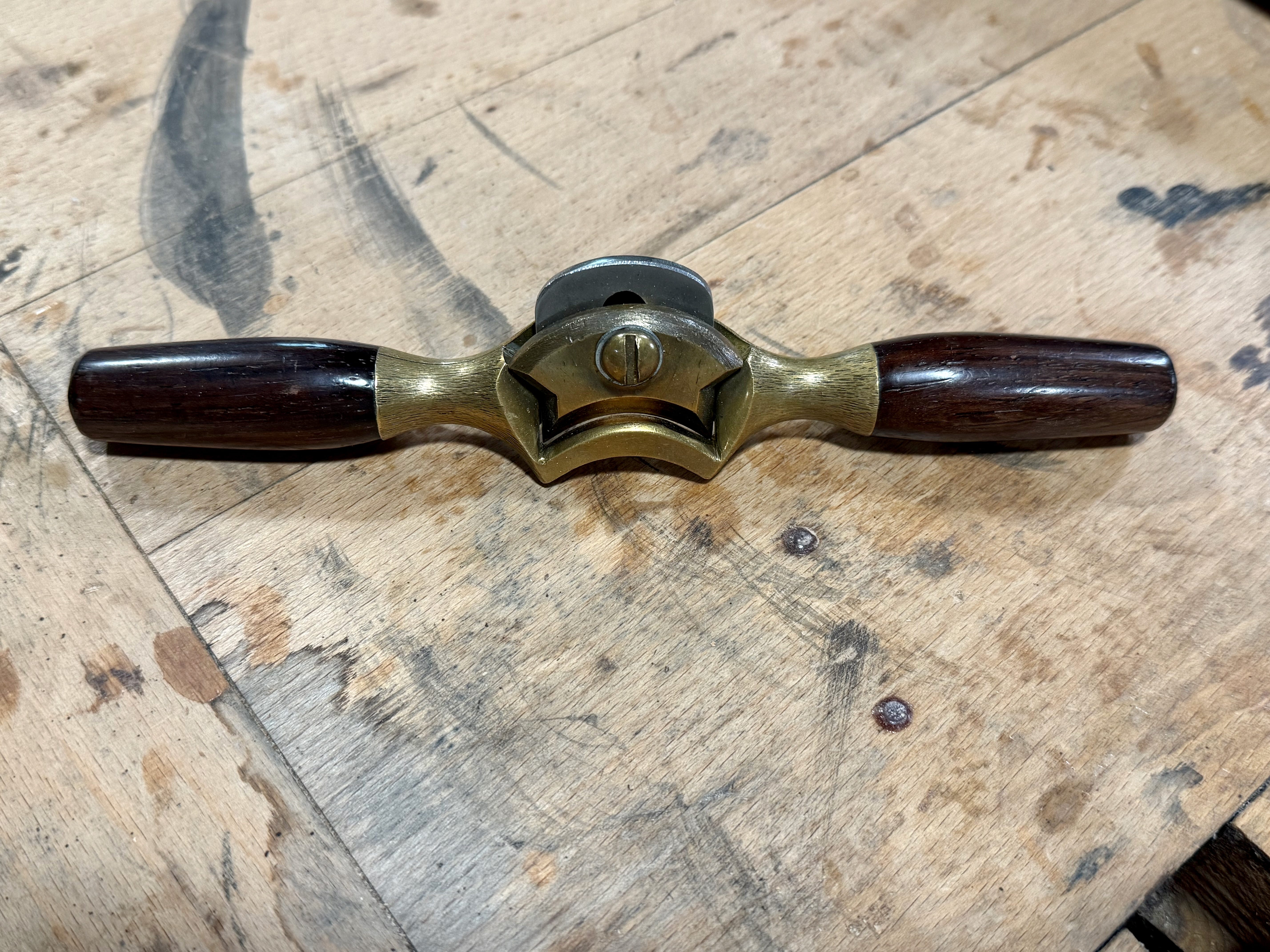
The tool that sealed my fate
Of course, the barrier was entirely imagined. Most barriers that limit us are. But breaking through it opened up more than I understood at the time.
That barrier contributed to the pile of failures I still keep in drawers. Breaking through it gave those failures a different meaning. They were no longer evidence that I was not a toolmaker. They were the cost of becoming one.
That is still how I think about tool development.
The next idea may add to the failure pile. In fact, I am almost certain it will. That is the typical price of finding out what a tool wants to become. But I do not need to learn the same lessons again. I have room for new ones now.
Later, that obsession would lead to collaborations, production tools, and a small tool business of my own. But the real turning point was not when someone else agreed the shave was worth making.
The turning point was when I finally understood that I could take an idea as far as it needed to go.
Not as far as the clock allowed.
Not as far as practicality allowed.
As far as the tool itself required.
That is the part that still has me hooked.
From the Bench — Brian Boggs
P.S. I’ll be at Handworks 2026 this August. If you’re there, please stop by and say hello. I’ll have at least some pieces of what the Sirens have been whispering lately.


