
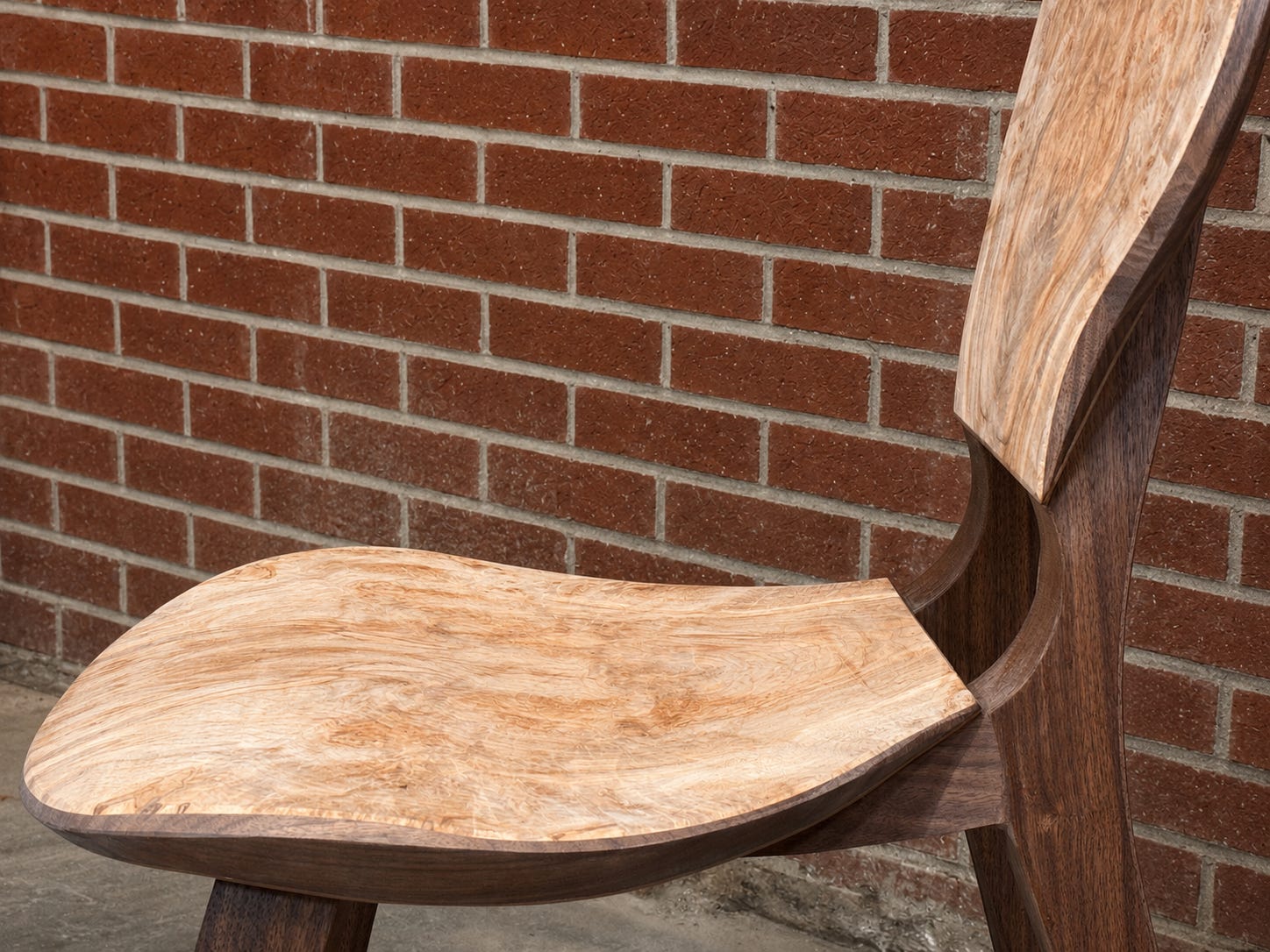
In 2010, Paul Heumiller approached our shop and asked us to design a chair for guitarists.
Paul owns Dream Guitars, a fine guitar store offering handmade instruments from luthiers around the world, both new and vintage. His customers had exacting standards. They appreciated beautiful materials, fine craftsmanship, and the subtle differences that distinguish an exceptional instrument from a merely good one.
Paul believed they deserved a chair made with the same care.
His vision was to offer a chair that spoke to their taste in craftsmanship while supporting them properly as they played. So we set out to define exactly what this chair’s form, style, and ergonomics would need to accomplish.
That took months of interviewing guitarists, watching them play, and building prototypes. A guitar chair presents a surprisingly complicated set of demands. It must support the body without interfering with the instrument. It must allow freedom of movement while encouraging a balanced playing position. And if it is going to share a room with a fine handmade guitar, it should look as though it belongs there.
Eventually, we arrived at the Sonus. In 2011, Paul introduced it in a video on the Dream Guitars YouTube channel.
Before long, Sonus found its way to some remarkable guitarists. Steve Vai, Colin Hay, and Phil Collen each endorsed the chair, helping introduce Sonus to guitarists around the world.
“My butt was molded into wooden butter” – Steve Vai
“I love my new chair! I shall treasure it, and sit upon it, while I ponder my good fortune” – Colin Hay
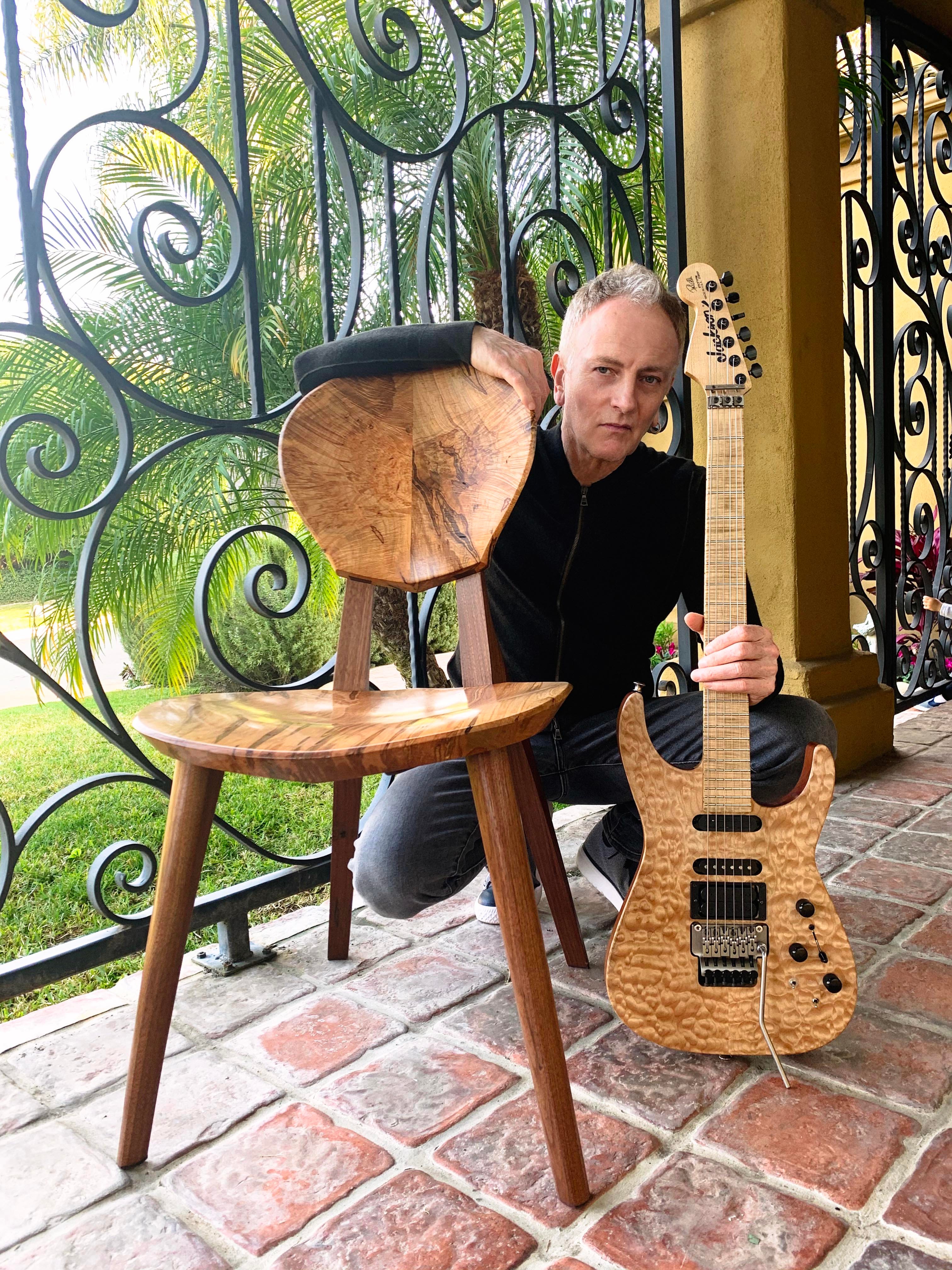
I use it where I do all my recordings, I love this chair” – Phil Collen
Although Sonus was designed specifically for guitarists, we soon discovered that it also worked beautifully for people playing certain other instruments, including mandolin, dulcimer, and trumpet. But something else came out of the design that we had not anticipated.
Once we got things rolling with Sonus, we realized that in solving the particular problems of a guitar chair, we had also designed a remarkably ergonomic chair for everyday sitting. Sonus itself made a great task chair at a desk. One client even got rid of all of his conference chairs and replaced them with nineteen Sonus chairs.
Then came the question that often leads a design somewhere new:
“Can you make these into dining chairs?”
The answer was yes.
We kept the underlying construction of Sonus but gave the chair a different profile better suited to dining. That became the Lily line, which eventually grew to include side chairs, armchairs, and bar stools. Once we made that adaptation, this new kind of seating found a much broader audience.
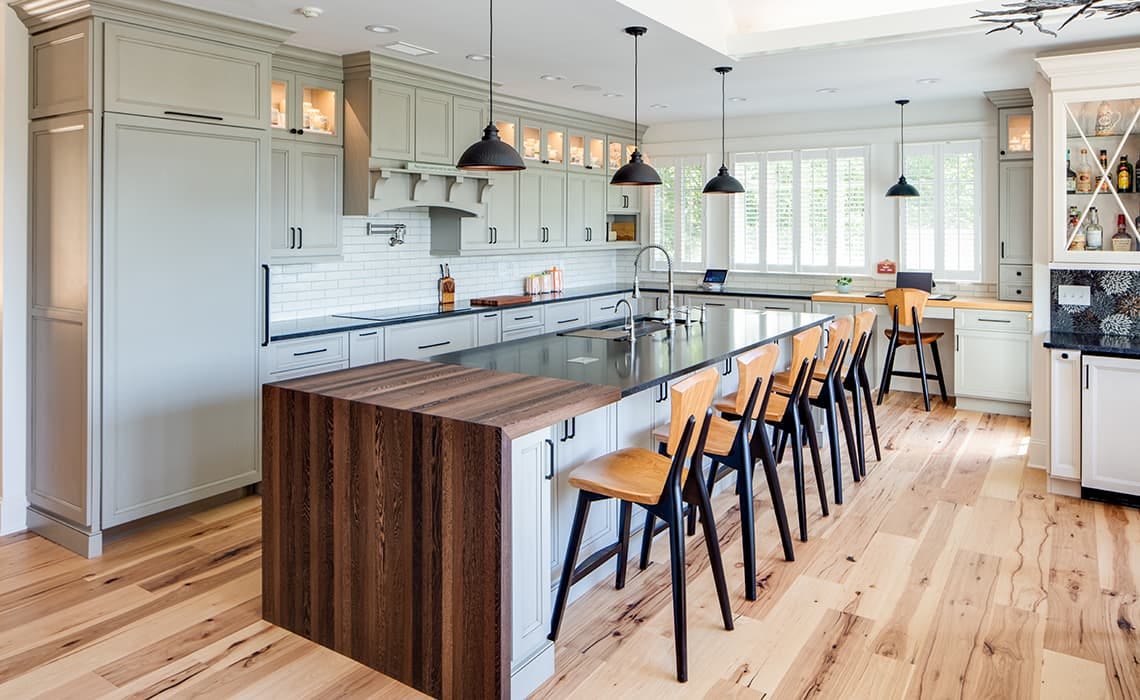
Butternut Lily Barstools with Ebonized legs
Melanie handles our Sonus sales and has maintained relationships with its owners over the years, so she has a much clearer picture of where these chairs have landed than I do. Sonus chairs can now be found all over the United States and in New Zealand, Mexico, Canada, Germany, the United Kingdom, France, Qatar, Japan, Thailand, and other places I never imagined they would reach.
Somewhere in Qatar, a man is playing classical guitar while sitting in a chair we designed and built here in Asheville. The chair began as an idea in our shop; now it supports the making of music halfway around the world. There is something humbling about that. This is the real reach of design: an object leaves your hands and becomes part of someone else’s creative life.
As sales grew year after year, demand eventually exceeded what our own shop could produce. That led us to outside CNC manufacturing. But Sonus occupied an awkward middle ground: its volume was more than our small crew could handle alone, yet ultimately not enough to make sense for a larger manufacturing partner.
For a number of years, the arrangement worked fairly well. We selected the wood and shipped it to our manufacturing partners, who cut the parts on CNC machines. The parts then came back to our shop, where our crew inspected every component, assembled and refined the chairs by hand, and applied the finish. That combination of CNC technology and hand craftsmanship allowed us to produce Sonus consistently at a volume we could never have managed alone.
Then, in October 2025, our manufacturing partner told us that the numbers no longer worked for them. They were dropping Sonus and Lily.
The news set us back on our heels. But there was nothing to negotiate. Sonus sales had exceeded what our own shop could produce, but they still did not generate the volume our manufacturing partner needed. The arrangement was over.
Fortunately, we had ordered a few extra chairs in the final run. After fulfilling our existing orders, we still had a small number left to sell. That gave us a little time, but it did not answer the larger question:
What would happen to Sonus?
Finding another CNC shop and recreating the same arrangement did not appeal to us. The other option was to bring production back in-house. But how could we do that when our plans were to scale the shop down, not up?
We spent months considering alternatives and talking with local furniture makers about a production partnership that might work for everyone. Then, almost improbably, a chairmaker and his crew moved into the same building with us. They were interested in taking on the project.
That solved one problem. It also opened the door to another.
I had wanted to redesign Sonus for years.
I had resisted because I did not want to rock the boat. Clients loved the chair. Sales were good. The project was working. There is always a risk in changing a successful design simply because the designer has learned something new.
But in the fifteen years since I first began working on Sonus, I had learned a great deal more about chair design, ergonomics, and production. I had also developed processes that gave me options I did not have when I designed the original chair.
Bringing Sonus back to Asheville and building it with analog systems meant retooling the entire production process anyway. If we had to begin again, why reproduce a fifteen-year-old design exactly as it was?
This was our chance to make Sonus reflect everything we know now.
The first thing I wanted to improve was the relationship between the guitarist’s body and the curves of the seat and back. Our clients already loved the comfort of Sonus, but I knew it could be better. I also wanted the leg shapes to grow more naturally from those ergonomic curves, so that the structure and comfort of the chair would feel like parts of the same idea.
On the original Sonus, I kept the rear planes of the seat and back flat, though angled, to keep the joinery sane. Curving those surfaces would have created compound-angle and curved joinery that was difficult to execute precisely and repeatedly with the processes available to us at the time.
I can do things now that I could not do then.
New techniques allow me much more freedom to cut precise curves, even where they meet at compound angles. So why not put those techniques to work?
In the new Sonus, the front and back surfaces of the seat and back relate to one another. The legs curve to meet them. The seat has a much deeper contour, borrowed from our Cio chair. The curves of the back also owe something to the Cio, though here they are expressed in solid wood rather than slats.
My shop is currently choking on curved prototype parts that did not hit the mark.
That is part of the process. Each one answers a question, even when the answer is no.
But there is now one chair sitting on the shop floor that is a delight to sit in, and I am mostly happy with the way it looks. The front legs need to be thinned. The lumbar support needs to shift slightly. We are not finished, but we are getting very close to what I had in mind.
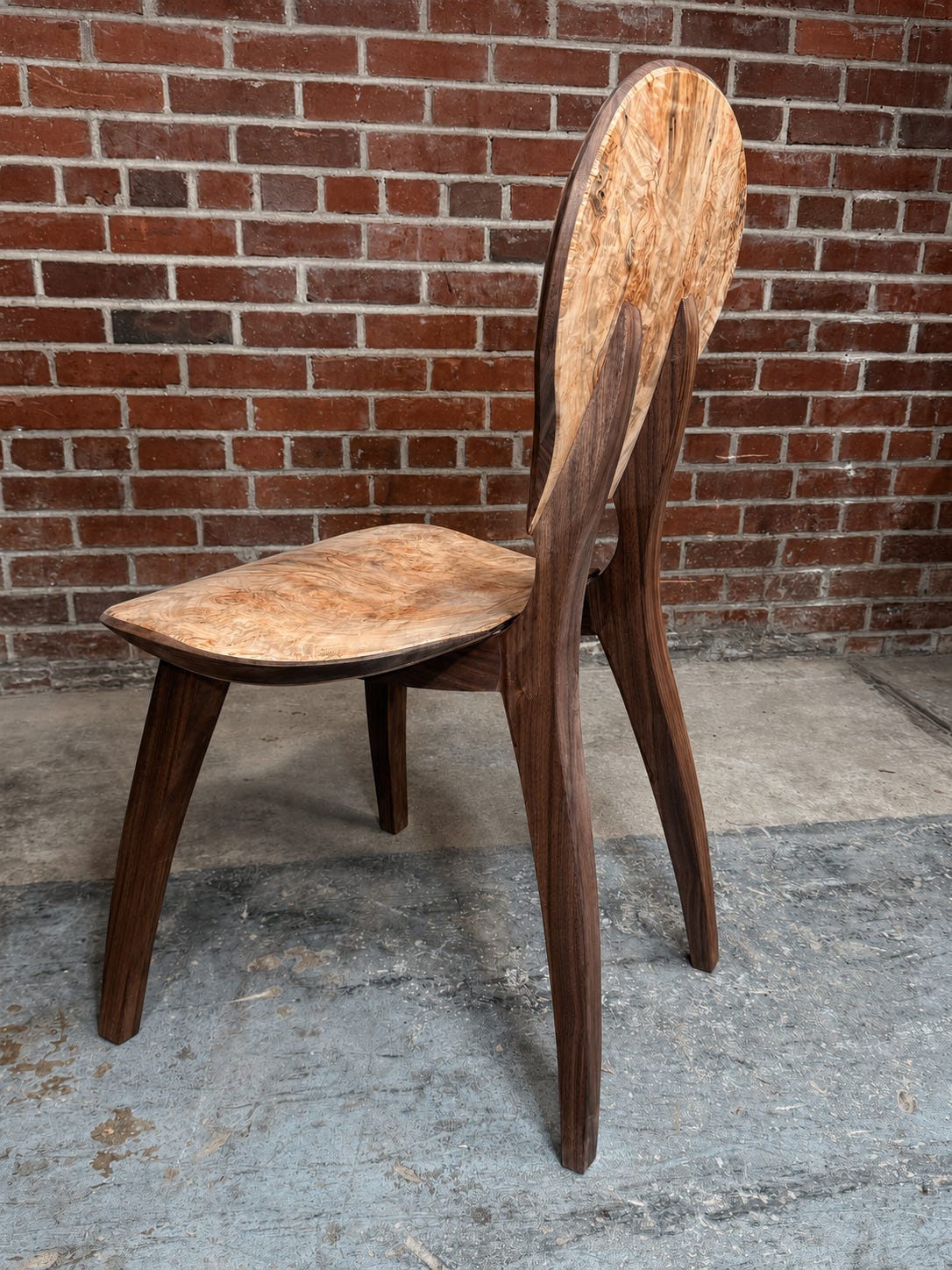
New Sonus prototype
CNC manufacturing is remarkably capable, but a design must still conform to the logic and economics of the manufacturing system. When our previous production arrangement ended, I faced a choice: redesign the chair to suit another manufacturer’s processes, or bring it home and develop analog systems capable of producing the chair I wanted to make.
In the end, I decided to do a little of both.
The new Sonus draws on everything I have learned about designing for production, but its production process is being built around the chair, rather than the chair being built around the process. The purpose is not to reject technology or return nostalgically to some supposedly purer way of working. It is to use the right combination of machines, fixtures, hand skills, and human judgment to produce a chair fluidly, consistently, and locally.
A chair that fits the guitarist.
A chair whose structure, ergonomics, and visual language all tell the same story.
And, if we get it right, the most beautiful chair our shops can manifest.
While the circumstances surrounding this redesign are unique, the design process is not. Nearly every chair I have designed has eventually gone through some form of redevelopment. I find it seriously difficult to continue building a chair, or any piece of furniture, when I know I could make it better by putting it back on the drawing board.
Of course, there is a limit to how often you can do that. Redesign is a huge investment, and it will take time to recoup what we have put into this chair.
But the new Sonus does not stand alone. Because the Lily grew out of Sonus and shares its underlying construction, what we have learned here will carry into the entire Lily line: side chairs, armchairs, and bar stools.
So I am not finished with the design work just yet.
But we have found the new language these chairs will speak, and right now I am loving the voice of the new Sonus.
From the Bench – Brian Boggs
P.S. Orders for the new Sonus guitar chair will open August 1. Ordering details will be available at brianboggschairmakers.com.


