
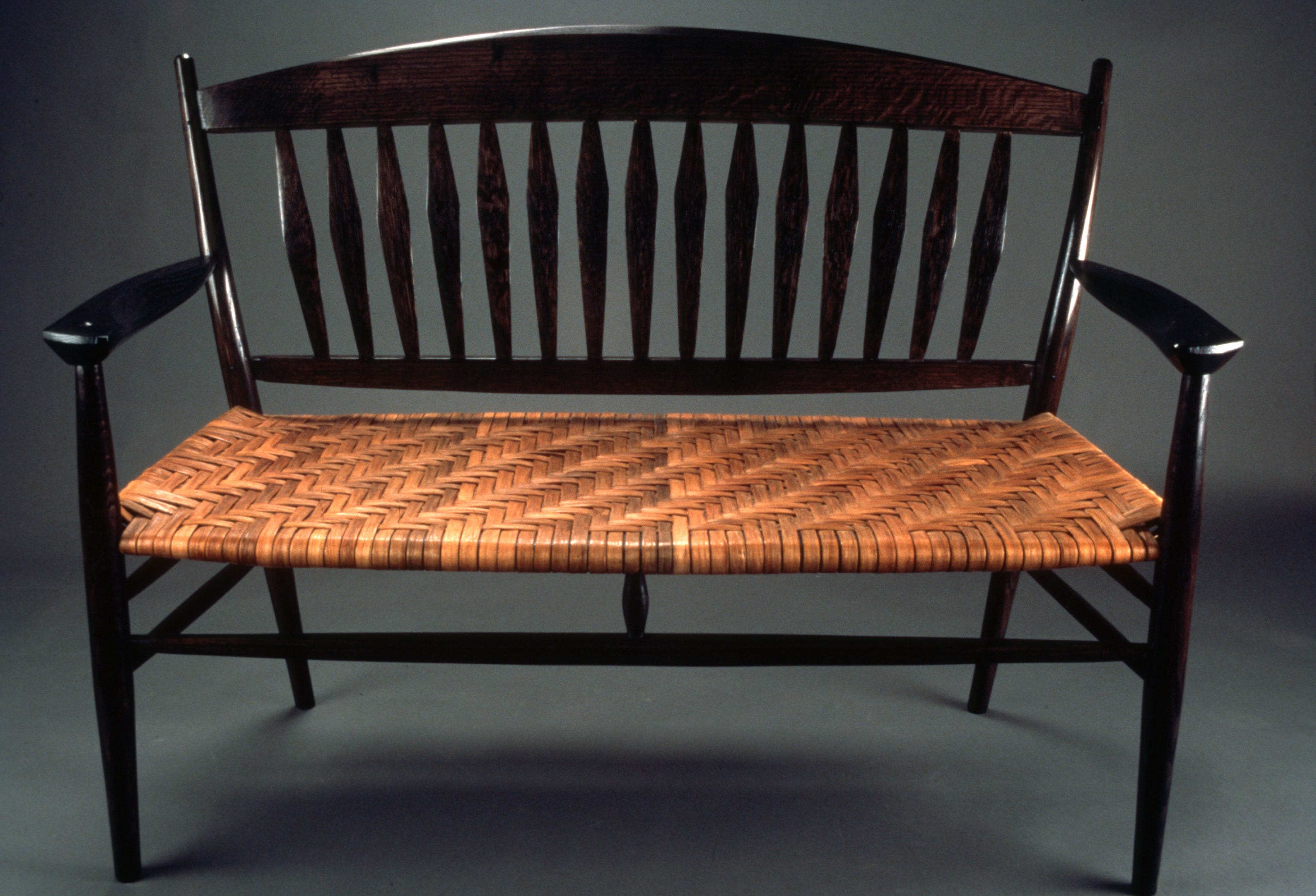
Mid 1990s Arrow Back Settee, Ebonized with Iron – by Brian Boggs
In 1982, not long after I began making chairs in Berea, Kentucky, my next door neighbor James Cooper told me there was somebody I ought to meet.
James called him Little Charlie.
There was nothing little about Charlie. He was a huge man, well into his eighties by then, and even at that age gave you the impression that he was probably not somebody you wanted to cross.
James took me out to Charlie’s cabin in the woods. Charlie knew I was coming to talk about chairmaking.
But first he wanted to show me his raccoon trap.
He set it in his lap, triggered it with the edge of one hand, and pulled his hand away just before the trap snapped shut.
Apparently that needed to happen before we could get down to chairs.
Then Charlie talked.
He had begun making chairs in the 1920s. He sold them beside the road for six dollars apiece. If someone brought him an old chair that needed a new woven seat, he charged fifty cents.
Some of the methods he described were things I had already read about as old ways of making chairs. But Charlie wasn’t talking about history.
He was talking about work.
They were simply the methods he had used when that was how chairs were made where he lived.
That changed something for me.
I never saw Charlie again, but I never forgot him.
James had already given me something different.
He had been making chairs for years before I met him. I was just beginning and trying to imagine whether chairmaking was something a person could actually build a life around in 1982.
Having James next door made that possibility real.
James made chairmaking feel possible in the present.
Then he introduced me to Charlie, who made its past feel very close.
I think those two experiences helped give me a sense of belonging before I had words for it.
I didn’t grow up in a chairmaking family. My father’s family, though, had deep roots in eastern Kentucky. Before I began making chairs, I had spent ten seasons cutting tobacco. My first shop in Berea was in my backyard.
Something about the work felt new to me and familiar at the same time.
It was as though I had married into an old family and started learning its stories.
Over the years, some of the people whose work influenced me became friends.
Jenny Alexander was one of them. She had an enormous effect on the way I thought about making chairs. I got to know Jenny well enough that I would make overnight visits to her home and shop in Baltimore. We could argue about a joint or the right way to weave a seat, but it was the kind of argument we both enjoyed. We were both trying to understand the work better.
Jenny came to chairmaking from a very different place than I did. She was a retired lawyer, not someone trying to make a living at the bench. But there was a simplicity to her approach that made the physical work of building a chair feel remarkably approachable.
I owe a great deal to that way of thinking.
That is one of the things I have always loved about this craft. Knowledge comes from so many directions.
It comes from people like James, who simply show you that the life is possible.
It comes from someone like Charlie, whom you meet once and remember for the rest of your life.
It comes through friendships like the one I had with Jenny, where disagreement itself becomes part of the learning.
And it comes from people whose names are long gone.
I have learned an enormous amount from makers I never met simply because something they made survived.
An old chair can tell you quite a lot if you are willing to look at it long enough.
There is history in a bend, in the way a rung enters a leg, in the shape of a tool, in some small solution another maker arrived at because the work demanded it.
Sometimes I understand immediately why something was done that way. Sometimes I have to work with it for years to get the why.
That conversation across time has always fed my own curiosity.
My chairs changed because I felt they wanted to.
My tools changed because I needed better ones.
I wasn’t changing things to separate my work from what had come before. I was trying to solve the problems that kept appearing at my bench.
Over time, the Boggs Berea Chairs grew from that long conversation with the post and rung tradition. I spent decades with those chairs, asking questions and following where they led.
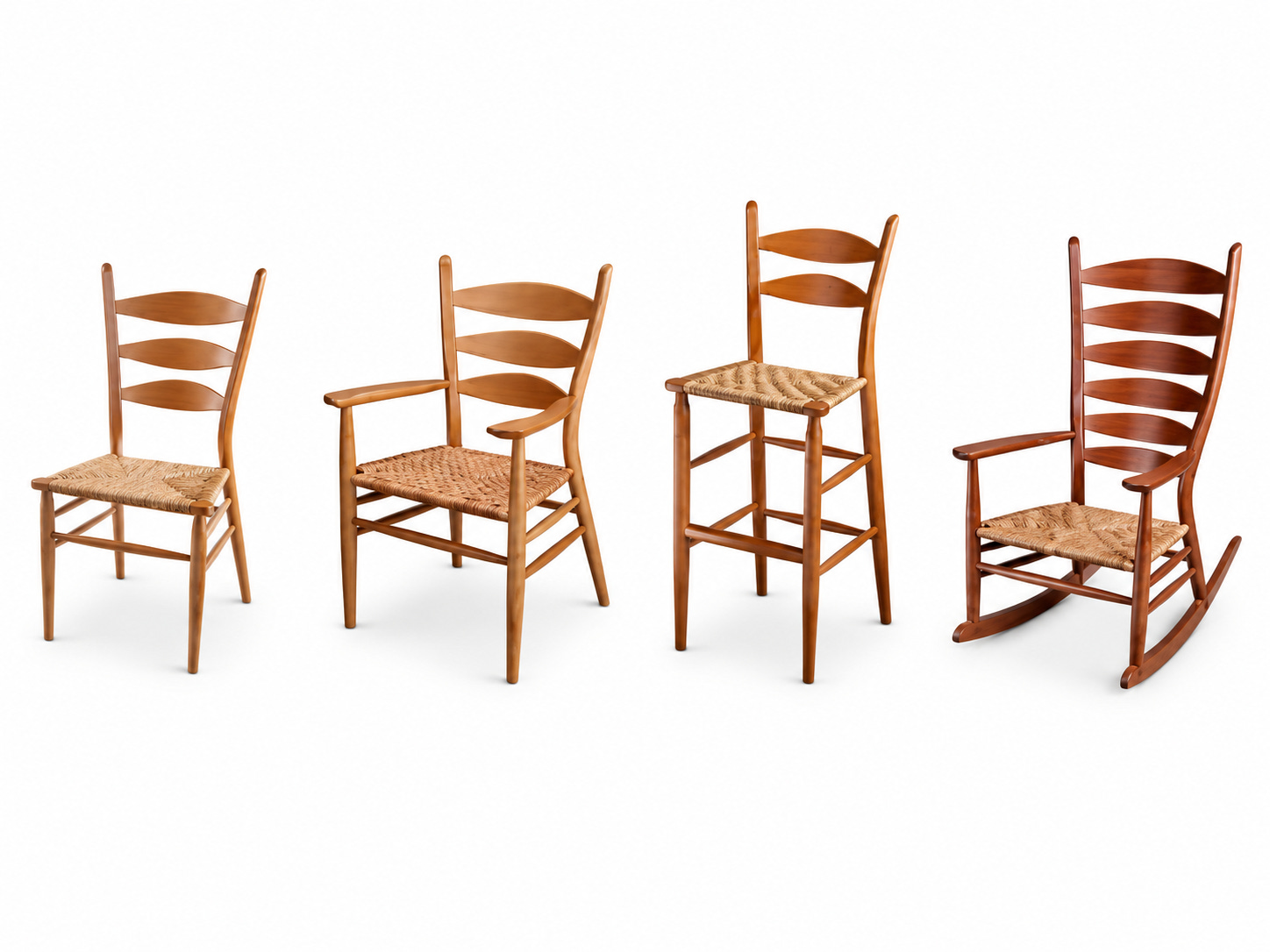
The Boggs Berea Chairs: side chair, arm chair, bar stool, and rocker.
Eventually those questions began leading me somewhere else.
In 2020, I stopped making the Boggs Berea Chairs and opened the designs for other people to make and sell. At the time I wrote that I hoped others would seek to perfect them.
I still like that thought.
Perfecting something does not always mean redesigning it.
There can be a lifetime of learning in simply making something very well.
By then, I had followed those chairs as far as I felt called to follow them. Letting them continue in other hands felt natural.
Last weekend at Handworks in Iowa, I found myself thinking about all of this again.
I ran into former students. I saw Steven James Zbornik, who once worked with me. I talked with chairmakers who are still early in their own work.
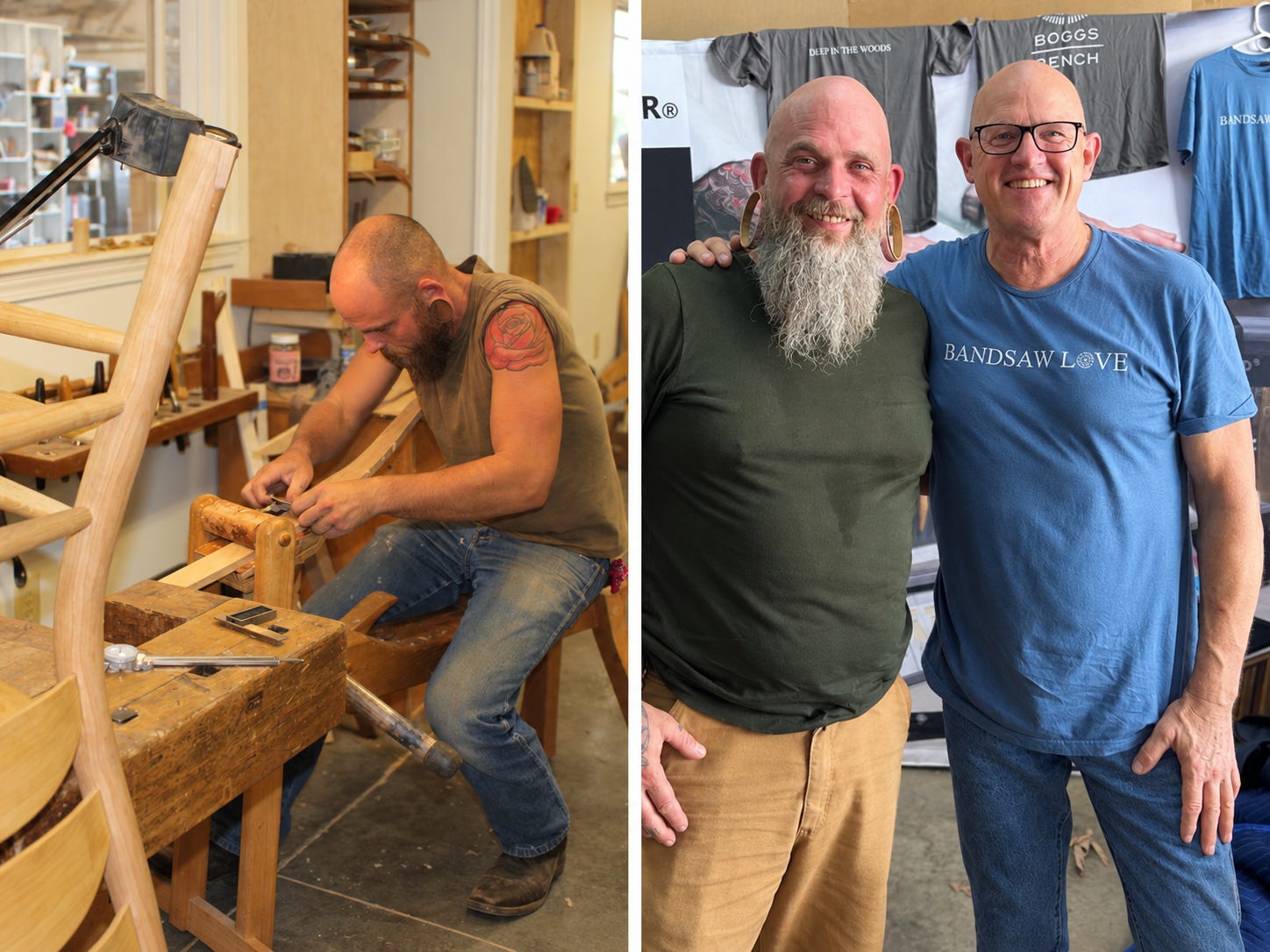
Stephen James Zbornik working in our Asheville shop in 2015, and with Brian again at Handworks eleven years later.
Everywhere I looked, people were showing one another things, comparing tools, asking questions, sharing what had worked and what hadn’t.
Knowledge was moving around the place like it had a life of its own.
It felt like a family reunion. Not everybody knew everybody else. Not everybody worked the same way. Certainly nobody agreed about everything. But for a weekend, there was this wonderful sense that none of us had arrived there alone.
Something about that put forty four years of chairmaking into perspective.
I was once the young man showing up at an old chairmaker’s cabin because I wanted to know how he did it.
Now I sometimes find myself on the other side of that conversation.
More than anything, it made me think about all the people who had made room for me.
They answered questions. They showed me things. They challenged my assumptions. They wrote books and articles. They handed me tools, let me examine chairs, and shared things that had taken them years to learn.
The only way I know to repay that generosity is to keep the door open and pass along what has been given to me.
Seeing that same kind of exchange happening all around me in Iowa felt like watching the craft continue to breathe.
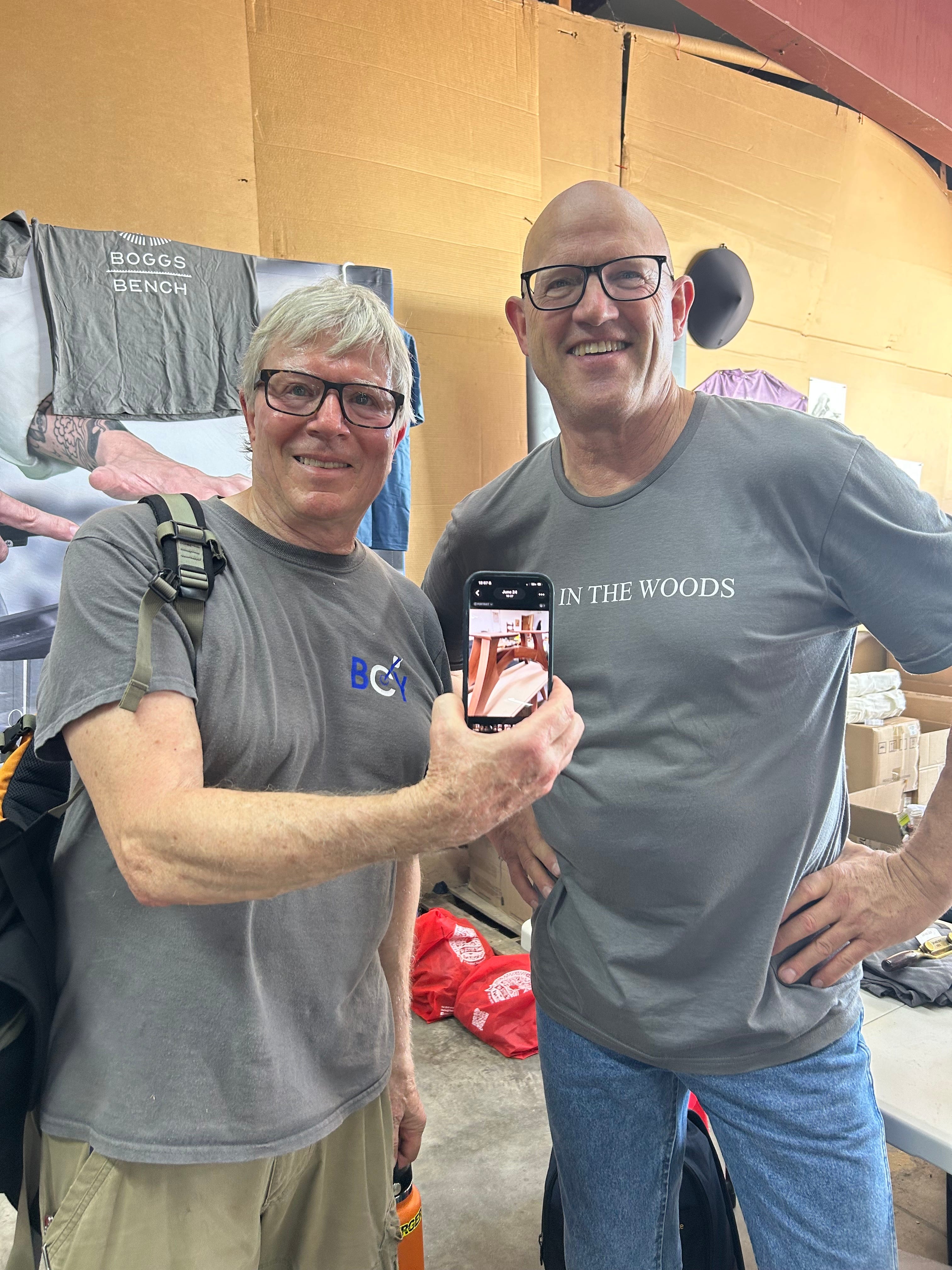
At Handworks, Eric shows Brian the Timber Frame Table he built after taking Brian’s on-line course.
Someone showed somebody something.
Someone heard a story.
Someone went home with a new question.
I have spent most of my working life cultivating ideas in ground that other people plowed before I arrived.
The longer I do this work, the more I appreciate what was already there.
James.
Jenny.
Little Charlie.
The makers whose names survived, and all the others whose hands are still present even when their names are not.
I don’t know what Charlie would make of any of this.
He might think I was making too much out of chairmaking.
He might just set the raccoon trap again.
Either way, I would happily sit down and listen.
More than forty years later, I am still carrying that afternoon with me, along with James, Jenny, and countless makers whose names I will never know.
That is what this craft has given me to carry forward.
Do you have a Little Charlie? Someone who crossed your path, perhaps only briefly, but changed the way you understood your work? I’d love to hear who they were and what you still carry from them.
From the Bench
Brian Boggs
Brian has spent more than four decades learning from wood, tools, mistakes, teaching, and making. He is still at the bench, working, questioning, experimenting, and finding new things to understand and share.
These essays are our way of capturing that ongoing work and putting it into the world.
If you believe this kind of knowledge is worth documenting and sharing, becoming a paid subscriber helps support the work of capturing it while Brian is still at the bench.


