
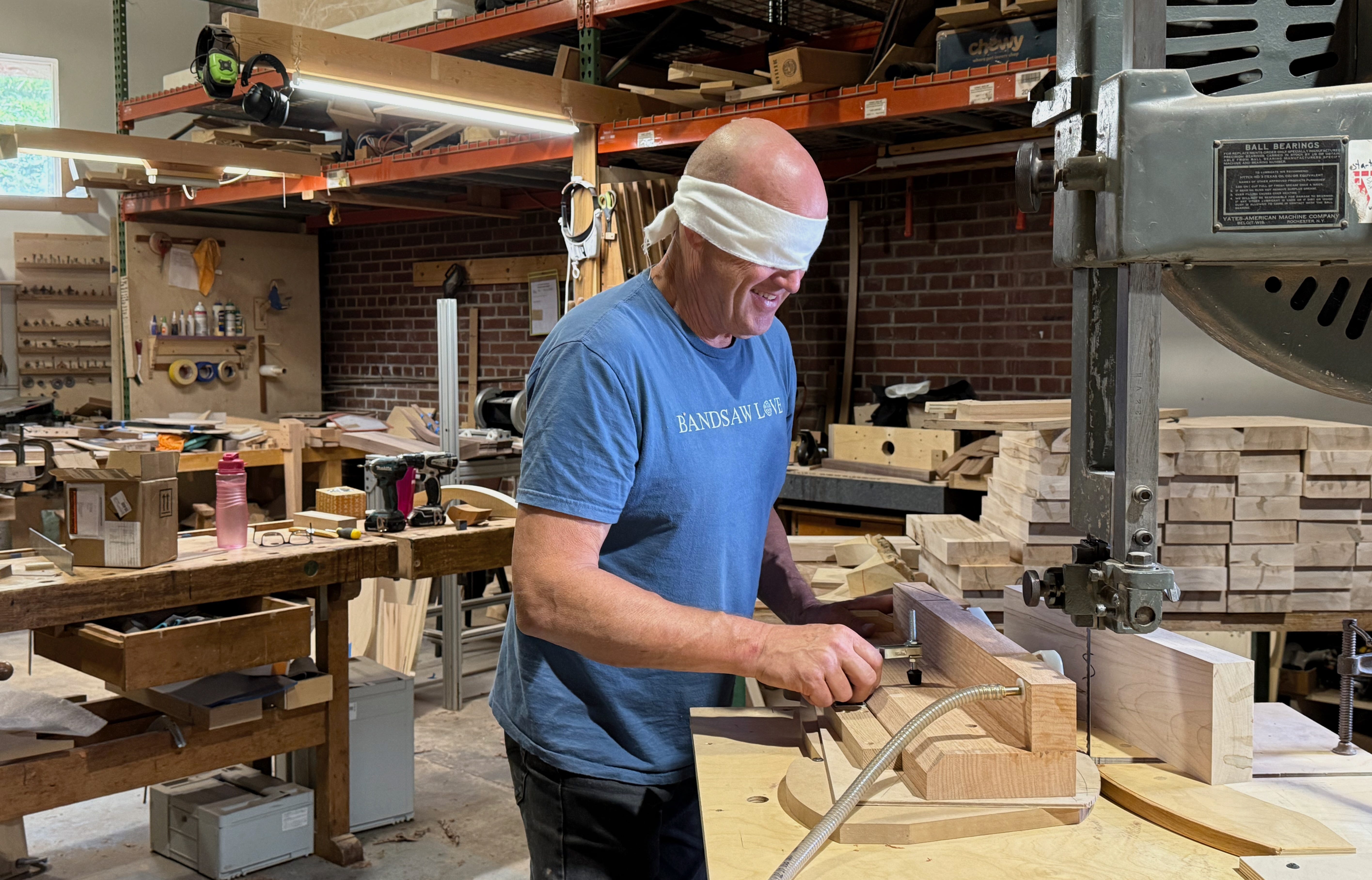
While teaching a new guy named Clay to use my systems on the bandsaw, he began to get variations in the cut shapes. It was clear to me immediately what had happened, but not to him.
The end of the day was upon us, so we stopped to clean up. That gave me some time to think about how to approach the next lesson.
As I considered what was happening and why, I began to see a commonality in most of what we have to learn in our shops, with both machine tools and hand tools. A central theme in the whole woodworking skill-development process suddenly came into focus.
We’re working blind!
Basically every process we learn involves gaining the skills that allow us to control a cut we cannot actually see happening. Even with drawknives, carving gouges, and chisels, what’s happening at the critical point of the cut is largely hidden from us. We can see a shaving coming up. We can see the bevel of a tool resting against the wood. But rarely can we actually watch the precise point or line where the cutting edge is severing fibers at that moment.
What we usually do is cut, examine, correct what we think needs correcting, and try again.
With planes and spokeshaves, what goes on at the cutting edge is a complete mystery to the eyes.
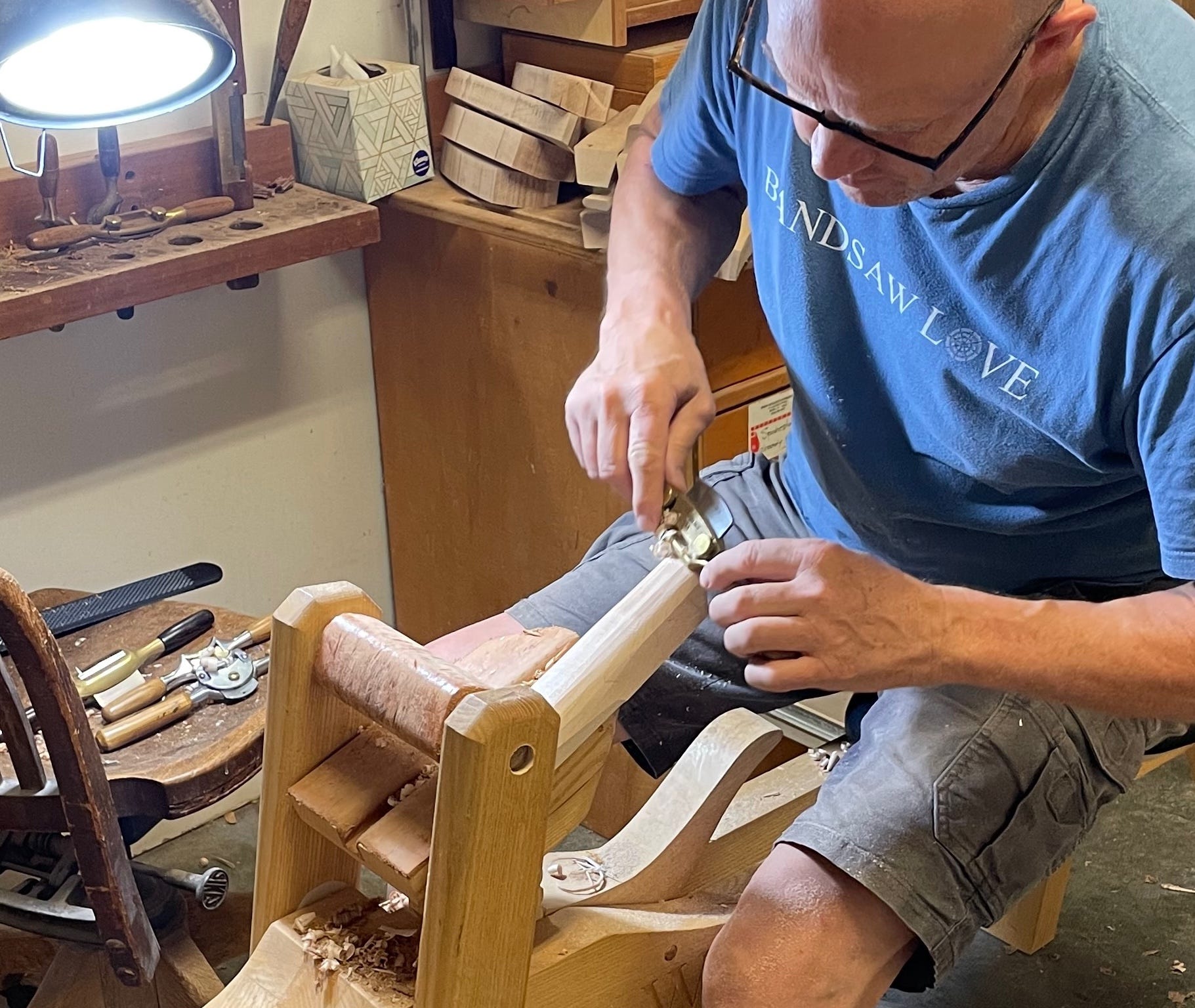
It’s easy to see when using a spoke shave and a hand plane that what’s happening inside the tool is invisible, however we do get plenty of feedback. The sound of the shaving coming off the wood the field the tool it’s resistance there’s plenty of data coming in.
No wonder woodworking takes so long to master. We’re working in the dark.
I have known this for decades, and most if not all of you know it too. But for some reason a new light shone on the problem for me last week and illuminated what I think is a partial solution.
The problem may not be that the information we need isn’t available.
Maybe we’re just looking for it in the wrong place.
We often hear it said that people who lose one of their senses develop heightened abilities in the others. What interests me more is the way they learn to extract far more information from the senses that remain.
Blind people don’t automatically receive more powerful hearing or touch. Through necessity, attention, practice, and adaptation, they become much better at noticing distinctions and interpreting information that those of us who can see may barely register.
The signals were there all along.
They simply learn to recognize and trust information arriving through other senses.
We have woodworkers who demonstrate this beautifully. George Wurtzel, for example, has built an extraordinary woodworking career without sight. His work reminds us that a huge amount of the information available to a craftsman never needed to come through the eyes in the first place.
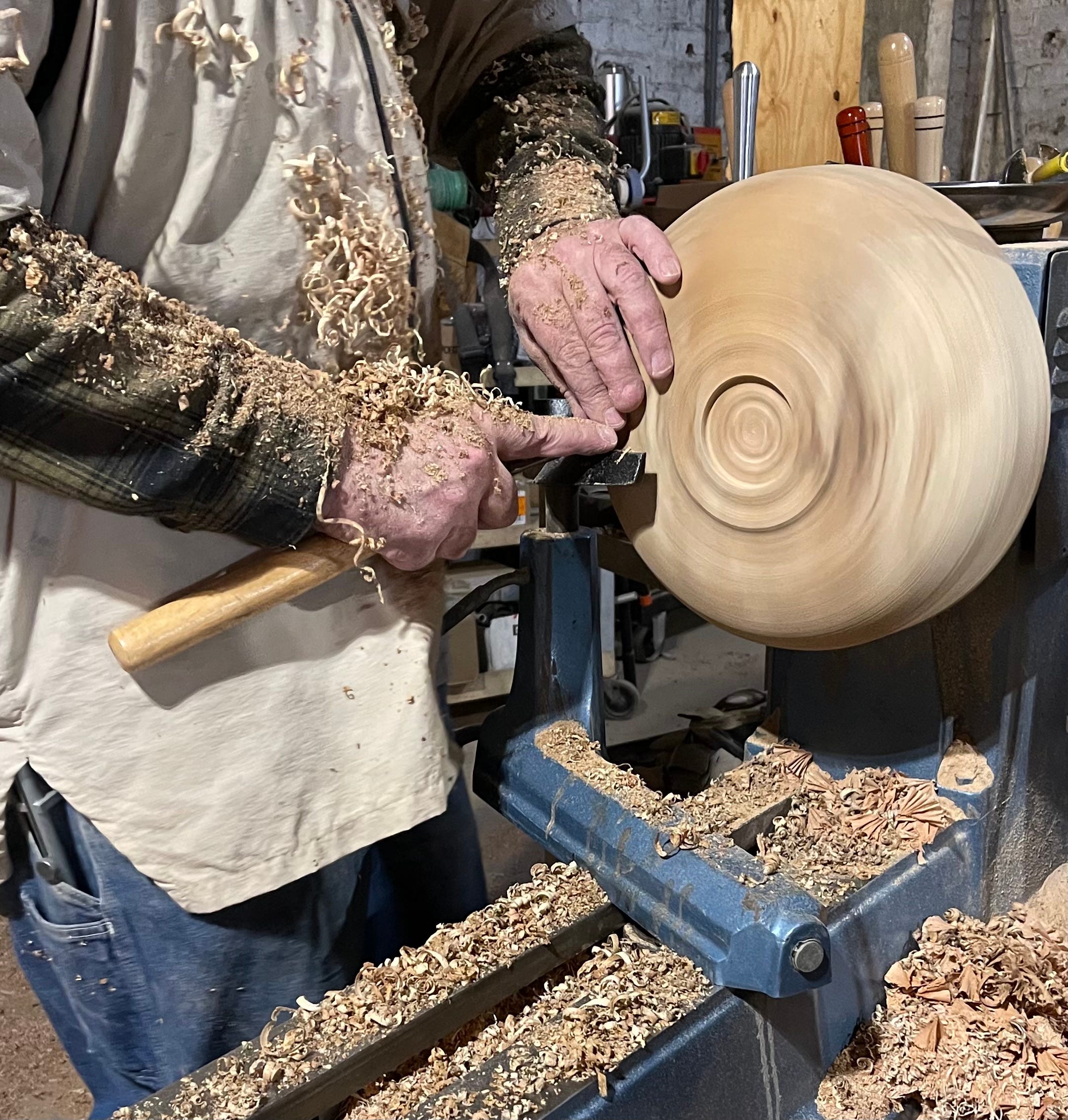
George Wurtzel turning a maple bowl. He uses one hand to “see” the piece while holding the turning tool with the other.
I think most of us understand this intuitively. We sometimes close our eyes when we want to feel something more clearly with our hands or hear subtle differences in music more vividly.
I often close my eyes when sitting in the shop trying to solve a design problem, simply to eliminate the distraction of everything around me.
I also remembered a story I heard decades ago about the legendary turner Del Stubbs working blindfolded.
While researching that story for this essay, I found an account in the Association of Woodturners of Great Britain newsletter, Revolutions, from January 1990. Del had recently returned from Ireland, where he had worked with a blind woodturner. During a demonstration afterward, Del blindfolded himself and talked his way through a small section of spindle turning while actually doing the work.
The writer explained that removing sight “helps to concentrate the mind and really emphasises the feel of the tool cutting.”
That really caught my attention.
In so much of what we do in our shops, we are not blind in general. We are blind to the critical act we are trying to control.
Think about what we can actually see: the body of a plane, the hand pushing a gouge and blocking our view, a bandsaw sled hiding its engagement with the fence. None of it tells us much about what is happening at the cut.
Almost nothing we can see tells us directly how well we are guiding the tool or how well the tool is performing where it matters.
So what are our eyes doing?
What are we looking at? What does that tell us? And why are we looking there?
It is certainly useful to keep an eye on a bandsaw blade whizzing past our work and to know exactly where our hands are in relation to it. Vision is helpful for working safely around machinery.
I am definitely not suggesting that anyone close their eyes while operating a power tool.
But what we are accomplishing at the cutting edge is often hidden from view until it is too late to change it.
And that leads to an important distinction:
Seeing the result is not the same thing as sensing the process.
We can see the shaving after the edge has severed it.
We can see the bandsawn surface after the blade has passed.
We can see the shape after the material has been removed.
Most people would say that I am looking at what I am doing in this video. But what’s really happening is my eyes are sharing feedback from what I just did. It is the feel of the knife through my hands, and the sound of the cut that let me know how the knife is doing in real time. But mastery requires gathering information soon enough to influence what happens before the result appears. (turn up volume)
That information is coming to us all the time.
When I am using the bandsaw, I listen to the blade. Its sound tells me whether it is cutting smoothly and whether something is changing.
I smell the dust. Does it smell fresh, like the wood itself? Or does it smell like wood toast? That tells me something is wrong. Maybe I’m feeding too slowly. Maybe the blade is getting dull. Whatever the cause, my nose has alerted me to something my eyes cannot see.
I feel the changing resistance of the blade as I push the wood into it.
I watch some things too. I look at whether the kerf is forming in a smooth line and whether the trailing edge of the blade is sitting where it should in that kerf.
When cutting fixture curves, I feel the sled against the curved fence. My hands are constantly receiving information about that contact even though my eyes cannot see it.
There is touch involved, but there is also something deeper: our sense of position and movement (proprioception) telling us where our hands, arms, bodies, tools, and work are in relation to one another.
The saw, the wood, my hands, my ears, my nose, and my body are all feeding me information that my eyes cannot interpret.
Learning how to understand those signals can certainly be accelerated by a good teacher. I had to let my saw and the wood be my teachers for much of my career, and they have never let me down.
They always tell the truth.
They are constantly sharing everything about that moment with whatever senses we have turned on and tuned in.
The same thing happens when I am planing.
With no music playing, I can hear the shaving whisper secrets as the blade severs it from the board. The resistance of the plane in my hands tells me something about the sharpness of the edge, the grain, and the depth of cut.
My eyes can tell me whether the shaving is centered on the blade, whether it is uniform from edge to edge, and how thin it is.
But by then, that particular cut has already happened.
The sound, resistance, pressure, and feel may tell me what is happening while there is still time to respond.
Everything we do in the shop is constantly giving us feedback, and none of our senses can pick it all up.
One of our most important skills may therefore be learning what, in all the noise, aromas, and vibration, is worth paying attention to.
Which signal matters right now?
Which sense is best equipped to gather it?
And what changes just before the work starts going wrong?
This may also explain something about why woodworking can be so difficult to teach.
An experienced craftsman says, “Listen to the cut.”
“Feel the bevel.”
“Don’t force it.”
“Keep the sled against the fence.”
Those instructions make perfect sense once you have developed the sensory reference they point toward. Before that, they may mean almost nothing.
A musician hears a shift in pitch or timing that another listener may not notice. An experienced cook can feel dough and know whether it needs more water or simply more time.
The information was there for everyone.
Experience teaches us what it means.
The teacher’s job is not simply to tell a student what to do.
Sometimes the real job is to help the student discover which signal deserves their attention.
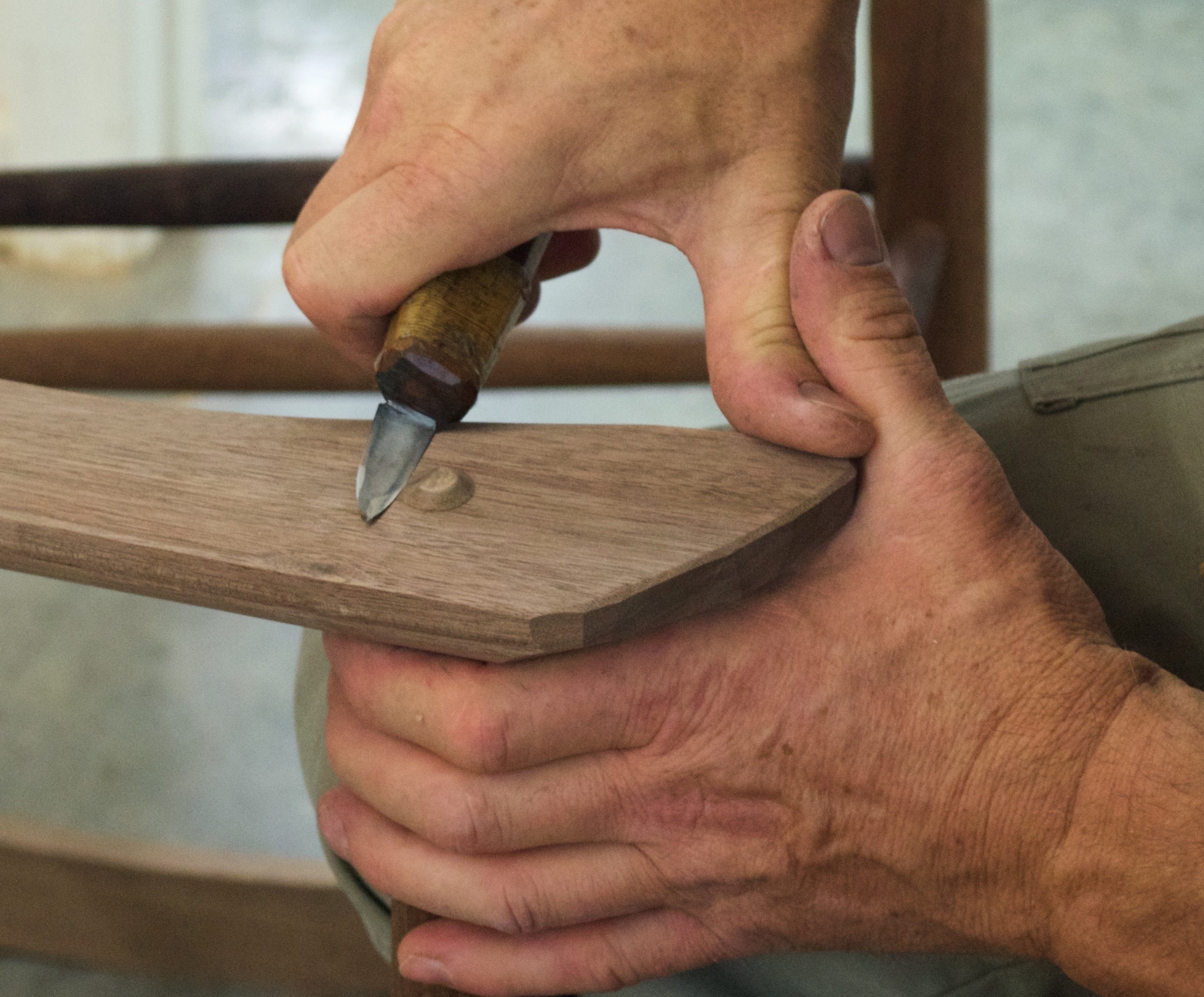
Contact, pressure, resistance, the hands are gathering information the eyes can’t.
The modern world puts enormous emphasis on what we can see. But in the shop, any one of our other senses may be the one that saves the day.
Sometimes, when it is completely safe to do so, closing our eyes can remind us how much information is available through the other channels. Del’s plunge into darkness shed light on that beautifully.
But we don’t have to work blindfolded to benefit from the lesson.
We simply need to let the rest of our senses play on the varsity team with our eyes.
That was what Clay needed on the bandsaw.
He was trying to use his eyes to gather information they simply could not give him. The sled blocked his view of its contact with the fence. Looking harder wasn’t going to solve the problem.
He needed to know what to feel for and where to feel it.
Once I understood that, I understood what I needed to teach.
My development as a craftsman still depends on how well I engage with the full spectrum of information available to me. I solve problems faster when all the systems are on and I know where to direct my attention.
But for me there is something even more important than becoming more efficient or more skilled.
When all of my senses are engaged, the depth of experience in any moment becomes much richer.
I hear more.
I feel more.
I notice more.
I am more completely there.
And that depth of experience feeds my love of the craft.
It may be one of the things that keeps me in the game on the toughest of days.
What signal have you learned to trust in your work, or what will you pay attention to now that you might have overlooked before?
From the Bench – Brian Boggs
Brian has spent more than four decades learning from wood, tools, mistakes, teaching, and making. He is still at the bench, working, questioning, experimenting, and finding new things to understand and share.
These essays are our way of capturing that ongoing work and putting it into the world.
If you believe this kind of knowledge is worth documenting and sharing, becoming a paid subscriber helps support the work of capturing it while Brian is still at the bench.


